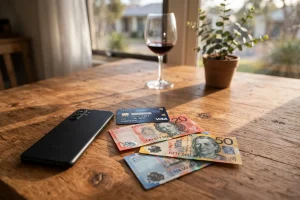
General payment information and Australian payment habits cannot confirm that a specific casino supports MiFinity.

A payment logo can look like a small promise: the method is available, the account can use it, and the transaction will proceed. In online gambling, those are separate matters. A brand’s presence on a payment page does not by itself confirm that Australian customers can use it, and a general description of a casino’s payment options cannot substitute for an operator-specific statement about MiFinity.
That is narrower than saying MiFinity is never accepted.
The same care applies to descriptions such as “best” or “new”. Those words imply that the sites or games being compared have first been identified and checked against a clear standard. The neatness of a list does not make its premise sound.
Payment habits in Australia offer context, but not proof of casino-specific support. Consumers are comfortable moving among cards, mobile wallets and services connected to bank accounts, including PayPal. Contactless cards and mobile wallets are common in ordinary commerce. Familiarity with a payment method in shops or other online services says nothing conclusive about whether a particular gambling cashier offers it. Everyday convenience and a casino’s payment settings belong to different systems.
When looking for casinos that accept MiFinity in Australia in 2026, check the details that matter to you before choosing a site. This shortlist highlights the specific payment, licensing, and deposit information available for each operator.
Playfina Casino
Playfina Casino is licensed by Curacao eGaming, with Hollycorn N.V. holding the license since 2017. The minimum deposit is A$20–30, depending on the offer.
Kingmaker
Kingmaker lists a minimum deposit of A$30. Payouts take around 90 minutes for crypto and 1–5 days for fiat.
Ricky Casino
Ricky Casino lists a minimum deposit of A$20, or A$30 to qualify for the bonus. Payouts are under an hour for crypto and 1–3 business days for PayID.
LevelUp Casino
LevelUp Casino is licensed by Curacao eGaming under OGL/2023/174/0082, with Dama N.V. The minimum deposit is A$15.
WinSpirit Casino
WinSpirit Casino is licensed by Curacao eGaming under OGL/2024/923/0383, with Antillephone N.V. The minimum deposit is A$30.
JustCasino
JustCasino is listed as holding a license from the Curacao Gaming Control Board.
MrPacho
MrPacho lists a minimum deposit of A$30. Payouts take 30–120 minutes for crypto and 24–72 hours for fiat.
Bizzo Casino
Bizzo Casino is listed as licensed by the Curacao Gaming Control Board, with TechSolutions Group N.V.
7Bit Casino
7Bit Casino is licensed in Curacao and operated by Dama N.V.
Roby Casino
Roby Casino is licensed by Curacao eGaming, with Roby Games Ltd.
That gap is easy to overlook because payment methods often share the same plain-language labels across very different settings. A card accepted by a retailer may be handled differently by a gambling operator or blocked by a financial provider. A digital wallet’s familiarity does not automatically carry over to every website. MiFinity should be treated with the same precision: its existence as a payment service is not evidence that an Australian casino accepts it.
A specialist review has described Visa as potentially more widely accepted at Australian online casinos than Amex. That comparison is a report from a particular kind of source, not a stable rule for every operator or every account. It also says nothing about MiFinity. Payment methods cannot be arranged into a reliable hierarchy by analogy: broader acceptance for one card does not establish the availability, absence or relative reach of another service.
The language used around payment options can blur these distinctions. “Supports MiFinity” might mean that a payment service is mentioned somewhere, while “accepts MiFinity” should mean that the method is actually offered for the relevant customer and transaction. Even then, a payment option visible in a general description would not by itself settle what an individual account sees. A precise statement needs to be tied to the particular operator and Australian access, rather than inferred from a payment brand’s presence elsewhere.
That does not turn uncertainty into a verdict against the payment method. It simply keeps the claim within its proper boundary.
A cashier is the practical point at which a payment option is presented, but the existence of a cashier does not answer every question about availability. Payment arrangements can differ between services, and a statement about one method does not settle another. The careful distinction is not glamorous. It is useful.
For readers comparing Australian online casinos, the relevant question is not whether a site mentions digital payments in general, or whether Australians use a service in other parts of life. It is whether MiFinity is specifically offered for Australian accounts.
A casino deposit is not merely a payment sent from a wallet or card. It depends on what appears in the operator’s cashier, whether the payment can be submitted, and whether the transaction is accepted. MiFinity and Amex are separate payment methods, and details about one cannot be used to infer how the other works.
The distinction is easy to lose in broad payment coverage. A payment provider may be familiar to customers, or appear beside cards and bank-linked services in general discussion, without being offered by a particular casino. The decisive point for a deposit is the cashier itself: whether MiFinity is shown as an available route for that account and whether its terms explain the transaction. Familiarity is not acceptance.
Amex Deposit Process
Open Cashier
Access the casino's cashier section.
Select Method
Choose American Express from the available payment options.
Enter Details
Provide the card details and the deposit amount in Australian dollars.
Submit Payment
Confirm and submit the transaction.
Amex provides a documented comparison, though it answers a different question. A specialist review reports that deposits by Amex are available at some Australian online casinos. That is a limited statement about one payment method, not evidence that MiFinity is available at those sites or that the same checkout steps apply. Payment menus are operator-specific; one card’s presence says nothing conclusive about a digital wallet’s place in the same menu.
Where Amex is offered, the described deposit sequence is straightforward. The customer opens the cashier, chooses Amex, enters the card details and the deposit amount in Australian dollars, then submits the payment. The sequence depends on Amex being presented as an option.
This is why searches for a casino that accepts MiFinity deposits often produce answers that sound more definite than the underlying detail. A list of payment brands, a general claim about deposits, or an Amex walkthrough does not establish that a MiFinity button is available. Nor does a stated deposit amount become a valid MiFinity minimum merely because the same site accepts another method. The currency and payment route matter.
The Amex comparison also shows how much a proper deposit description needs to specify: the method selected, the information entered, the currency displayed and the action that submits the transaction. Such claims turn an unknown checkout into a fictional one.
The same caution applies to the word “best.” A site cannot responsibly be called the best place for a MiFinity deposit on the basis of a different payment method. The Amex information establishes that some Australian casino deposits by Amex have been reported; it does not rank casinos for MiFinity, identify a MiFinity cashier, or demonstrate that an Amex-friendly site accepts a wallet. One route does not stand in for another.
There is a quiet history in the cashier. It is where payment systems meet the rules and business choices of an operator, and where a payment method becomes practical only when it is actually offered for the transaction. Outside that small interface, brand recognition can create an impression of access that has not been earned. The button is the evidence; the resemblance between payment methods is not.
So the available deposit detail is narrow but useful when kept in its proper place. Amex has a reported process: select it in the cashier, enter card details and an AUD amount, and submit. No minimum or step-by-step MiFinity deposit instructions should be inferred from the Amex example. Distinctions first. Then payment.
A “best MiFinity casino” ranking sounds like a practical shortcut: compare a few names, weigh their payment options, then settle on a site. But a ranking only means something when its central claim can be checked.
Payment information is specific to the operator and the transaction. A method mentioned in general casino material does not, by itself, establish that MiFinity appears in a particular cashier, can be used for deposits, or is available to Australian customers. Nor does a payment logo settle every part of the process. An operator may distinguish between ways to add funds and ways to receive them; availability for one does not prove availability for the other.
That distinction matters to anyone comparing sites on the strength of a MiFinity claim. “Accepts MiFinity” can be read as a simple yes or no, while actual payment terms may involve separate conditions. A site name beside a payment method is not a complete account of those conditions. Without operator-specific confirmation, it cannot support a dependable comparison of deposit access, withdrawal routes or processing speed.
The same caution applies to claims about instant MiFinity withdrawals. “Instant” is an appealing word in a market where money moves through several hands and systems. It is not evidence of a particular operator’s processing time. A confident ranking would merely hide the uncertainty inside a neat table.
The phrase “best MiFinity games” adds another complication: games and payment methods are different things. A game’s presence on a casino site would not prove that MiFinity can fund play there. And a payment method’s availability would not establish that it applies to every game or product.
There are still useful distinctions to make, even without a league table. A payment claim should identify the operator, the country for which it applies, and whether it concerns deposits, withdrawals or both. It should also be current enough to describe the cashier rather than a past version of it. If those details are absent, the claim does not establish that an Australian MiFinity casino site is suitable; it establishes only that the claim has been made.
This is less satisfying than a list of winners. It is also more honest. Rankings give an impression of measurement, but a comparison cannot be stronger than the information beneath it. Names arranged in order do not become verified merely by being arranged.
A ranking built on those claims would have a polished surface and a missing foundation.
That is not a recommendation to use one site over another. It is a limit on what can responsibly be said about MiFinity acceptance. The difference may seem small; when the claim concerns where money can be sent or returned, it is not.
“Instant withdrawal” sounds like a single event: a balance leaves a casino and appears in a payment account. In practice, a displayed withdrawal time can refer to different stages, and a short estimate for one payment method says little about another. The distinction matters for MiFinity searches. An Amex processing estimate is not a MiFinity estimate; each route has its own handling, and one cannot stand in for the other.
A specialist review gives a specific outer estimate for Amex casino withdrawals: clearance can take as long as five days. That is a reported timeframe, not a universal promise or a description of every casino’s process. It also does not mean every withdrawal takes five days. The wording marks a possible wait, not a schedule that applies across the market.
The interval is worth reading carefully. A withdrawal can involve casino-side processing before a payment provider or card issuer handles the transfer. A stated clearance period may describe the movement after approval, rather than the entire time from requesting a payout to seeing funds. Without a clear definition of the starting point, “instant” and “five days” are not necessarily opposing measurements of the same stage.
Attention: A reported Amex clearance time of up to five days is not a universal rule and does not establish a timetable for MiFinity withdrawals.
Nor does the Amex estimate establish how quickly MiFinity withdrawals are handled. A payment brand is not a shared clock: processing attached to one route cannot be carried across to another simply because both appear in a cashier. Calling a MiFinity payout instant on the strength of an Amex figure would be a category error, dressed as a comparison.
There is a further constraint. A specialist review reports that not every Australian casino permits withdrawals to Amex. A payment method appearing as an option for one stage of a transaction does not, by itself, show that it is available for payouts. That difference can matter more than a headline speed: a rapid route is of little use if the casino does not allow it for the withdrawal in question.
The phrase “instant withdrawal” also leaves unanswered what has been made instant. It may describe an approval step, a transfer being sent, or funds becoming usable. Those are distinct milestones. A page that gives a single adjective without saying which milestone it measures offers little practical clarity. An estimate should be tied to the named method and to the actual stage being timed.
For Amex, the reported figure is bounded: clearance may extend to five days, and the route is not accepted for withdrawals at every Australian casino. These details do not provide a MiFinity timetable, and they cannot be used to label a MiFinity payout fast or instant. Payment systems resist borrowed adjectives.
The search for a casino using MiFinity sits inside a legal framework that is more decisive than any cashier menu. Under the Interactive Gambling Act 2001, operators must not provide real-money online casino services to people located in Australia. That prohibition covers online casino-style games, including pokies, poker and table games. It concerns the operator’s conduct; the Act does not explicitly make an individual player’s use of an offshore site a criminal offence.
That distinction can be easy to misread. The absence of an explicit player offence is not approval of the service, a local licence, or a promise that a site will remain reachable. The law places the restriction on providing the service to people in Australia, while enforcement is directed at the prohibited service and its providers.
The Australian Communications and Media Authority, or ACMA, administers enforcement of the Act. Offshore casino services are subject to active blocking and enforcement, so an overseas website’s presence on the internet does not settle whether it can be accessed from Australia. Nor does a payment option alter the legal character of the underlying service. MiFinity is a payment method; it does not confer permission to offer online casino games to Australians.
This matters when considering claims about a casino that accepts MiFinity in Australia. A cashier may display payment methods, but payment availability and lawful provision of the gambling service are separate questions. Neither a brand’s location overseas nor the appearance of a familiar wallet changes the Australian restriction. The method of payment is not a regulatory passport.
Legal Restriction
Under the Interactive Gambling Act 2001, it is prohibited for operators to provide real-money online casino services to people located in Australia.
There is also a practical gap in consumer protection. Australian consumer law does not protect players who use offshore casinos. If a dispute arises over an account, a payment or an attempted withdrawal, the ordinary protections associated with a domestic consumer transaction cannot be assumed to apply. An offshore operator may be beyond the reach of the systems through which Australian consumers normally seek redress. Distance, different legal systems and enforcement barriers are not decorative details.
The arrangement is revealing. Australia has not framed the issue as a simple licensing choice in which a player can compare local approvals. The law prohibits the service itself when offered to people in the country, and ACMA’s role is to enforce that boundary. At the same time, the legal position distinguishes between operators providing the prohibited service and players using offshore sites. A narrow distinction, with broad consequences.
For anyone weighing payment claims, the legal setting should come before the convenience of a wallet or the wording of a cashier page. MiFinity cannot make an offshore casino a locally authorised service, and consumer law offers no safety net for Australians using one. That is the boundary.
A payment method and a game catalogue are separate parts of an online casino’s systems. Seeing MiFinity mentioned alongside casino payments would not, on its own, show that it can be used for every game, or identify any particular game that accepts it.
That distinction matters because payment labels can make an arrangement look more complete than it is. A cashier may describe ways to move funds, while the games area describes what an operator makes available; one does not necessarily explain the rules of the other. “MiFinity accepted” would therefore be too broad to answer which games, if any, can be funded through it.
There is another threshold before financial activity: identity checks. Online casinos commonly ask customers to pass a Know Your Customer assessment before they can carry out financial transactions. The purpose is to establish who is using the account, rather than to certify that a particular payment service works with a particular game. A verified identity does not settle that separate question.
This can make the sequence feel less like a single checkout and more like a set of gates. Account details are examined first; payment availability and game access are different matters, each governed by the operator’s arrangements. A payment method’s name cannot stand in for those details.
Nor should a broad phrase such as “casino games with MiFinity” be read as proof of a universal arrangement. The useful distinction is modest but important: identity verification concerns the customer, while game-specific funding would require separate confirmation. One does not imply the other.
The same caution applies to payment options described at a general level. A method may be associated with a casino without establishing that it can be selected for every transaction or in every part of the service. Treating a payment logo as a map of the entire catalogue turns a small symbol into a rather ambitious promise.
For Australian readers, this is a description of how verification and payment claims differ, not an invitation to use online casino games. The key point is simply that completing an identity assessment does not prove MiFinity can fund any particular game, and a reference to MiFinity does not identify which games it might cover. Verification answers one question. The rest needs its own evidence.
In Australia, tapping a contactless credit or debit card has become an ordinary part of paying for things. The same is true of mobile wallets: Google Pay and Apple Pay are accepted across almost every corner of everyday commerce. The gesture is quick; the infrastructure behind it is easy to overlook.
That familiarity can make payment methods seem interchangeable. They are not. A wallet that works at a shop, or a card accepted at a café, does not thereby become an available option for every kind of online service. Payment acceptance belongs to the merchant and the transaction, not simply to the customer’s preferred way of paying.
Australians are also accustomed to moving between cards, phone-based wallets and services connected to bank accounts, including PayPal. This flexibility is part of the country’s ordinary payment culture: people switch channels without treating each change as a new financial custom. But broad comfort with digital payments says nothing specific about MiFinity’s availability at an online casino.
That distinction matters because a familiar name can carry more weight than the evidence warrants. MiFinity may appear in searches alongside Australian casinos, while daily experience with contactless payments encourages an assumption that another digital service will fit just as neatly. Neither familiarity nor general payment habits establishes that a particular casino supports it.
The everyday pattern is clear; the casino-specific conclusion is not. Broad acceptance of cards and mobile wallets describes how Australians pay across ordinary settings. It cannot be used as proof that MiFinity is accepted by an Australian-facing casino, or that a casino offers any particular payment route. These are separate questions, even when the language of convenience makes them sound like one.
A payment culture can change faster than the rules and systems attached to a particular service. At the counter, a tap may settle the matter. Online, acceptance depends on the service’s own available methods and conditions. Habit is not confirmation.
A withdrawal is not simply a deposit travelling in reverse. The payment method used to fund an account can affect which route is available when winnings are requested. For Amex, one stated condition is that a player must have made an earlier deposit with that card before withdrawing to it. That makes the transaction history relevant: an Amex withdrawal is tied to prior Amex use, not merely to the presence of an Amex card.
The condition is specific to Amex. It does not establish how a casino handles a withdrawal through MiFinity, or whether MiFinity can be selected for that purpose. Payment methods have their own rules; treating them as interchangeable because they appear in the same cashier would be a tidy fiction.
Amex Withdrawal Condition
For Amex, one stated condition is that a player must have made an earlier deposit with that card before they can withdraw funds to it.
Limits are another matter. A specialist review reports that online casinos set their own Amex deposit and withdrawal limits, which can vary between operators. The figures therefore belong to the individual casino’s terms, rather than to a single universal Amex schedule. A limit that applies to one route or account cannot safely be carried across to another.
For people looking into MiFinity withdrawals at Australian pokies sites, these Amex conditions offer context about how a separate payment route may be governed, not a template for MiFinity. They do not establish a MiFinity withdrawal requirement, a processing time, a fee, or a casino’s support for the method. Those details need to be stated by the operator for MiFinity itself before they can be treated as rules.
The distinction matters because deposit acceptance and withdrawal availability are not identical questions. A payment option appearing at the point of deposit would not, by itself, prove that the same option is available for cashing out. In the Amex case, prior use is an express condition; casino-set limits also shape the route. For MiFinity, neither condition should be assumed from the Amex example.
Separate rails, separate terms.
A payment brand can be familiar without being accepted at a particular cashier. MiFinity’s name appearing in discussions of online payments, or being available elsewhere, would not by itself show that an Australian-facing casino supports it. Payment acceptance is an operator-level condition, not a quality that transfers automatically from one site to another.
The distinction matters because a deposit method is more than a logo. It has to appear among the options offered for the account and transaction in question. Without that, calling MiFinity a casino payment method would turn an assumption into a practical claim. The same caution applies to searches for casinos that take MiFinity: a phrase repeated across payment pages is not proof of a working deposit route.
There is a narrow point of comparison. A specialist review reports that some Australian online casinos offer deposits by American Express. That statement concerns Amex, not MiFinity, and reflects a source’s account of a changing subject. It cannot be used to infer that another wallet or payment service is accepted as well. Different methods have separate arrangements; one does not open the door for the others.
Nor does the word “casino” settle what a payment label means. A method might be described in general terms, while the cashier’s available choices can differ. The useful distinction is between a service being known as a way to pay and a particular operator actually listing it for deposits. Those are not interchangeable statements.
For MiFinity, then, the careful answer is not a list of Australian casinos, nor a claim that none accept it. It is simply that Amex reports tell nothing about MiFinity acceptance. Familiarity is not confirmation.
A casino promotion and a payment method are separate things. The presence of MiFinity as a cashier option would not, by itself, show that a bonus is available to someone depositing through it. Nor would a general welcome offer establish that MiFinity deposits qualify.
That distinction matters because bonus conditions are operator-specific.
The language used to describe a promotion can also blur separate ideas. A bonus shown by a casino is not necessarily a bonus for using a particular wallet. Likewise, a payment method appearing in a cashier does not establish that it is eligible for a promotion. The two details need to be connected explicitly in the terms.
For anyone comparing payment methods, the useful distinction is between a general casino offer and a promotion that expressly names MiFinity. Only the latter would support calling an offer MiFinity-linked; broad promotional wording is not enough.
Limits are set by each casino and can vary. Check the casino’s cashier and payment terms for the limits that apply to Amex.
Check the casino’s cashier for American Express as a deposit option. Amex is available at some Australian online casinos, but not all accept it.
Acceptance differs between casinos, and Amex or your Australian bank may block gambling transactions to a particular site. Check whether Amex is offered in the casino cashier and whether your card issuer allows the payment.
Amex deposits typically have no fee, but a casino may add a surcharge, and a currency conversion fee may apply. Withdrawals can also incur fees, and not all casinos allow withdrawals to Amex.
Look for American Express in the casino’s cashier as a deposit method. Some Australian online casinos accept it, while others do not.
Yes. Each casino sets its own Amex deposit and withdrawal limits, so check the cashier or the casino’s payment terms.