Progressive pools, qualifying bets, payout structures and return figures shape how these games work and what a jackpot can mean.
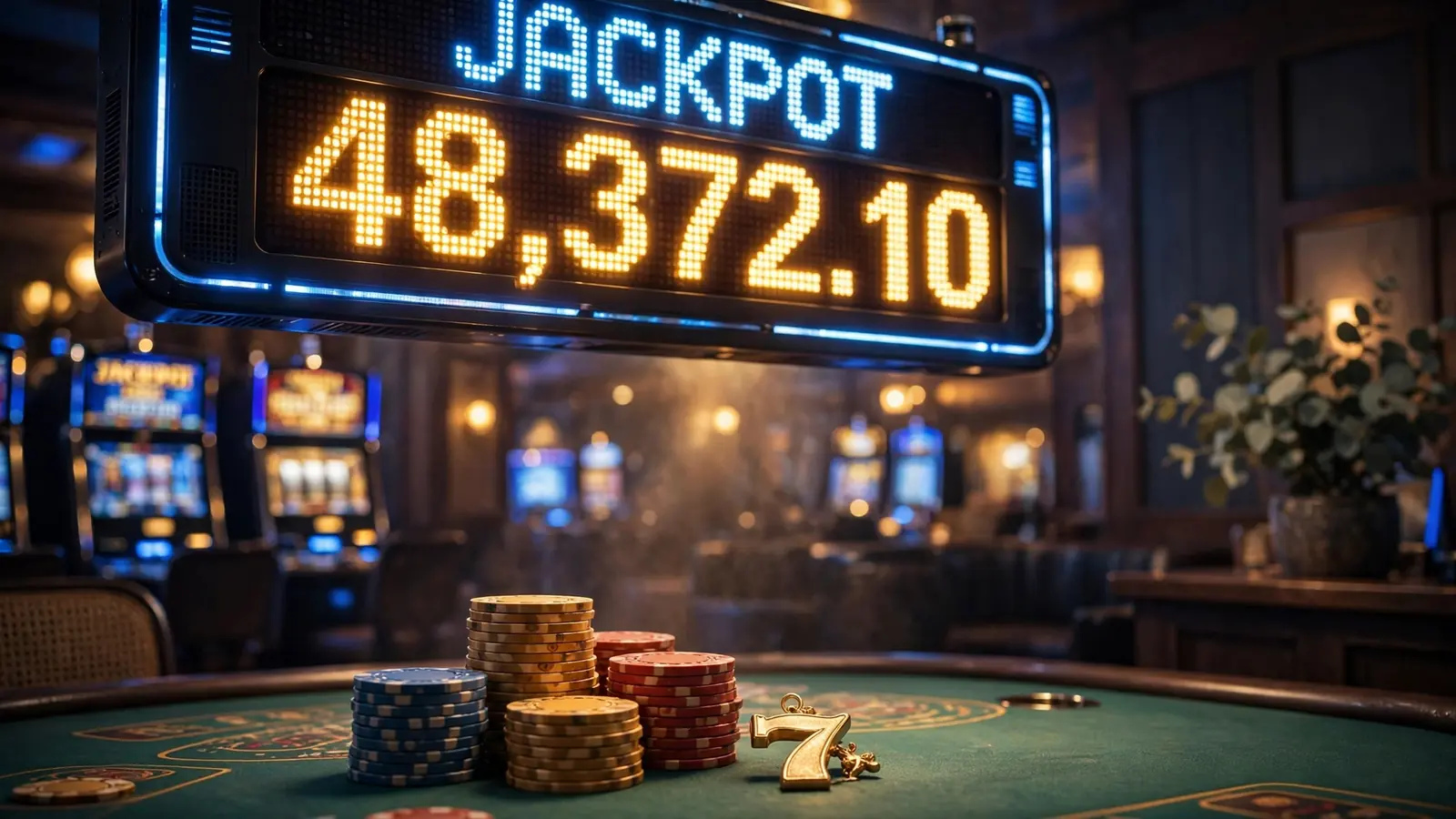
A progressive jackpot is not a prize waiting unchanged behind a game. It is a pool that grows as qualifying play contributes to it, then begins building again after a win. The movement is simple: wagers add to the total, the displayed figure changes, and a winning result takes the pool out of its current cycle.
The contribution is only a portion of each wager, not the whole stake. One account of the mechanism puts that share at 1% to 3%; another gives a range of 1% to 5%, reflecting differences in how the game is described or designed. Those figures should not be blended into a single rate. The exact contribution for a particular game is a matter of its own rules, rather than a universal setting for every progressive jackpot pokie.
That distinction matters because a jackpot’s visible growth is not the same as the total amount wagered. The pool receives a small slice; the rest of the bet belongs to the ordinary game structure. Across repeated spins, even a modest contribution can accumulate into a sum much larger than any single stake. The machine’s display turns that slow arithmetic into spectacle: each new contribution is small, while the number on screen can become the main event.
A progressive jackpot therefore has two rhythms. The first is gradual, built from portions of many wagers. The second is abrupt: a winning combination ends that run, the current pool is awarded, and the figure returns to a base amount. From there, the next cycle starts. A large displayed total is not a permanent feature of the game but a temporary stage in this process.
There is a social history tucked into that mechanism. Traditional prizes were bounded by the game’s own structure; a progressive prize makes the play of many people visible in one shared number. The contribution is easy to overlook because it is folded into each wager, while the accumulating total is made conspicuous. The game presents a collective fund as an individual possibility. A neat piece of theatre.
For players looking at online progressive slots, this funding cycle explains why the advertised total can change between visits. It grows as contributing play continues and falls back after someone wins. A still image of a jackpot figure, then, is only a snapshot, not a lasting promise about what the pool will contain later. Nor does the climb itself reveal how close a win might be. The pool’s size records contributions and resets; it does not provide a timetable.
The basic mechanic is shared by progressive pokies in broad terms, but the precise contribution rate and prize structure belong to the individual game. The label “progressive” describes the changing pool, not a guarantee that every game handles its contributions identically. That is why the game’s own information is more useful than assumptions based on another title’s display or rules.
In Australia, the distinction between the game mechanic and its availability is important. The Interactive Gambling Act 2001 prohibits operators from providing real-money online casino games, including slots, to people located in Australia. The fact that an online progressive slot can be described mechanically does not make real-money online casino play lawful for Australian customers. Here, the explanation concerns how the pool works, not an invitation to play.
At its simplest, the cycle can be read as a sequence: real-money wagers contribute a portion to the pool; repeated contributions increase its displayed value; a winning combination takes the current prize; and the pool restarts from a base amount. The mechanism is cumulative, but not mysterious. Its drama comes from making a small, distributed contribution look like a prize gathering momentum toward one decisive moment. The arithmetic keeps running. The display does the persuading.
A progressive jackpot can appear inside a casino’s game lobby, but that does not mean the casino keeps the accumulating pool on its own systems. For a network jackpot, the balance is held on the software provider’s server. The casino is the visible doorway; the provider’s infrastructure is where the shared prize is recorded.
For network jackpots, the balance is recorded on the software provider's server rather than the individual casino's systems.
That distinction matters because the interface can make a network pool feel like part of one venue. A figure rises beside a game, players see it while browsing, and the casino presents the title among its offerings. Yet the pool may connect play across a wider network. Its location is technical, not theatrical: the provider maintains the jackpot record, while an individual casino does not simply hold the whole prize in its own account.
Custody is not the same as a guarantee about how a claim will be handled. A displayed balance does not, by itself, explain who verifies a winning result, what documents may be requested, how the award is transferred, or whether payment is made at once. Those questions belong to the terms governing the game and the payout, not to the size of the number glowing on screen. The central point is modest but useful: a casino’s role in presenting a game should not be confused with ownership of a network pool.
The gap between the visible venue and the underlying arrangement is familiar in commercial life. Shops display goods they did not make; ticket counters sell access to events they do not stage. Digital gambling adds a less visible layer: the game and its jackpot can be supplied and maintained outside the casino brand through which they are encountered. The interface compresses those relationships into one tidy panel. The infrastructure does not.
Payment terms add another layer. A specialist review has reported that some casinos may pay very large jackpot prizes in instalments. That is a report about a possible arrangement, not a rule applying to every casino or every prize. A winner’s expectations should therefore come from the written payout terms for the particular game and service, rather than from the image of a single dramatic transfer. Where instalments are permitted, the timing and structure of payments matter as much as the headline amount.
Withdrawal conditions deserve separate attention. A jackpot can be recorded by a provider, presented through a casino and then paid under terms that govern the route from award to recipient. Those are distinct stages. Before any real-money play, the relevant terms need to be checked for payment method, withdrawal limits and the way a large prize is handled. A large award can be less straightforward to receive than its display suggests. The small print has a job.
There is, however, a legal fact that changes the setting for Australian readers. Under the Interactive Gambling Act 2001, operators may not provide real-money online casino games, including slots, to people physically located in Australia. Casino-style online services are prohibited when offered to customers here. A discussion of how an offshore progressive jackpot is held or paid describes the mechanics of a service; it does not make that service lawful to provide in Australia.
This difference between technical availability and legal permission is easily blurred by a polished online lobby. A game may be visible on a screen, and its pool may be maintained on a provider’s server, without that visibility establishing that real-money play is permitted for someone in Australia. The screen reports a product; it does not settle the jurisdiction.
Nor does the provider’s custody mean that every casino will handle a win identically. Payment terms may differ, and a general description of network storage cannot substitute for the conditions attached to a particular game or service. Instalments are a possibility reported in specialist coverage, not a universal feature to assume. The sensible distinction is between where a pool is maintained and how an award is paid: one is a matter of system custody, the other of payout terms.
Legal Restriction
Under the Interactive Gambling Act 2001, real-money online casino games, including slots, are prohibited for people physically located in Australia.
The jackpot’s location, then, is not necessarily the place where it appears. And a number displayed as one prize does not necessarily describe one immediate payment. In Australia, those details sit within an even more basic boundary: real-money online casino games are prohibited services when provided to people in the country. A neat interface cannot make that boundary disappear.
A return-to-player figure, usually shortened to RTP, gives a percentage for the average amount a game is expected to return over the long run. In Australia and the United Kingdom, information about the cost of playing a game often includes such figures. They can help describe a game on paper, but they do not forecast the result of a particular session. The distinction is easy to miss: a percentage looks precise, while the experience of play arrives one spin at a time.
That gap matters especially with progressive jackpot pokies. Their advertised prize can dominate attention, leaving the return figure to look like a compact verdict on whether a game is generous. It is no such thing. RTP describes an average over extended play, not a schedule of repayments. A player may receive much less than the stated return, more than it, or nothing notable over a short spell. Almost any outcome remains possible in the short term, despite theories built around RTP.
The language of averages belongs to populations and long stretches of play, not to individual fortunes. A figure cannot say when a particular outcome will occur, nor turn a sequence of spins into a promise that losses will be balanced by a later win. This is less a flaw in arithmetic than a mismatch between arithmetic and human expectation: people meet the machine in the present tense, while its return figure speaks from a long view.
A legal warning about that mismatch arrived in Australia in 2018. The Federal Court found information about RTP misleading because it represented long-term winnings rather than short-term outcomes. The point was not that return figures are useless, but that their meaning can be misunderstood when the time scale is left in the background. A number may be accurate as an average and still create a false impression about what a person is likely to experience in a sitting.
The difference is particularly visible when figures are compared across settings. At Crown Perth, every slot machine has a minimum RTP of 90%. That statement describes a floor for the machines there; it does not say that each session returns a matching share of a player’s stake, or that outcomes are evenly spread. Nor does it establish that a progressive jackpot casino game with a higher-looking figure will produce a better short-term result. The long-run measure and the short-run experience remain different kinds of information.
RTP is therefore most useful as context, not as a selection rule that promises certainty. In progressive jackpot casino games, a return figure does not reveal whether a jackpot is close, whether recent spins have altered the next result, or whether a machine is “due”. The jackpot’s size may make a game conspicuous, but conspicuousness is not evidence about timing. A large prize and a return percentage answer different questions, and neither turns randomness into a timetable.
There is a social history in the appeal of these figures. Gambling has always borrowed the authority of accounting: a percentage, a printed paytable, a claim about the average. Such information makes an uncertain activity legible, at least in outline. But legibility is not control. The same neatness that helps describe a game can encourage people to read more into it than it says.
For progressive jackpot slot machines, the sensible reading is a restrained one. RTP offers a long-run description of return; it does not promise a personal result, a steady rhythm of wins, or compensation for a poor run. Averages remain averages. In the short term, the machine owes no one a pattern.
A large progressive pool has an obvious power over attention. It turns a game into a public spectacle: the figure rises, players notice, and the ordinary spin begins to look like a ticket into a different life. That is the salesmanship built into a visible jackpot. It is not evidence that the prize is close to being won.
A larger pool can marginally improve the expected return on bets that qualify for it. The distinction matters: a change in expected return is not a forecast of the next result. Jackpot outcomes remain random, and no betting method can guarantee a hit. A rising number may change the arithmetic slightly; it does not disclose what the next spin will do.
The sensible way to assess a progressive pokie is therefore less dramatic than the display suggests. Start with what the game actually offers: its rules, its ordinary play, and the cost of taking part. A jackpot should be treated as a possible extra outcome, not as the reason to stretch a budget or keep playing after a planned stopping point. The pool does not know who has lost, who is waiting, or who believes a win is due.
Timing is a particularly persuasive illusion. A jackpot that has been growing for a long time can feel overdue, while a recent winner may make another hit seem either more or less likely. Neither impression predicts the next outcome. The size of the pool is not a clock, and a sequence of spins does not turn a random result into a pattern that can be read.
That leaves room for preference, but not prophecy. A player can choose a game because its theme or pace is enjoyable, or decide that the prospect of a changing prize is worth the cost within a fixed entertainment budget. Those are judgments about experience. They do not improve the chance of identifying which spin will win.
The distinction is useful because gambling products often make uncertainty look legible. A bright meter, a rising total and a story about the eventual winner give randomness a plot. The plot is memorable. The underlying result remains random.
A practical choice begins before play: decide what amount is affordable to lose, set a strict weekly deposit limit, and keep to it regardless of the jackpot’s size. Rent money has no place in a jackpot game. If a session reaches its limit, continuing because the pool looks unusually tempting is still chasing losses, not a change in the odds.
Budget also shapes which games are suitable. A game may impose its own conditions for jackpot eligibility, so those rules need checking before any stake is placed. A maximum bet should never be pursued simply to qualify if it is unaffordable. The possibility of access to a prize does not turn an unsuitable stake into a sensible one.
Game information can help describe the terms of play, but it cannot remove uncertainty. Paytables and help screens are where contribution details, volatility and any jackpot cap can be examined. These features help explain how a game is structured; none offers a reliable signal that a win is near. Even a pool that has climbed to an attention-grabbing level does not make timing or supposed patterns useful guides.
The phrase “best progressive jackpot slots” can suggest a neat ranking, as though a single title could be crowned by its pool alone. That would mistake visibility for value. A better choice is one whose rules are understood, whose cost fits the player’s limits, and whose entertainment does not depend on treating the jackpot as expected income.
There is no clever timing. Just a limit.
A headline jackpot has a talent for making scale look like proximity. The number rises, the display glows, and a prize that could alter a life becomes easier to imagine than the arithmetic behind it. Yet the size of a progressive prize says little about whether the next spin will win it. A growing pool is not a countdown.
For top-tier progressive jackpots, the probability of a win is typically somewhere between one in 30 million and one in 100 million. Expressed as a percentage, that is less than 0.001%. The exact odds depend on the game, but the scale is the point: a jackpot can be famous without being near. It is not reliable income, and no pattern of past results turns the next outcome into a forecast.
That distance is easy to lose sight of. A large prize is public and vivid; the many losing spins that precede it are mostly invisible. The display records the accumulation, not the private histories of everyone who has contributed. In this sense, the largest progressive slot jackpot is also a piece of theatre: a shared number made visible, while chance remains stubbornly individual.
A higher pool does not mean a win is due. The amount may change while the chance attached to a particular spin remains governed by the game’s design. Timing, machine status and supposed patterns offer no dependable route to the prize. The pool can look ripe. That is not evidence.
Some operators set a cap: when the jackpot reaches a specified level, an automatic win is triggered. This is a limit on how far the pool can grow under those terms, not a signal that a particular player is approaching a win. The cap changes the pool’s behaviour at its ceiling; it does not make the result predictable beforehand. Its details belong in the game’s paytable or help screen, alongside information about jackpot conditions.
Attention: A jackpot cap or must-drop feature is not a signal that a particular player is approaching a win, but a rule governing the pool's ceiling.
The difference matters because a must-drop feature can sound like a promise of imminence. It is not. Until the stated threshold is reached, the cap has no bearing on whether the next spin wins; once it is reached, the game’s stated rule governs what happens. Clear terms are less glamorous than a rising counter, but more useful.
The social bargain behind a progressive prize is plain enough: many small contributions sustain the possibility of one conspicuous payout. The spectacle belongs to the winner; the probability belongs to every eligible spin. That imbalance is the design, not a flaw that can be solved by waiting for the display to climb.
In Australia, real-money online casino games are prohibited services when offered to people in the country. In any discussion of jackpot mechanics, that legal setting remains part of the picture. Where gambling is discussed more broadly, a strict weekly deposit limit and a budget that can be lost without consequence are safeguards, not predictions. Rent money has no place in a jackpot pursuit, and losses should not be chased. The prize is large. The chance remains small.
A promotional free spin and a real-money jackpot wager are not the same thing. A free spin is an offer attached to a promotion; it does not turn a prize into withdrawable cash automatically. Winnings may carry wagering requirements before they can be cashed out, and those conditions can make withdrawal statistically improbable. Most bonus terms also exclude progressive jackpot winnings from counting towards the wagering requirement.
The distinction matters in Australia for a more fundamental reason. Under the Interactive Gambling Act 2001, it is illegal for operators to provide real-money online casino games, including slots, to people physically in Australia. A promotion does not change that legal status. “Free” describes the offer, not an exemption from the rules governing the service.
Bonus terms are therefore more than small print. They may define wagering as a multiple of the bonus and deposit, and they determine which games or winnings count. Read those terms before claiming anything; a headline offer says little about the route from a promotional balance to a withdrawal. A strict weekly deposit limit should be set and kept regardless of the jackpot displayed. Rent money has no place in gambling.
The scale of a requirement can change the apparent value of an offer. An affiliate review reports jackpot boosts with wagering requirements of 30x or more; that is a report about particular offers, not a standing rule for every promotion. The same type of review notes that a high-value bonus carrying a 50x requirement may cost more to clear than a modest bonus with a 10x requirement. The multiplication is the point: a larger advertised bonus can bring a larger amount of wagering with it.
Tax sits apart from both the game and the promotion. A tax-focused specialist account describes recreational gambling winnings in Australia as generally not taxable, while noting that the Australian Taxation Office may treat profits differently if gambling is conducted as a business. That distinction does not alter the terms of a bonus or make an otherwise prohibited online casino service lawful.
Promotional language tends to make the prize visible and the conditions peripheral. The arithmetic runs the other way. A bonus is only as useful as its withdrawal terms, and a free spin is not a shortcut around them.
Progressive jackpot slots can offer a different kind of play, so it is worth checking the available operator details before choosing where to explore them. This list gives a brief, fact-based reference for the operators featured on this page.
Playfina Casino
Playfina Casino is listed with a Curacao eGaming licence held by Hollycorn N.V. since 2017. Its minimum deposit is A$20–30, depending on the offer.
Kingmaker
Kingmaker lists crypto payouts at around 90 minutes and fiat payouts at 1–5 days. Its minimum deposit is A$30.
Ricky Casino
Ricky Casino lists crypto payouts in under an hour and PayID payouts in 1–3 business days. The minimum deposit is A$20, or A$30 to qualify for the bonus.
LevelUp Casino
LevelUp Casino is listed with a Curacao eGaming licence, OGL/2023/174/0082, held by Dama N.V. Its minimum deposit is A$15.
WinSpirit Casino
WinSpirit Casino is listed with a Curacao eGaming licence, OGL/2024/923/0383, held by Antillephone N.V. Its minimum deposit is A$30.
JustCasino
JustCasino is listed with a Curacao Gaming Control Board licence. No other operator details are provided here.
MrPacho
MrPacho lists crypto payouts at 30–120 minutes and fiat payouts at 24–72 hours. Its minimum deposit is A$30.
Bizzo Casino
Bizzo Casino is listed with a Curacao Gaming Control Board licence, with TechSolutions Group N.V. named as the operator. No other operator details are provided here.
7Bit Casino
7Bit Casino is listed as operating under a Curacao licence and being operated by Dama N.V. No other operator details are provided here.
Roby Casino
Roby Casino is listed with a Curacao eGaming licence held by Roby Games Ltd. No other operator details are provided here.
A progressive jackpot is not always waiting for the same kind of winning event. The trigger may be visible on the reels, concealed behind a threshold, determined at random or associated with a hyperlink mechanism. The distinction matters: the growing prize describes the pool, while the trigger describes how it is awarded.
A symbol-driven jackpot depends on a particular combination appearing on the reel strips. Its chance of being triggered is the same as the chance of landing that combination. The event is legible, at least in principle: the symbols appear, and the jackpot condition is met. That does not make the outcome steerable. A sequence of near-misses cannot turn an unlikely combination into a more likely one on the next spin.
A mystery, or deterministic, jackpot keeps its condition out of view. It begins at a set value and increases as bets are made; when the pool passes a hidden value, the prize is awarded and the process resets. The player sees the changing prize, not the threshold that decides when it falls. The word “mystery” is doing useful work there.
A random trigger does not require a particular reel combination to appear. The award is determined randomly rather than by a displayed symbol pattern. That separates it from the symbol-driven format, but it does not make the result predictable or responsive to timing. A large displayed pool is still not a signal that a win is due.
A hyperlink-style trigger is another category named in descriptions of jackpot mechanics. The label indicates a particular trigger method, but it should not be mistaken for a promise that a visible link, pattern or player action can reveal when the prize will be awarded. The game’s own paytable or help screen is the place to establish what its terms mean.
There is also a separate design distinction: a bolt-on jackpot can be attached to a game that did not traditionally include one. Such a prize is typically independent of the game’s own features. It is an added layer, not necessarily a new reel combination or bonus round. The familiar game may remain familiar; the prize mechanism has been placed beside it.
These categories describe different routes to an award, not a method for finding a favourable moment to play. In Australia, real-money online casino games are prohibited services when offered to people in the country. Technical descriptions do not change that legal setting.
A Microgaming label identifies a game provider; by itself, it does not establish which of its titles have progressive jackpots. The distinction matters: a provider name is not evidence that every game bearing it shares a jackpot, or that any specific title belongs in a list.
The general mechanism is clearer. A progressive pool is funded by portions of wagers, with the precise contribution determined by the game’s design. The relevant figure, where supplied, belongs to the individual game’s rules.
That contribution is the quiet arithmetic behind the headline prize. Each qualifying spin adds money to a pool; the provider label does not reveal the rate, the pool’s arrangement or the rules for a particular title. A name is a clue, not a specification.
This is also why a broad search for Microgaming progressive jackpot pokies can produce a false sense of certainty. The words may suggest a neat family of games, but a provider-specific catalogue cannot be inferred from the label alone.
There is a larger institutional point in that small gap. Casino branding encourages the impression that a product has one clear owner and one stable identity. Progressive games complicate it: the provider may be recognisable, while the pool’s terms remain game-specific. The label opens the door. It does not show what is inside.
“Progressive jackpot” describes how a prize grows, not a single family of pokies with one complete catalogue. The prize increases as contributions accumulate from turnover on the specified game. That definition draws a boundary around the pool: it is linked to the game or games that contribute to it, rather than automatically encompassing every pokie that offers a jackpot.
This matters when an inventory claims to cover every progressive title. A stand-alone jackpot belongs to a particular game, while a network jackpot can connect games through a shared pool. Both may be progressive, but they do not describe the same arrangement. A list that mixes them without explaining the distinction can look comprehensive while leaving the important question unanswered: which games actually contribute to the prize being described?
There is no single universal roll-call implied by the term. A catalogue has to define its scope—by provider, game collection or pool arrangement—before “all” can mean anything precise. Without that boundary, a long list of names is not evidence of completeness. It is merely a long list.
The distinction is less glamorous than a jackpot total, but more useful. A game may display a progressive prize without belonging to the same pool as another game with a similar feature. The label alone does not establish a connection between them, nor does it tell how broad the contributing field is.
So the useful question is not whether a page has gathered every progressive jackpot pokie in existence. It is whether each entry is clearly identified as progressive and whether the pool it describes is attached to that game or shared across a network. A catalogue can be informative without pretending to be final. A complete list requires a defined field.
A progressive jackpot can be visible on a pokie without every stake qualifying for it. The rule belongs to the individual game: some titles require the maximum bet for jackpot eligibility, while others permit different bet sizes. The distinction is easy to miss when the jackpot display is more prominent than the paytable.
A specialist affiliate review reports that, on network progressives, the chance of a jackpot hit can scale with the size of the bet, giving a maximum-bet spin greater progressive eligibility than a minimum-bet spin. That is a report about a particular kind of game, not a dependable rule for every title. Terms and game design matter; the paytable and help screen are the places where qualification should be stated.
The practical point is not to raise a stake simply because a larger one may qualify more fully. A maximum bet that strains a budget is not a sensible price for eligibility. No jackpot makes an unaffordable stake prudent, and no strategy turns a larger bet into a guaranteed win.
Australia’s legal setting also matters: operators are prohibited from providing real-money online slot games to people physically in the country. Information about qualification therefore describes game mechanics, not an invitation to play them online from Australia.
For any setting where such games are lawfully available, the rule should be checked before a spin: does the jackpot require the maximum bet, or does the selected stake qualify? Do not chase a maximum bet that cannot comfortably be afforded. The display can make every stake look like a ticket. The terms decide otherwise.
A progressive jackpot grows as a portion of qualifying wagers is added to its pool, then resets to a base amount after a win. A fixed jackpot does not grow through those accumulating contributions.
No betting strategy guarantees a progressive jackpot win; jackpot results are random. A larger pool does not make the next win predictable.
It depends on the game: some require a maximum bet to qualify, while others allow any bet size. Check the game's jackpot eligibility rules before playing.
A portion of qualifying wagers is added to a shared prize pool, increasing its displayed value over time. When a winning result triggers the jackpot, the pool is awarded and resets to a base amount.
The base game's house edge is slightly higher than that of a non-progressive version because part of each bet funds the jackpot pool.