Venue listings may show a building is open without confirming that its gaming area or pokies are available.
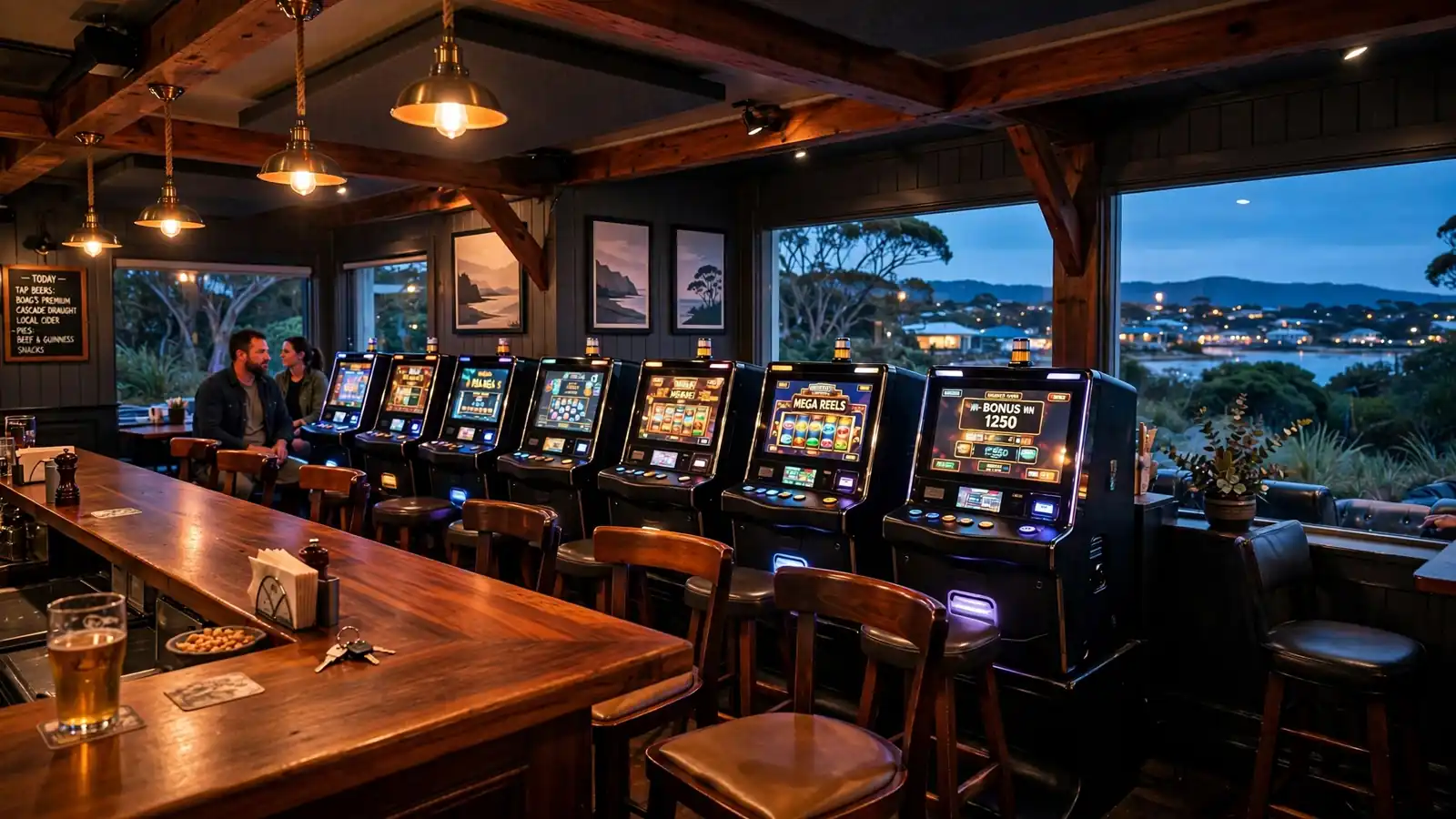
A search for pokies open in Tasmania can mean two different things: a general question about the state’s venues, or a practical one about whether a particular gaming room is operating at this moment. Only the second calls for a live, venue-specific check. A broad description of Tasmanian gambling cannot settle whether a door is open, whether the machines are available, or whether the hours have changed for a particular day.
That distinction matters because “open” is an imprecise word. A hotel, club or other venue may be open while its gaming area is not; conversely, the hours published for a gaming area may differ from the hours for food, bar service or other facilities. A listing that says a venue is open therefore does not, by itself, confirm that pokies are available. The detail that matters is the operating status of the relevant room, not merely the building.
For a check that needs to be current, the most useful starting point is the venue’s own information: its official website, a current notice on its verified social account, or a direct telephone enquiry. A venue’s staff can clarify whether the gaming room is open separately from the rest of the premises and whether a temporary change applies. This is more specific than relying on a general page about gambling in Tasmania, which may explain the local setting but cannot serve as a live status board.
Choosing pokies for Tasmania in 2026 means finding an option that fits your preferences and checking the details that matter to you. These short verdicts highlight the specific information available for each operator.
Playfina Casino
Playfina Casino is listed with a Curacao eGaming license held by Hollycorn N.V. since 2017. Its minimum deposit is A$20–30, depending on the offer.
Kingmaker
Kingmaker lists a A$30 minimum deposit. Its stated payout speed is around 90 minutes for crypto and 1–5 days for fiat.
Ricky Casino
Ricky Casino lists a A$20 minimum deposit, or A$30 to qualify for the bonus. Stated payout times are under an hour for crypto and 1–3 business days for PayID.
LevelUp Casino
LevelUp Casino is listed with Curacao eGaming license OGL/2023/174/0082, held by Dama N.V. Its minimum deposit is A$15.
WinSpirit Casino
WinSpirit Casino is listed with Curacao eGaming license OGL/2024/923/0383, held by Antillephone N.V. Its minimum deposit is A$30.
JustCasino
JustCasino is listed with a Curacao Gaming Control Board license. No other operator details were provided.
MrPacho
MrPacho lists a A$30 minimum deposit. Its stated payout speed is 30–120 minutes for crypto and 24–72 hours for fiat.
Bizzo Casino
Bizzo Casino is listed with a Curacao Gaming Control Board license, with TechSolutions Group N.V. identified as the operator. No other details were provided.
7Bit Casino
7Bit Casino is listed as operating under a Curacao license, with Dama N.V. identified as the operator. No other details were provided.
Roby Casino
Roby Casino is listed with a Curacao eGaming license held by Roby Games Ltd. No other operator details were provided.
A map or directory listing can still help locate a venue’s published hours, but it should be read as a lead rather than a guarantee. Such listings may be supplied or updated separately from the venue’s own channels. A schedule can also describe ordinary operations without reflecting a one-off closure, maintenance, a private event or another change. The sensible distinction is not between a useful and a useless listing; it is between information that gives a broad indication and confirmation tied to the place and the time in question.
That is especially relevant to searches for early-morning or late-night play. A general result for Tasmania cannot establish that any particular room operates through those periods. Nor does a venue’s usual schedule prove that its gaming area follows the same pattern every day. The specific venue, the specific room and the date all matter. Without a current confirmation, an early or late opening should be treated as unconfirmed, not inferred from another venue’s hours or from a statewide description.
The same caution applies when a name appears beside “Tasmania” in a search. A phrase such as “Crown Tasmania pokies” does not establish that a particular Crown venue or gaming room is located in Tasmania, or that it is open there. Search terms can combine a brand, a place and a hoped-for activity without proving that the combination corresponds to an operating venue. A location-specific check needs a real venue identity and its own current contact or opening information; a familiar name is not a substitute.
There is a quiet social history in the way opening hours are sought. Gambling has long been woven into places that also serve ordinary purposes: meeting, eating, drinking, passing time. That overlap makes the word “open” feel self-explanatory, although different parts of a venue can have distinct schedules. The room with the machines is not necessarily governed, in practice, by the same public timetable as the foyer or dining area. A live check is useful precisely because the architecture of a venue can divide what a casual listing collapses into one status.
A useful check therefore asks a narrow question: is the gaming room operating now, and are the machines available? It does not need to settle every broader question about a venue. A current answer about the room is more informative than a general claim that a location is open, while an ordinary schedule remains useful only as a statement of expected hours. If the venue’s own page gives one answer and a third-party listing gives another, direct confirmation is the cleanest way to resolve the conflict.
It is also worth separating operating information from rules about the room. A report published by regionriverina.com.au describes a requirement taking effect from 1 July for venues with more than 20 gaming machines to have a Responsible gambling officer (RGO) on duty while the machines are operating. The same report describes a one-month grace period for removing signage and introducing those officers, and a requirement for venues to keep a register of gambling incidents, including conduct that may indicate a patron is at risk of harm. These are reported operational and harm-minimisation measures. They do not say when a particular Tasmanian venue opens, whether its gaming room is open today, or whether machines are currently available.
That distinction can be easy to lose. A rule that applies while machines are operating describes a condition of operation; it is not a timetable. The presence or absence of staff, signs or a register cannot be used as a reliable shortcut for deciding whether a room is open to the public. Nor should a general account of responsible-gambling arrangements be repurposed as evidence of a venue’s current hours. Different questions need different evidence.
The practical meaning of “open now” is consequently modest but exact. It concerns a named place, its gaming area and the present moment. A statewide page can explain context. A regular schedule can indicate what is planned. A fresh venue-specific confirmation can address the immediate question. Each has a role, but they are not interchangeable.
Where the venue cannot be reached and its official information has no current update, the honest answer is that the status remains uncertain. A third-party page may still show a schedule, but that does not turn it into a live confirmation. The gap is not filled by guessing from nearby businesses, from a venue’s general trading hours, or from the fact that gambling machines are regulated. None of those establishes whether the room is operating at that moment.
This is a small distinction with practical consequences. It prevents “the venue is open” from being mistaken for “the pokies are available,” and it keeps a state-wide description from posing as information about an individual premises. In Tasmania, as elsewhere, opening hours are local facts. For an immediate answer, the check has to be local too.
“Pokies in Tasmania” can mean the machines found in local venues, a particular game someone remembers, or simply the hope of finding one that pays well. Those are different questions, though they are often folded into a single request for the best pokies. A confident ranking would need evidence about named games and their relevant settings. Without that, “best” is a verdict without a measure.
Even a familiar title may not tell the whole story. A specialist review reports that some providers allow casinos to choose among different return-to-player settings for the same pokie. If that arrangement applies, the game name alone cannot establish its return percentage at a particular casino. The setting matters; so does knowing whether the information is current and applies to the version being discussed. A neat list can conceal that distinction rather easily.
Nor does a run of wins or losses reveal what a machine will do next. Each spin is generated separately by a Random Number Generator, so earlier results do not determine a later one. A machine that has been quiet is not thereby “due”, and a recent win does not turn the next spin into a safer prospect. Randomness is less theatrical than folklore, but it keeps its own timetable.
Each spin is generated separately by a Random Number Generator, meaning earlier results do not determine later ones, and no machine is ever "due" for a win.
Questions about maximum bets and cash payouts also need specific terms. A maximum bet describes what may be wagered on a play; a maximum cash payout concerns what a game can award under its conditions. Neither phrase, by itself, identifies a particular pokie or establishes a Tasmanian-wide standard. The answer depends on the game and the applicable machine or venue information. Treating one limit as a feature shared by every pokie would turn a local question into a false generalisation.
Place names can narrow the meaning further. Someone asking about pokies near a small Tasmanian community may be looking for a venue, while someone asking for the best game is asking about performance. Those cannot be answered by the same ranking, and a place name attached to a game does not make it a local game.
So the useful distinction is between what can be identified and what is merely asserted. A named pokie, a documented return setting and stated payout conditions can support a comparison; a broad claim that one machine is the best cannot stand in for those details. No magic list.
A guide to casino pokies can sound authoritative before it has said anything useful. “Best” is an inviting word: it suggests a settled order, a clear winner and a reason to choose one game over another. For Tasmanian players looking for the best-paying pokies, though, the phrase carries more weight than a list of titles can bear. A name alone does not establish how a game performs, and a ranking without comparable evidence is theatre dressed as advice.
Return to player, or RTP, is one measure often used to describe the share of stakes a game is designed to return over time. A specialist review reports that some providers allow casinos to choose between different RTP configurations for the same pokie. That account makes a useful distinction: even a familiar title may not have one universal return setting across every casino. But it does not establish which setting applies at a particular venue, or make a game’s advertised reputation a reliable guide to an individual result.
Nor does RTP forecast the next spin. The outcome of each turn is generated separately through a random-number system; a run of wins or losses does not oblige the following spin to balance the books. Long-run figures describe a statistical design, not a promise to the person sitting at the machine. The distinction is less exciting than a jackpot story. It is also more honest.
That is why a “best-paying” label needs more than a game name. It would require comparable information about the version and setting being assessed, as well as a clear account of what the measure means. Without those, “best” may refer to popularity, visual style, volatility, a promotional claim or simply the writer’s preference. Those are different things, and none can be quietly substituted for a measured payout ranking.
A measure describing the share of stakes a game is designed to return to players over time, though specific configurations may vary by casino.
The same caution applies to guides promising the best pokies in Tasmania or a definitive list for a city centre. A local label can make a general catalogue feel specific, but it does not by itself tell anyone which games are installed at a particular casino, what configuration they use or how their returns compare. A guide can still be useful if it explains its method and separates measurable information from opinion. A confident adjective is not a method.
There is a human reason these lists keep appearing. People have always made maps of uncertainty: odds tables, lucky routines, stories about machines that are “due”. The machines offer a precise display and a dramatic pause, while chance remains stubbornly uninterested in narrative. A guide that respects that tension can explain what a measure says and where it stops. One that turns a few titles into a ladder of winners risks lending certainty to a random process.
For anyone comparing casino pokies, the practical questions are therefore narrower than the headline suggests. Is the return figure tied to the exact game configuration? Is it clearly identified as a long-term theoretical measure rather than a forecast? Does the comparison use the same basis for every title? If those details are absent, a ranked table may still be attractive, but its order cannot carry much meaning.
This matters especially when a page blends venue language with online-game language. “Tasmania casino pokies” may refer to a physical room, while “online pokies” points somewhere else entirely. The phrase does not turn a general game description into evidence about a Tasmanian machine. Nor does a city or state label settle a question about payout performance. Location, availability and game mathematics are separate claims.
A careful casino pokies guide can still offer orientation without pretending to crown a champion. It can explain RTP, distinguish a theoretical return from a short session’s result, and show why the same title may not mean the same configuration everywhere. That is less tidy than a top-ten list. It is a better account of what the numbers can—and cannot—say.
The useful standard is modest: claims should be specific enough to check, and modest enough to survive checking. “Best” is not a property that appears simply because a page says so. In a game built on chance, restraint is part of the information.
A request for pokies near an airport sounds precise, but “near” is a traveller’s word, not a measurement. It may mean a short walk, a straightforward drive or simply somewhere in the same broad area. Without a named venue and a confirmed address, none of those meanings can be turned into a reliable claim about proximity.
Tasmania adds a small complication: the island is a state, not a single city with one central business district or one airport. A search for a place near the CBD needs a city attached to it; a search near an airport needs the relevant airport identified. Otherwise, results can blur distinct destinations into one convenient-looking map. Maps are good at drawing lines. They cannot decide what counts as close.
The same caution applies to searches for pokies near the airport or inside an airport. Those phrases express a location hope, not evidence that a venue is in the terminal or on airport grounds. A result appearing beside an airport label may be outside the airport itself, and a pin on a map does not establish how long the journey takes. Road access, walking routes and transport connections all change the practical meaning of distance.
CBD searches have their own ambiguity. “Near the CBD” might describe a venue within the central grid, on its edge or in a neighbouring district. A map view can make these places look adjacent while concealing the route between them. The useful comparison is therefore not simply which pin sits closest to the centre, but whether the stated address and the intended route match the journey being planned.
“Near me” is more immediate, but not more exact. Location services can help sort places around a device’s position, yet the result depends on where that device is and how the map defines the surrounding area. A location result is a starting point for checking, not a guarantee that a venue is open, accessible or as close as its marker suggests. Those are separate questions.
Geographic labels such as northern Tasmania are broader still. They describe a region rather than a particular starting point. Someone comparing places across the north would need to distinguish the town or landmark in question; a regional label alone cannot establish which venue is nearest. And a reference to Tasmania alongside Victoria may reflect a cross-state journey or a loosely phrased destination, not a single local area.
There is a quiet lesson in all this cartography. Search language compresses a landscape into “near,” while actual travel unpacks it into streets, entrances and routes. A venue’s location should be treated as a concrete address, not inferred from a regional label, a nearby airport name or a map pin. Close is not a postcode.
A venue is more than the machines it contains. Its layout, the way staff respond to distress and the signs placed around the room all shape the experience. Responsible-gambling rules are not a guarantee that harm will be prevented; they set expectations for how venues should recognise and respond to it.
One reported change concerns the presence of a Responsible gambling officer (RGO). Region Riverina (regionriverina.com.au) reports that, from 1 July, venues operating more than 20 gaming machines must have a dedicated RGO on duty while those machines are running. The report also describes a one-month grace period for venues to remove signage and introduce the required officers. These are reported provisions, not a basis for assuming that every Tasmanian venue has the same facilities or staffing in place at a particular moment.
The distinction matters. A rule about staffing is not a live account of a room. It does not establish whether a particular venue has an officer on duty, what support is available there, or how quickly staff will respond to a concern. Those are questions about an individual operation. The rule sets the threshold and the duty; it does not turn every venue into an identical place.
The same report says venues will be required to keep a gambling incident register. That register is intended to record occurrences, including behaviour suggesting that a patron may be at risk of, or affected by, gambling harm. The point is institutional memory: a troubling episode should not disappear simply because a shift ends or a different staff member takes over. A record can make patterns visible, though recording an incident is not the same thing as resolving its cause.
There is an unglamorous logic to this paperwork. Gambling harm may become apparent through repeated signs rather than one dramatic event. A register gives a venue a way to document what staff observe and what action follows. The machinery of care, in this case, is partly administrative. Not very theatrical.
The room itself also has rules about how gambling is presented. Signage directing patrons to gaming lounges must be removed if it is within eyeshot of ATMs or EFTPOS terminals. Signage directing patrons to ATMs must be removed when it is within eyesight of gaming machines. These restrictions recognise that the route between a cash point and a gambling area is not neutral: a prompt placed in the wrong line of sight can make access to money part of the invitation.
That principle is more revealing than it first appears. A venue is designed through small decisions about movement and attention. Where a sign points, what can be seen from a machine, and how readily a patron can reach cash all affect the character of the room. Regulation does not erase those choices. It draws a boundary around some of them.
For people concerned about their own gambling, self-exclusion is one of the responsible-gambling tools available in Australia. Other tools include deposit limits, loss limits and session time limits. These measures differ in what they restrict: some set a financial boundary, while a time limit addresses how long a session continues. Self-exclusion is a stronger step, intended to prevent access to gambling rather than simply shape a particular session.
None should be mistaken for a judgement about character. A person can decide that a room, a habit or a period of life calls for a barrier. The practical value of a tool depends on how it works and where it applies, so its terms matter. The existence of a policy does not establish how a particular venue administers it or what support it can offer on the spot.
That is why venue descriptions deserve care. A claim that a club or casino is “best” cannot be proved by a polished room, a prominent sign or the existence of a responsible-gambling policy alone. A meaningful comparison would need to distinguish what is formally required from what can be confirmed about a particular operation. The first is a rule; the second is a venue-specific fact.
Tasmania’s clubs and other venues sit within a broader social compromise. Gambling is permitted in physical settings, but the permission comes with duties around supervision, records and the environment in which play takes place. The rules acknowledge that risk is not confined to an individual’s choices; it can also be influenced by the systems and surroundings built around those choices. A decent venue policy cannot remove that risk. It can, at least, make it harder to pretend the room has nothing to do with it.
The Spirit of Tasmania belongs to the geography of travel: a crossing between the island and the mainland, with timetables, terminals and the particular patience required by a sea journey. A search that places pokies beside the ferry may be asking whether gambling machines are available aboard, or simply using the vessel as a landmark while looking for entertainment in Tasmania. Those are different questions, and neither can be answered by treating the ferry’s name as proof that a gaming room exists on board.
No claim about pokies being available during the crossing follows from the association alone. Nor does the ferry become a casino because someone searches for it alongside that word. The distinction is plain, though the internet has a talent for making unrelated terms look like a destination.
The island’s physical casinos and gaming-machine venues are one subject; online gambling is another. An online service is not a Tasmanian venue, even if it uses Tasmania in its description or appears to be within reach on a phone. Location in a search result is not the same as location in law. In Australia, the relevant question for real-money online casino games is whether an operator may lawfully provide them to people in the country.
The Interactive Gambling Act 2001 prohibits companies from offering real-money online casino games to people in Australia unless they hold a domestic licence. No Australian licence for an online casino has been issued. In practical terms, there is no Australian-licensed online casino, and online pokies offered for real money to Australians do not become lawful simply because a site describes itself as international, lists Tasmanian players among its audience or displays a foreign licence.
This rule is directed at the companies providing the service, not at individual players. Australian law does not make a person criminally liable merely for playing on an offshore site that accepts them. That distinction matters, but it is not an endorsement of offshore gambling. The fact that a player is not the target of the prohibition does not give the site an Australian licence, bring it under domestic casino regulation or make its promises enforceable here.
There is also a difference between legal exposure and practical access. The Australian Communications and Media Authority can block illegal offshore gambling sites, and internet providers must comply with its blocklist. A site may therefore be interrupted or inaccessible from Australia. The existence of sites that accept Australian customers does not cancel the prohibition on operators, and a page that happens to load is not evidence of lawful Australian authorisation.
A narrow legal distinction. A wide practical gap.
The words “real money” are important. They separate a casino-style service involving deposits, wagers and possible withdrawals from material that merely discusses games. Online casino-style games, including pokies, sit within the prohibited interactive gambling services when supplied to customers in Australia. A promotional phrase such as “no deposit” does not alter the underlying category if the offer concerns real-money gambling. Nor does a bonus label transform an offshore operator into a domestic one.
Legal Risk
The Interactive Gambling Act 2001 prohibits companies from offering real-money online casino games to people in Australia without a domestic licence, which has not been issued.
That makes claims about online play in Tasmania especially easy to misread. A page can be written for Australian readers without being authorised to provide a real-money casino service to them. A local-sounding name, a Tasmanian reference or a familiar payment option cannot settle the legal question. The law turns on the service being supplied, not the warmth of its branding.
For a player, the most concrete consequence of using an offshore casino is not a fine under the law. It is the limited protection available when something goes wrong. If an offshore operator refuses to pay winnings, an Australian player has no legal recourse in Australia to compel payment. That leaves a substantial difference between being able to access a website and being able to enforce a claim against it.
This is why a search for online pokies should not be mistaken for a directory of lawful Australian services. Search results can lead to offshore operators, but their visibility does not confer domestic status. ACMA’s blocking powers further complicate access: a page may appear, disappear or be blocked, while the legal position remains the same. Availability is not approval.
Terms such as “best paying” also suggest a certainty that cannot be supplied by a location label. A Tasmanian reference says nothing about the legal standing of an online operator, and it cannot establish what a player would receive. The central issue here is not a ranking of games or a comparison of venues. It is whether the service is permitted to offer real-money online casino play to people in Australia—and the domestic licensing route for such a service has not produced an Australian-licensed casino.
The ferry and the internet, then, belong to separate kinds of inquiry. One concerns a vessel and a journey; the other concerns a prohibited category of commercial service and the limits of protection when dealing with offshore operators. Putting their names together does not establish that pokies are available on board, and adding “Tasmania” to an online casino description does not make that casino Australian-licensed.
The difference is worth keeping intact. The law places responsibility on operators, not individual players, while leaving players who use offshore casinos without an Australian remedy if winnings are withheld. Neither fact turns an offshore site into a domestic service. A search can join almost any two ideas. The law does not have to follow.
“Cashless” can describe a way of moving money, but it does not, by itself, explain how a pokie room operates. A payment network and a gaming machine are different things. Knowing how one works cannot establish what a particular venue accepts, which games it offers, or whether a game is fair.
PayID belongs to the payment layer. It uses an alias—such as an email address, mobile number or ABN—to route a transfer through Australia’s New Payments Platform (NPP). The NPP is available through all major banks and protects transfers with end-to-end encryption. Those features describe the infrastructure carrying a payment; they do not certify whatever service might sit at the other end of a transfer.
That distinction matters when cashless play is discussed in Tasmania. A reference to PayID does not show that a local venue has adopted cashless pokies, or that PayID is a feature available inside its gaming room. Nor does the presence of a payment method establish a game’s return settings, fairness, or the legal status of an operator. Payment technology answers a narrow question: how a transfer may be addressed and carried.
Place names can create a similar false impression. A request for the best pokies in Newcastle, Tasmania, does not turn a payment-network description into evidence about a venue there. The technology has no map of local machines hidden inside it.
There is a quiet social shift in the move from notes and coins to digital aliases: payment becomes less visible, while the institutions moving it remain in the background. Encryption is a protection for the transfer, not a certificate for every use made of it. A useful distinction.
There are no Australian-licensed online casinos, and Australian players have no legal recourse in Australia if an offshore casino withholds winnings. Treat that lack of protection as a significant risk.
It is the amount you must bet before bonus winnings can be withdrawn. For example, a $500 bonus with a 40x requirement means $20,000 in bets; if the requirement applies to a $500 deposit plus a $500 bonus at 35x, it means $35,000 in bets.
You must be at least 18 years old to gamble online in Australia.
Most operators set minimum deposits at AU$10–AU$20, while some accept AU$5. PayID is treated like other qualifying deposit methods, but the minimum can vary by operator.
Yes. PayID is treated like any other qualifying deposit method at the recommended sites, so eligible PayID deposits qualify for bonuses under the site's terms.