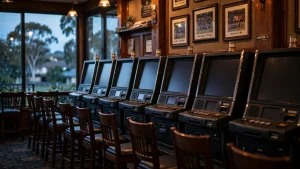
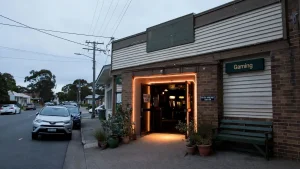
Location results can narrow the search, but venue details, opening hours and machine availability still need separate verification.
A request for pokies near Sydney sounds like a straightforward matter of distance. In practice, “near” can mean within a suburb, close to a transport point, somewhere in the wider metropolitan area, or simply easier to reach than a destination farther away. A result that appears relevant to one meaning may be a poor fit for another.
That distinction matters because a place name is not evidence of what a venue offers. A listing associated with Sydney, the central business district or the airport does not, by itself, confirm that pokies are available there. Nor does a result appearing nearby establish that it is current, open to visitors or accurately described. Location can narrow a search; it cannot complete the verification.
The same caution applies to “near me”. That phrase depends on the location supplied by a device or account, and the result can change as that location changes. It describes a relationship between a person’s position and a listing, not a promise that a particular facility is present. Sydney’s size makes the distinction especially practical: a result may be within the broad urban area while still being inconveniently far from the suburb or landmark that matters.
Choosing pokies for Sydney in 2026 means weighing the available operator information before deciding where to play. These verdicts highlight the specific details provided for each option.
Playfina Casino
Playfina Casino is listed with a Curacao eGaming license held by Hollycorn N.V. since 2017. Its minimum deposit is A$20–30, depending on the offer.
Kingmaker
Kingmaker lists crypto payouts at about 90 minutes and fiat payouts at 1–5 days. Its minimum deposit is A$30.
Ricky Casino
Ricky Casino lists crypto payouts in under an hour and PayID payouts in 1–3 business days. The minimum deposit is A$20, or A$30 to qualify for the bonus.
LevelUp Casino
LevelUp Casino is listed under Curacao eGaming license OGL/2023/174/0082, held by Dama N.V. Its minimum deposit is A$15.
WinSpirit Casino
WinSpirit Casino is listed under Curacao eGaming license OGL/2024/923/0383, held by Antillephone N.V. Its minimum deposit is A$30.
JustCasino
JustCasino is listed with a Curacao Gaming Control Board license.
MrPacho
MrPacho lists crypto payouts at 30–120 minutes and fiat payouts at 24–72 hours. Its minimum deposit is A$30.
Bizzo Casino
Bizzo Casino is listed with a Curacao Gaming Control Board license, with TechSolutions Group N.V. named as the operator.
7Bit Casino
7Bit Casino is listed as operating under a Curacao license, with Dama N.V. named as the operator.
Roby Casino
Roby Casino is listed with a Curacao eGaming license held by Roby Games Ltd.
Airport wording adds another layer of ambiguity. Someone passing through may mean the terminal itself; someone travelling to or from it may mean somewhere along a route. Those are different requests, even when they share the same place name. A nearby-looking result is not confirmation of an on-site facility, and a reference to the airport does not settle how close a venue actually is.
The wording “pokies near Sydney” can also blur the boundary between a physical destination and an online service. The city in the phrase may identify where someone is, rather than where a machine is located. But a local reference does not turn an online offer into a Sydney venue. For Australian residents, the Interactive Gambling Act 2001 prohibits operators from providing real-money online casino games to people in Australia, and no domestic online casino licences have been issued. Geography does not alter that position.
Search language is compressed by design. It leaves out the details that people would normally use to distinguish one errand from another: which part of the city, whether the destination needs to be walkable, whether the request concerns a physical venue, and what kind of evidence would count as confirmation. The machine sorts words into apparent relevance; it does not know which of those missing details are decisive.
A useful way to read a location result is to separate three claims. First, a name or listing is associated with a place. Second, the place is genuinely where the listing suggests. Third, the specific facility being sought is available there. Each claim needs its own support. A suburb in a title may support the first; a reliable address may help with the second; neither alone proves the third.
This is why “near Sydney Central” or “near the CBD” should not be treated as venue descriptions. They are broad geographic cues. Centrality can mean different things to a person arriving by train, staying in the city or travelling across it, and a label does not reveal the distance in practical terms. Without a confirmed venue and a confirmed offering, naming supposed destinations would replace uncertainty with invention.
The phrase “best pokies in Sydney” carries an additional implication: that a set of local options has been checked and compared. A ranking cannot be inferred from a city name, a map pin or the number of times a listing appears. It would require reliable venue-level information and a clear basis for comparison. Without those, “best” is decoration, not a finding.
The sensible boundary is narrow but useful. A location search can indicate the area someone has in mind. It cannot verify a venue, its machines or its suitability for a particular journey. Sydney in the wording is a starting point, not proof of what waits at the destination.
An online pokie can look like a local product when its page mentions Sydney, uses Australian currency or accepts a familiar payment method. None of those details changes the legal position. The Interactive Gambling Act 2001 prohibits companies from providing real-money online pokies to people in Australia, and no Australian licence for an online casino has been issued. There is no domestic licensed online casino behind the language of a Sydney offer.
Legal Prohibition
The Interactive Gambling Act 2001 prohibits operators from providing real-money online casino games to people in Australia, and no domestic online casino licences have been issued.
The distinction between the operator and the player matters. The law is directed at companies offering the service, not at an individual for playing on an offshore site that accepts Australians. That does not make the operator’s service lawful in Australia, nor does it turn an offshore casino into a locally regulated business. A search for online pokies in Sydney, whether framed around real money, a welcome offer or a supposed no-deposit bonus, cannot alter that boundary.
Nor does the word “casino” settle the question. A named Sydney casino and an online site bearing similar language are different things; a local name in a web address or promotion is not evidence of an Australian online gambling licence. The legal landscape is unusually stark: real-money online casino services are prohibited to operators here, while the player is not the target of the prohibition. Those two statements can sit together, though they are often blurred in promotional copy.
The absence of local licensing has practical consequences. If an offshore operator refuses to pay winnings, an Australian player has no legal recourse in Australia to compel payment. A polished site, an account balance displayed on screen or an assurance of prompt withdrawals does not create the protections that would come from an Australian-licensed online casino. There is none.
That gap is more than a technicality. Licensing is the point at which a state can impose obligations, inspect conduct and provide a route for complaints. Without a domestic casino licence, there is no local licensing framework for an online operator to answer to. Familiar payment terminology or a Sydney-themed page may lend a service the appearance of proximity; neither supplies the missing legal relationship.
The Australian Communications and Media Authority enforces the Interactive Gambling Act. It blocks access to illegal offshore gambling sites, and internet service providers must comply with its blocklist. A site that cannot be reached may therefore reflect enforcement, rather than a temporary fault or an invitation to find another route. Offshore services are not simply a parallel, locally protected version of the same industry.
This is why claims about the best-paying online pokies in Sydney, high-limit play or cashless access should be read as claims made by a service, not as confirmation of Australian oversight. The label “best” cannot establish a reliable local ranking, and a payment option cannot certify that a site is licensed, fair or transparent about game settings. Those are separate questions, and the legal one comes first.
The same applies when an offer is presented as a way to try a game without depositing. A bonus phrase does not change the nature of a service if it leads to real-money online casino play for someone in Australia. The restriction concerns the operator providing prohibited interactive gambling, not the wording chosen to draw attention to it. The sales language is not the law.
For anyone comparing online access with a physical venue, the distinction is therefore not simply between a screen and a machine. Online, the market has no Australian-licensed casino, offshore operators can be blocked, and a payment dispute may have no Australian legal remedy. A result that appears to answer a Sydney search does not make those conditions disappear. Proximity is a design choice. Protection is another matter.
Legal Recourse
If an offshore operator refuses to pay winnings, an Australian player has no legal recourse in Australia to compel payment.
An early start has a practical meaning: a person wants to know whether pokies will be available at a particular time, not merely whether a venue exists somewhere in Sydney. Yet a request for an opening time is not itself evidence of one. Words such as “early” describe an expectation; they do not establish a schedule.
That distinction matters when the hour is unusually specific. A search for pokies available at six or seven in the morning can sound like a question with a simple yes-or-no answer. In reality, the answer depends on the particular venue and the conditions attached to its operating hours. Without reliable, current information for that venue, neither time can responsibly be presented as confirmed.
A listed opening time may also leave a smaller but important question unresolved: what, exactly, is opening? A hotel, bar or other premises may have its own hours, while access to a particular area or activity may be governed separately. Treating one schedule as proof of the other turns a broad label into a promise it cannot support. “Open” is not always as precise as it looks.
This is especially easy to miss with hotel pokies. The phrase joins a type of venue to an activity and can suggest that the two share a timetable. But the words alone do not establish when a gaming area operates, whether it is accessible at a given hour, or whether a schedule has changed. Those details belong to the individual premises, not to the category.
Opening hours are also time-sensitive. A schedule that was accurate at one point may later be altered, and a page that remains visible does not become current merely by staying online. The more exact the requested hour, the more useful it is to know who published the information and when it was checked. A vague indication of early service cannot settle a question about a specific morning.
There is a social habit behind this kind of request. Cities are organised by clocks: shifts begin before daylight, transport runs to timetables, and hospitality has its own uneven rhythm. Gambling searches fit into that practical landscape. They reveal a desire to match recreation with the hours available, but they do not tell whether a venue can meet that schedule. The search phrase is evidence of intent, not of access.
The same caution applies to promises that a place stays open late. A late closing time does not, by itself, show that pokies remain available until that moment. Nor does a venue’s general description settle the operating hours of every part of its premises. Each claim needs to match the precise service being described.
For a dependable answer, the relevant information must be attached to a specific venue and refer to its current operating arrangements. If that detail cannot be established, an exact opening time is better left unstated than dressed up as a Sydney-wide fact. The city is not one timetable.
That is the limit of an early-hours claim: it can describe what someone hopes to find, but only venue-specific information can establish when it is available. Until then, a precise hour is just a precise-sounding uncertainty.
A return figure can look like a clean answer to a messy question: which pokie pays well? In practice, it describes a setting attached to a game, not a promise about what will happen during a visit to a Sydney casino. Even when the figure is clearly stated, it needs context before it can be compared with another.
A specialist review reports that some game providers let casinos choose between different return settings for the same pokie. The title alone, then, may not identify the version in use. A figure listed for a game at one casino cannot safely be assumed to apply to the same game elsewhere. The setting matters, and a claim about a “best-paying” pokie is incomplete unless it says which setting and where that setting applies.
That is a distinction between a game and its configuration. It is also why a return figure found in a general description may not settle what is installed on a particular floor. The wording can sound universal while the setting is not. Dryly put, the name travels more easily than the terms.
The other limit is more fundamental. Each spin is generated as its own random event, so a return figure does not prescribe the result of the next spin, or of a particular session. A long-run return describes an aggregate expectation across play; it is not a schedule of repayments to each person who sits down. A machine does not keep a personal account of what someone has lost and then owe it back.
This makes short stretches of play especially poor evidence for judging a stated return. A run of wins does not prove that a setting is generous, just as a run of losses does not establish that the figure is false. Random outcomes can cluster. The number may describe the underlying configuration, while an individual experience remains unsettled.
Comparisons between Sydney venues therefore need more than a list of game names or a headline figure. The relevant questions are whether the stated return belongs to the exact version on offer, whether the casino’s setting is identified, and whether the information is current. Without those details, a ranking of pokies in Sydney can give an appearance of precision without a sound basis for comparing like with like.
The same caution applies to claims about pokies in the CBD or elsewhere in the city. A return percentage is not a venue-level report, and it says nothing by itself about which machines are available at a particular location. Nor does a higher stated return transform a random game into a dependable way to win. The figure concerns the game’s return setting; it cannot tell an individual what will happen.
So “pays well” is not a complete description. It may point to a published return figure, but that figure needs a matching setting and a clear account of what it measures. Even then, it remains a long-run measure, not a forecast for one person. Numbers can clarify the terms. They cannot settle the outcome.
An airport is a place of arrivals, departures and hurried decisions. North Sydney belongs to a different geography: a district across the harbour, with its own streets and patterns of movement. Putting either name beside “pokies” expresses a wish to locate a particular kind of entertainment. It does not establish that machines are present there.
That distinction matters especially at an airport, where a broad label can cover very different spaces: terminals, transport links, hotels and surrounding businesses. A result associated with the airport area may refer to somewhere nearby rather than inside the airport itself. Without a precise venue and current, venue-level confirmation, those possibilities cannot responsibly be folded into one claim. The name of a transport hub is not a floor plan.
North Sydney needs the same care, though for another reason. A district name can stand for a wide patch of city, not one identifiable premises. Information about one address would not automatically describe the whole area, and a general reference to Sydney would say even less. The city, the airport and North Sydney are not interchangeable labels; each would need to be checked on its own terms.
This is where location language can quietly outrun what it proves. A place may be familiar, busy or surrounded by other services, yet none of those qualities confirms that pokies are available there. Nor does a reference to Sydney City settle whether a particular machine area exists at an airport or in North Sydney. The useful unit is the specific venue, not the suggestive radius around a landmark.
The distinction also protects against a common kind of accidental certainty. A guide that groups “Sydney” with “airport” can sound as though it has checked the terminal; one that moves from the city to North Sydney can make the district seem covered by association. But geography does not transfer evidence. Each location requires its own confirmation, and a venue’s presence cannot be inferred from its proximity to a better-known place.
The question about the maximum cash payout has a separate limit. A search for a maximum does not supply one, and a city-wide figure cannot be responsibly attached to locations whose machine offerings have not been established. Payout arrangements are not a feature that can be read from a suburb name. Without venue-specific information, any precise ceiling would be guesswork dressed as local knowledge.
The practical standard is modest: identify the exact premises, then rely on information that actually refers to that premises. Airport-area references should not be mistaken for confirmation within the airport; North Sydney references should not be treated as a map of the district. This is not needless precision. It is the difference between naming a place and describing what is there.
For anyone comparing locations, the airport and North Sydney therefore remain separate questions, not entries in a verified list. Sydney City is broader still. A concise answer is less satisfying than a confident address, but confidence without local confirmation is only scenery.
Crown Sydney is a recognisable name, but recognition is not a machine-by-machine description. A person looking for pokies at Crown Sydney may be trying to establish something quite practical: whether particular games are available, where they are located, or what conditions apply. The name alone settles none of those points.
That distinction matters because venue names can acquire a life of their own online. A phrase repeated across directories, reviews and conversations can begin to sound like a complete account, even when it says little about what is presently on offer. Search results may bring together old descriptions, broad claims and material about different parts of a business. Familiarity lends these fragments a borrowed authority.
A responsible guide would need to distinguish a general reference to Crown Sydney from current, venue-specific details. It would identify what has actually been confirmed, and avoid turning a location label into a promise about machines or facilities. Without that distinction, “pokies at Crown” can read as an answer while leaving the central questions untouched.
The same care applies to the phrase “best pokies room”. “Best” has no settled meaning without a stated measure. It might refer to the range of machines, the room itself, access, or some other preference. None can be inferred from the venue name. Nor does a broad label establish that a particular room exists in the form a searcher imagines.
This is not a small editorial quibble. Gambling decisions are made in places, under particular conditions, and those conditions matter more than a polished description. A name can point towards an inquiry; it cannot do the checking on the inquiry’s behalf. Treating it as a recommendation would blur the difference between being well known and being well documented.
There is also a cultural habit at work. Cities compress complicated places into short labels: a landmark, a district, a venue. The compression is useful for finding a subject, but poor at conveying its present details. Online, that shorthand can harden into certainty, especially when many pages repeat the same few words. Repetition is not confirmation.
For Crown Sydney, the careful account is therefore narrow. The name can be discussed as the subject of interest, but not used to assert which pokies are available, how they are arranged, or what a visit would involve. Those claims require information tied to the venue and current conditions. No flourish can substitute for it.
A useful description would keep the boundary visible: a named place is not, by itself, a verified pokies guide. That may sound less satisfying than a ranked room or a confident list. It is also more honest.
A venue’s appeal is often reduced to what sits on the floor: the number of pokies, the room they occupy, the promise of a particular atmosphere. But the less visible question is how a venue responds when gambling stops looking like leisure. New duties reported for New South Wales venues shift some attention from the machines themselves to the people responsible for noticing what happens around them.
According to reporting by regionriverina.com.au, venues with more than 20 gaming machines are required, from 1 July, to have a dedicated responsible gambling officer (RGO) on duty while those machines are operating. The report also describes a one-month grace period for venues to introduce the officers and remove signage. These are venue obligations, not a rating system for the best pokies venue in Sydney. A title on a door cannot establish how consistently a duty is carried out.
The RGO requirement makes a person, rather than a poster, part of the room’s formal structure. That matters because gambling harm is not always announced in a way that neatly fits a policy. It may become visible through conduct, distress, or a pattern that staff recognise only in context. Assigning responsibility gives the venue a defined role to fulfil; it does not, by itself, prove how well the role works in practice.
A related requirement, also described in the report, is a gambling incident register. Venues are to record occurrences, including situations in which a patron’s behaviour suggests they may be at risk of, or already affected by, gambling harm. The register turns an encounter that might otherwise disappear into staff memory into a recorded incident. That can support accountability, though a record is not the same thing as assistance, and paperwork cannot substitute for a humane response.
The shift has a particular social logic. For years, public discussion of pokies has often treated the machine as the whole story: its design, its returns, the person seated before it. Venue duties widen the frame. The room, the staff, and the decisions made when someone appears vulnerable become part of the account too. Regulation is less romantic than personal choice, but it recognises that choice takes place in a managed environment.
For anyone comparing Sydney venues, these measures offer context, not a recommendation. They do not establish which venues have machines, what the atmosphere is like, or how a particular venue applies its responsibilities. Nor do they make a venue “best” by default. They describe duties that attach to certain premises and the conduct expected around machine areas.
A rule can assign responsibility. It cannot guarantee attention.
“Open now” describes a moment. “Open around the clock” describes an unbroken span of time. The two phrases can sit side by side on a screen, but they answer different questions: whether a place appears to be operating at the instant of checking, and whether it remains accessible through every hour of the day and night.
That distinction matters for anyone looking for pokies in Sydney. A venue’s general opening status does not, by itself, establish that its gaming area is open, that machines are available, or that access continues without interruption. A door may be open for one purpose while a particular part of a premises follows another schedule. Search listings can compress such differences into a single green dot and a reassuring word.
A clock is not a schedule.
The wording also carries more certainty than it deserves. “Open now” can be based on hours attached to a listing, rather than a fresh confirmation of what is happening inside. Even when those hours are accurate for the venue as a whole, they do not settle the separate question of pokies access. A continuous-access claim needs information about the relevant area, not merely the address or the building.
This is why “24-hour pokies venues” is not a category that can be responsibly inferred from a general opening-hours result. The phrase sounds precise, but precision depends on what the hours refer to. A listing that says a venue is open late is not evidence that pokies operate through the night; one that shows a venue open at the time of checking does not establish an all-day-and-night schedule.
The sensible distinction is modest: treat an “open now” indicator as a snapshot, not a promise of continuous access. For a journey made specifically to play, the venue’s own current information is more relevant than a broad listing, and any uncertainty about the gaming area should be resolved before setting out. That is not a claim that Sydney venues follow one pattern. It is simply a refusal to let a short label stand in for a full timetable.
Round-the-clock availability is a stronger claim than being open at a particular moment. Without a confirmed schedule that specifically covers pokies, neither a search result nor a venue’s general status can establish it. A small difference in wording; a substantial difference in what it tells the traveller.
Sydney’s central business district invites a particular kind of shorthand: a club becomes a pin on a map, and the pin is taken to mean a known collection of pokies. Yet a club’s presence in the city says little about its gaming facilities. The practical details belong to the venue itself, not to the neighbourhood label.
That distinction matters when comparing places. A claim that one club has the “best” pokies would need more than a CBD address. It would require reliable, current information about the machines and the basis for comparison. Without that, a ranking would dress uncertainty as local knowledge. The adjective does the work; the evidence does not.
There is also a difference between a club and a machine area within it. A venue may be familiar for dining, events or membership, while the details of its gaming facilities remain a separate question. Familiarity with the name is not a measure of what is available on the floor.
The city’s rules frame these places too. From 1 July, a venue with more than 20 gaming machines must have a Responsible gambling officer on duty while those machines operate. A report by regionriverina.com.au also describes a one-month grace period for venues to remove signage and introduce officers, alongside a requirement to keep a gambling incident register for events that may indicate gambling harm. These obligations concern how machine areas are managed; they do not establish what any particular CBD club offers.
Self-exclusion belongs to a different part of the picture: a person’s decision to bar themselves from gambling venues. BetStop applies only to Australian-licensed operators and does not bind offshore sites. It should not be mistaken for a universal switch that closes every possible route to gambling.
The result is a more modest way to understand central Sydney’s clubs. A district can be known for nightlife without every venue being a pokies venue, and a club can exist without its machine details being publicly clear. Names travel easily. Venue-level facts require care.
A map is not a floor plan.
A request for pokies in Sydney and Parkes combines place names without explaining how they relate. Parkes may refer to the town in New South Wales, or to a street or another locality with that name; Sydney may mean the city itself or a broader area. Those possibilities point to different journeys, so a result matching the words is not automatically a useful local answer.
“Best” adds another ambiguity. It could mean a venue’s location, its facilities, accessibility or the games available. None of those qualities follows from a name appearing beside “Sydney” or “Parkes”. Nor does a directory entry establish that a venue has pokies, that a particular machine is available, or that the information is current.
The practical distinction is between a place label and a confirmed venue detail. A current address helps establish where a venue is; the venue’s own published information or a direct confirmation is needed to establish what it offers. If Parkes is the intended destination, a Sydney result should not be treated as a nearby alternative merely because both names appear in the same listing. If the intended location is within Sydney, the exact suburb or locality matters more than the broad city label.
This is a small problem of geography, but also one of how digital directories compress a life into keywords. They make distant or unrelated places look neatly adjacent. The map does not.
For a meaningful comparison, the location needs to be settled first, then the specific venue and its current machine offering checked independently. A claim that a place has the “best pokies” is not a substitute for either step. It is a judgement, not a verified description—and the Parkes/Sydney wording alone cannot show which place, or which venue, is meant.
Yes, Australian players can legally play on offshore sites that accept them, but operators are prohibited from offering real-money online pokies to Australians. No Australian-licensed online casino exists.
Each spin is an independent random event determined by a Random Number Generator. The same pokie can also have different return percentages at different casinos.
There is no Australian-licensed online casino, and Australian players have no legal recourse in Australia if an offshore casino withholds winnings.
You must be 18 or older to gamble online in Australia.