Venue listings can show whether a building is open, but the gaming area’s current status may need a separate check.
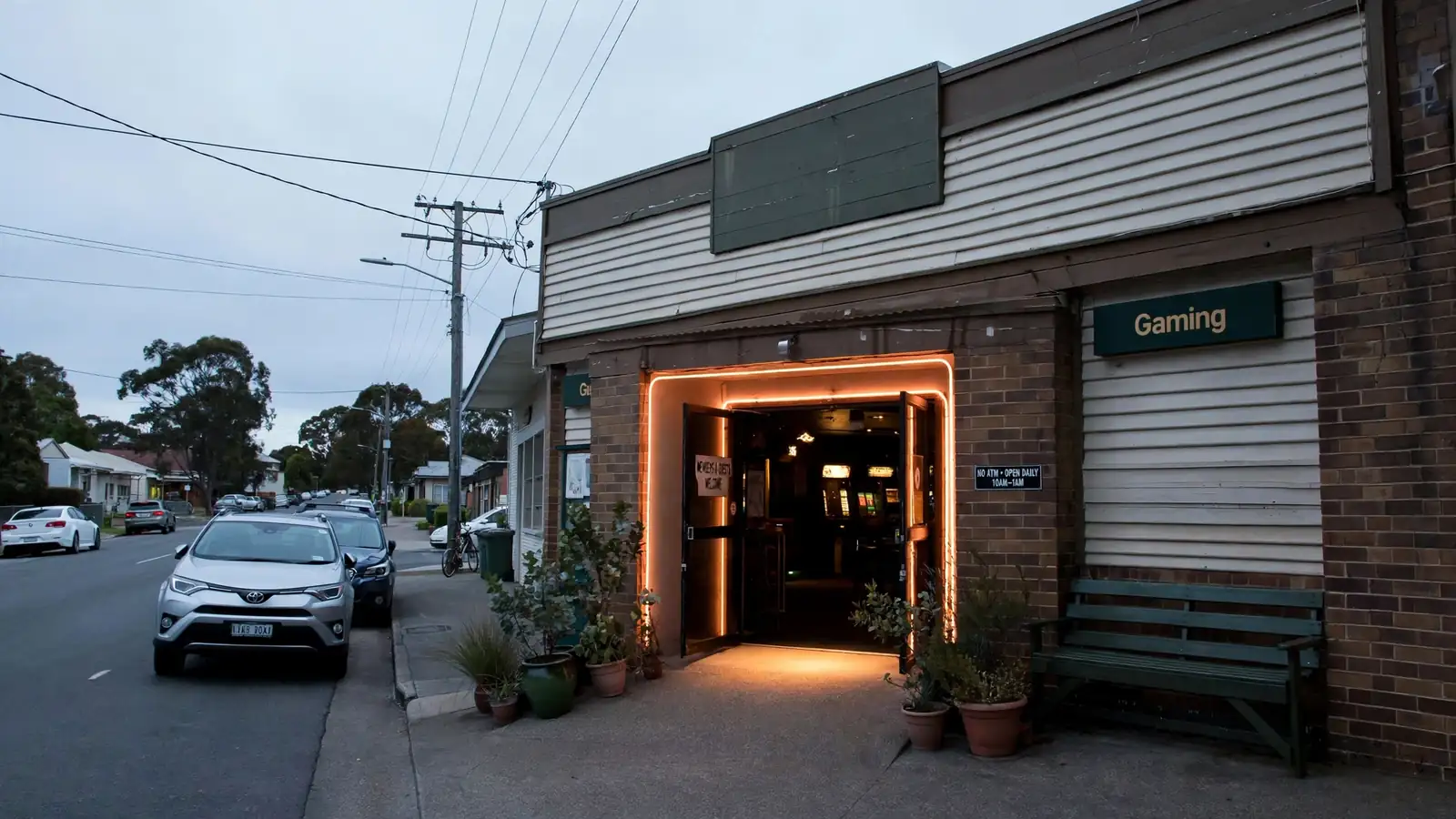
A venue’s opening hours and the operating hours of its pokies are not necessarily the same thing. A building may be open for meals, drinks or other services while a gaming area is unavailable; posted business hours alone may not settle the question. For anyone checking whether pokies are available at a particular Geelong venue now, the useful detail is the current status of the gaming area, not merely whether the front door is open.
That distinction matters most when plans depend on a narrow window: early in the morning, later in the evening or during a public holiday. A listing that says a venue is open can be accurate in one sense and still leave the practical question unanswered. Opening times can also change for a one-off event, maintenance or a change to the venue’s schedule. A familiar weekly pattern is not a promise about today.
The most direct check is the venue’s own current information. An official website may publish operating hours, and an official social-media account may note a temporary change. Where the information is unclear, a phone call to the venue can establish whether it is open at that moment and whether the gaming area is operating. The question is best kept specific: general venue hours, kitchen hours and pokies availability can refer to different things.
Choosing pokies in Geelong for 2026 means finding an option that suits your preferences and the details you want to check before playing. Use these operator notes as a starting point for your own review.
Playfina Casino
Playfina Casino is listed with a Curacao eGaming license held by Hollycorn N.V. since 2017. Its minimum deposit is A$20–30, depending on the offer.
Kingmaker
Kingmaker lists a A$30 minimum deposit. Its stated payout times are around 90 minutes for crypto and 1–5 days for fiat.
Ricky Casino
Ricky Casino lists a A$20 minimum deposit, rising to A$30 to qualify for the bonus. Its stated payout times are under an hour for crypto and 1–3 business days for PayID.
LevelUp Casino
LevelUp Casino is listed under Curacao eGaming license OGL/2023/174/0082, held by Dama N.V. Its minimum deposit is A$15.
WinSpirit Casino
WinSpirit Casino is listed under Curacao eGaming license OGL/2024/923/0383, held by Antillephone N.V. Its minimum deposit is A$30.
JustCasino
JustCasino is listed with a Curacao Gaming Control Board license.
MrPacho
MrPacho lists a A$30 minimum deposit. Its stated payout times are 30–120 minutes for crypto and 24–72 hours for fiat.
Bizzo Casino
Bizzo Casino is listed with a Curacao Gaming Control Board license, with TechSolutions Group N.V. named as the operator.
7Bit Casino
7Bit Casino is listed as a Curacao-licensed casino operated by Dama N.V.
Roby Casino
Roby Casino is listed with a Curacao eGaming license, with Roby Games Ltd named in connection with it.
Online map listings can help locate a business and display its stated hours, but they are not a live view of the premises. Their information may lag behind a change, and a label such as “open” does not necessarily describe every service inside. A recent update from the venue is stronger evidence than a generic listing; direct confirmation is stronger still. The small inconvenience of checking is preferable to treating a screen as a doorman.
Early opening times call for the same care. A person looking for a venue at dawn should not infer that pokies are available because a business listing shows an early opening time. Nor does an old review, photograph or discussion establish what is happening now. If a venue’s published schedule does not state when the gaming area operates, that detail needs to be confirmed rather than supplied by assumption.
The same principle applies later in the day. A venue open in the evening may have different service hours from its gaming area, and a listing that remains visible after a change does not resolve the difference. For a late visit, checking the date as well as the stated time is useful: holiday arrangements and one-off changes can make a regular schedule a poor guide. “Open” is a simple word carrying several possible meanings.
There is also a difference between a venue being open now and keeping the same hours every day. A current status indicator can answer a question about this moment, while a weekly schedule describes a pattern that may be subject to exceptions. Neither should be stretched beyond what it says. If the status appears inconsistent across sources, the venue’s own latest notice or a direct call is the sensible tie-breaker.
This is not merely a technical wrinkle. Opening hours organise the public life of a venue: staff shifts, meals, entertainment and access to different parts of the premises. A single set of hours compresses those arrangements into one neat line, although the building may contain several services with separate schedules. The convenience of the line should not be mistaken for precision.
For Geelong, a reliable answer about a particular venue therefore depends on checking that venue’s current information, then confirming the gaming-area detail if the published hours do not make it plain. No general statement about the town can substitute for that check, and no listing should be read as proof that a particular set of machines is operating at the time of arrival.
Current status is local and changeable. A venue’s own update, checked close to the intended visit, is more useful than an old mention or an unqualified “open” label. If uncertainty remains, a call can settle the practical point before the trip begins. Better a brief check than a wasted journey.
“Best” sounds like a verdict, but in pokies it can conceal several different questions. A player might mean a game with a higher published return, a particular style of play, or simply one that feels enjoyable. Those are not interchangeable standards. A title praised as a favourite is not thereby the best-paying option, and a high theoretical return does not promise a favourable result in any individual session.
That distinction matters when considering claims about Geelong. A list of the best pokies in Geelong for 2026 would need to connect specific games to specific local venues and establish a basis for comparing them. Without that link, a ranking would be a confident-looking arrangement of names, not a local finding. The same applies to claims about the best-paying pokies in the CBD or elsewhere in the city: a place name alone does not establish what games are available there, or what settings they use.
Even a game title is not enough to settle the question. A specialist review reports that some providers allow casinos to choose among multiple return-to-player settings for the same pokie. In other words, a familiar game can carry different RTP settings at different casinos. A figure attached to a title in one context cannot automatically be treated as the setting used in another. The distinction is easy to miss because the game’s name and appearance may stay the same while the underlying return setting differs.
RTP, or return to player, describes a theoretical proportion of stakes returned over extensive play. It is a long-run measure, not a forecast for the next visit or a promise about what any player will receive. Nor does it tell the whole story of how a game feels. Two games with similar theoretical returns can differ in their features and rhythm; those qualities may shape the experience, but they do not turn a short session into a predictable outcome.
Every spin is generated through a random process. The result of one spin does not make a particular result more due on the next, and a recent run of wins or losses cannot reveal what is about to happen. That is why stories about a machine being “ready” to pay should not be treated as evidence of its prospects. A streak is a sequence, not a signal.
The word “best” can also blur the difference between a personal preference and a measurable comparison. Someone may prefer a familiar theme or a game that moves at a particular pace. Those preferences are real, but they are not proof that the game has a better return, and they cannot establish that it is the strongest choice across Geelong. A recommendation based on taste needs to be labelled as taste; a claim about payouts needs evidence tied to the actual game setting.
The same caution applies to phrases such as “Geelong casino pokies”. They can suggest that a specific casino or a settled local collection of games has been identified, when the wording alone establishes neither. A city-centred label is not an inventory. It cannot show which titles are installed, whether the same title is configured identically across venues, or whether a quoted RTP belongs to the version in question.
A careful comparison would therefore need more than a game’s reputation or a general figure copied from elsewhere. It would need a confirmed title, the relevant venue, and information about the setting that applies there. Without those elements, naming a winner would create precision where there is none. This is not a technical quibble. It is the difference between describing a game and making a claim about a local machine.
Return to Player describes a theoretical proportion of stakes returned over extensive play. It is a long-run measure, not a forecast for an individual session.
For anyone weighing pokies in Geelong, the soundest conclusion is modest: a town-wide “best” cannot be inferred from the game name, a recent result, or a broad RTP claim. The available idea of a best game remains personal unless it is anchored to comparable, venue-specific information. Randomness does not become local knowledge simply because a ranking gives it a postcode.
A pokie in a Geelong venue and a real-money pokie offered over the internet may look like versions of the same pastime. Legally, they sit on different sides of a boundary. Local venue play is governed through state and territory rules; online casino-style games are addressed by federal law. The distinction matters because a familiar game name or Australian-facing website does not make an online casino an Australian-licensed service.
Under the Interactive Gambling Act 2001, companies cannot provide real-money online casino games, including pokies, to people in Australia. No Australian online casino licences have been issued. There is therefore no domestic licence against which an online casino’s claims of approval can be checked. The Australian Communications and Media Authority (ACMA) enforces the Act and blocks access to illegal offshore gambling sites; internet service providers must comply with its blocklist.
That framework is aimed at operators, not individual players. Australians are not subject to a player penalty simply for using an offshore site that accepts them. But the absence of a penalty for the player is not an endorsement, nor does it turn the operator’s service into a lawful Australian casino. The practical gap is important: a site may be reachable for a time, yet remain outside the domestic licensing system.
Reachability is not protection.
For anyone comparing online real-money play with pokies in Geelong, the central issue is not whether a website uses local language, advertises a welcome offer or displays a payment method familiar to Australians. None of those features establishes that the service is licensed here. Nor does a claim about generous returns or high betting limits establish a reliable local comparison. The legal status rests on the nature of the service and the law, not on the confidence of its marketing.
The consequences become clearest when a dispute arises. If an offshore casino refuses to pay winnings, an Australian player has no legal recourse in Australia against that operator. A domestic regulator cannot supply the protections of a local online-casino licence where no such licence exists. That leaves a stark imbalance: the operator controls the account and the withdrawal process, while the player lacks an Australian casino regulator to turn to for that dispute.
BetStop has a narrower reach than its name may suggest. It applies to Australian-licensed operators and does not bind offshore sites. Since Australia has no licensed online casino, registration with BetStop should not be treated as a barrier that will prevent an offshore casino from accepting an account or sending marketing. Self-exclusion tools still matter, but their limits matter too.
Legal Risk
Under the Interactive Gambling Act 2001, no Australian online casino licences have been issued. Players using offshore sites have no legal recourse in Australia if an operator refuses to pay winnings.
The phrase “online pokies near Geelong” can blur geography with legality. A website does not become a local venue because it can be opened from Geelong, and an online bonus does not alter the federal rules. Physical venue play and online real-money casino services belong to separate regulatory arrangements. One is not a lawful substitute for the other simply because both involve pokies.
Australia’s approach is unusually direct in one respect: the law places the burden on companies offering the service, while leaving individual players without the same criminal liability. That is not the same as a protected online market. For a player, the most consequential difference may appear only after a win, when a refusal to pay meets the absence of an Australian legal remedy.
A request for pokies near Geelong Airport sounds precise, but a place name is not a measure of distance. It may refer to the airport itself, the roads and businesses around it, or a wider part of the region. Without a confirmed venue address and reliable location information, “near” cannot be translated into a particular journey or a promise of convenience.
The same problem appears in searches for pokies in Geelong or close to the CBD. Geelong can describe a broad area; the central business district is narrower, but that does not establish which venues there have pokies. A map pin, directory entry or familiar-sounding venue label is only a starting point. It should not be treated as proof that gaming machines are present at that address.
North Geelong adds another layer of ambiguity. A result carrying that area name might be listed there by a directory, situated close to a boundary, or simply associated with the locality in a broad way. The label alone cannot settle the location. Nor does it establish how far a venue is from the airport, the CBD or another point of interest.
For a useful comparison, the venue’s own address matters more than a loose description such as “near the airport”. That address can be checked against a map, while the venue can confirm whether it has pokies. These are separate questions: a place may be easy to locate without offering gaming machines, and a listing that mentions pokies may not explain exactly where the venue sits.
Distance also means different things to different people. A short trip on a map may not answer whether a venue is convenient from an airport, a central street or a particular suburb. Without dependable location and transport details, claims about travel time, routes or closeness would be guesswork dressed as local knowledge. Dry, but important.
The phrase “pokies near me” depends on the location setting of the device or service producing the result. That setting may not match the place someone has in mind, especially when the search is made before arriving in the area. A result can therefore be geographically plausible and still fail to answer the practical question: whether a specific venue is where expected and has the facilities sought.
A careful check has three parts: confirm the venue’s exact address, confirm directly that pokies are available there, and assess the location against the intended starting point. A map can help with the first and third; the venue is the better source for the second. Search results can narrow the field, but they cannot make an unverified location claim certain.
Verifying a Venue
Confirm the Address
Check the venue's exact address against a map to assess distance and travel routes.
Verify Pokie Availability
Contact the venue directly to confirm that gaming machines are actually present at that location.
Assess Convenience
Compare the confirmed address against your intended starting point to determine actual travel time.
This matters most around place names that sound interchangeable but are not. Geelong, its CBD, North Geelong and the airport are not one point on a map. Treating them as such can produce a confident answer to the wrong question. For a local location search, specificity is not a flourish. It is the whole point.
A venue’s approach to responsible gambling is not something that can be judged from the machines on its floor. The relevant questions concern staffing and what happens when someone’s behaviour suggests gambling harm: whether there is an officer assigned to the work and whether incidents are documented.
A report by regionriverina.com.au describes a requirement for venues with more than 20 gaming machines to have a dedicated Responsible gambling officer (RGO) on duty while those machines are operating, from 1 July. The threshold matters. The reported rule does not establish that every venue has the same staffing obligation, nor does it show how many machines any particular Geelong venue has. A local venue cannot be classified from its name or general reputation alone.
The role is more than a sign on a wall. Having a dedicated officer on duty places responsibility for gambling-related oversight within the venue while machines are in use. That distinction is practical: a policy can exist on paper, but an assigned person gives the venue a point of responsibility when a patron’s conduct raises concern. It does not, by itself, establish how an individual venue handles a particular situation.
The same report describes a gambling incident register that venues will be required to keep. It is intended to capture details of relevant occurrences, including cases where a patron displays behaviour indicating they may be at risk of, or affected by, gambling harm. The register makes those events part of an accountable record rather than leaving them as unrecorded impressions. It does not mean that every visit or every instance of play is recorded as an incident; the described focus is behaviour suggesting harm.
These duties point to a quieter measure of venue standards than claims about which place has the “best pokies”. They concern the systems around play: who is responsible on the floor and whether warning signs are recorded. Neither obligation identifies the games available, establishes a venue’s payout performance, or provides a basis for ranking Geelong venues. Paperwork cannot turn chance into a recommendation.
The report describes requirements, not an inspection of every local venue. For that reason, the existence of a statewide or broader rule should not be taken as proof that a named venue meets it in practice. Equally, the absence of public detail about a venue’s staffing or register is not proof that it has failed to comply. Those are separate questions: what the requirement calls for, and what can be established about an individual operation.
For anyone comparing pokies venues in Geelong, these obligations offer a more grounded point of reference than promotional language. The officer requirement applies above a stated machine threshold; the register concerns incidents that may indicate gambling harm. Both place some responsibility on the venue, not only on the person playing. They do not settle which venue is best. That is a different claim.
Responsible Gambling
Venues with more than 20 gaming machines are required to have a dedicated Responsible Gambling Officer (RGO) on duty and maintain a gambling incident register.
A request for pokies around the clock is more specific than a search for somewhere open late. It asks whether access continues through the night and into the next day, without a closing interval. A venue’s general opening hours do not, by themselves, establish that its pokies operate for the same span.
That distinction is easy to miss. A listing can describe a venue as open while saying nothing precise about when gaming machines are available. The room, the wider premises and the machines are not interchangeable parts of one timetable. A late closing time is not proof of continuous play; a venue that welcomes people overnight is not necessarily offering pokies throughout those hours.
For anyone comparing opening information, the useful detail is the machine-operating schedule itself. Venue websites and direct contact can clarify whether published hours refer to the whole premises or to gaming areas, and whether the schedule changes on particular days. A listing copied across directories may be less useful than a current statement from the venue. Dates matter, too: opening information can become stale without announcing itself.
The phrase “24-hour pokies in Geelong” therefore describes a condition to verify, not a reliable description of local access. No venue should be treated as operating continuously merely because a directory labels it open around the clock, or because another part of its business does. The wording needs to match the thing being checked.
There is also a practical difference between a building remaining open and uninterrupted access to a particular activity. Businesses publish hours for different purposes, and short labels tend to compress those distinctions. “Open” is an economical word; it is not a complete operating schedule.
A careful check looks for explicit hours for the gaming area, not simply a general opening time. If those details are unclear, the uncertainty should remain uncertainty rather than being rounded up to a promise of all-night availability. That is especially important for a search framed around 24-hour access, where a small difference in wording changes the answer entirely.
The appeal of an all-hours venue is plain: it suggests access without planning around a closing time. But a search result cannot make that promise on a venue’s behalf. In Geelong, as elsewhere, the claim belongs to the venue’s own current information. Until the hours say so plainly, “open” and “pokies operating” remain separate statements.
Putting “Crown” beside Geelong, casino and pokies creates a neat phrase, but not a confirmed address. The words may express an assumption that a Crown-branded casino is in Geelong, or that a Geelong venue has a Crown pokies room. The wording alone establishes neither. A familiar name can pull several ideas together without proving that they belong together locally.
That distinction matters because a venue name, a gaming room and the machines inside it are separate claims. A reference to Crown does not identify a Geelong premises; a reference to pokies does not confirm that those machines are there; and neither tells anything reliable about the room’s size, selection or conditions. Treating the combined phrase as a directory entry would turn a reader’s premise into an apparent fact.
The same caution applies to descriptions such as “best pokies room”. “Best” needs a basis: perhaps a defined feature, a documented comparison or a clear account of what is being assessed. Without that, it is an impression dressed as a ranking. A room cannot be called the best in Geelong merely because its name is paired with a prominent casino brand. Nor does a brand association establish that a particular game is available at a local venue.
The question of a maximum cash payout is more specific still. It cannot be answered by the name of a casino or by the general idea of a pokie room. A payout claim would need to refer to an identified machine and the applicable conditions. Without those details, a figure would be false precision, not useful guidance. The word “maximum” makes the missing context especially important: it can refer to a machine’s prize, a venue process or another limit entirely.
Names have a peculiar power in gambling. They lend a room the reputation of a larger institution, even when the relationship has not been established. Search wording can intensify that effect: adjacent terms look like evidence because they sit in one line. They are not evidence. The distinction is plain, if less satisfying than a map pin.
For Geelong, the careful answer is therefore narrow. The Crown wording does not establish a Crown casino or Crown pokies in the city, identify a local room, or support a ranking or cash-payout figure. It signals what someone hopes to find; it does not settle where that place is, or whether the premise is correct.
A club can be a place for meals, sport, community gatherings or other social activity; the word does not, by itself, establish that pokies are part of its offer. Nor does a central address settle the question. A venue’s identity and its gaming facilities are separate matters, even when people commonly associate clubs with both.
That distinction matters when looking for pokies in Geelong’s CBD. A list of clubs is not automatically a list of gaming venues, and a familiar name is not evidence of what machines are available on site. The same caution applies to claims about the “best” club: without comparable information about the games and their settings, a ranking would turn an impression into a fact.
Pokies are also not a reliable way to measure a venue’s character. They sit within a wider social setting, where hospitality and recreation may be the public face while gambling remains one part of the business. That arrangement says something about how Australian clubs have come to combine community life with commercial entertainment. It does not say that every club has made the same choices.
Self-exclusion belongs to the practical side of gambling harm prevention. It is a tool that can help a person restrict their own access to gambling, alongside measures such as deposit, loss and session-time limits. The existence of such tools in responsible-gambling practice does not establish which Geelong club offers a particular process, how that process works, or whether it covers more than one venue. Those details need to be confirmed with the venue or the relevant service before any decision depends on them.
For a local comparison, the useful questions are plain: does the specific club have pokies, what responsible-gambling support is available there, and what steps apply to self-exclusion? A venue’s own current information is more relevant to those questions than its label as a club or its position in the CBD.
The location can suggest convenience. It cannot supply the missing detail.
The word “Parkes” alongside Geelong does not, by itself, identify a place, a venue or a connection between the two. It could be intended as a location, part of a venue name, or simply a term that has become attached to Geelong in the wording. Without a clearer reference, each interpretation remains possible—and none supports a reliable claim about where pokies are available.
That distinction matters because place names do more than decorate a request. They guide people towards a particular destination. Treating “Parkes” as though it were a confirmed Geelong address could turn an ambiguous phrase into a false direction. Attaching it to a local club or other venue would make the same mistake in a more consequential form.
Geelong remains the location named in the broader interest in pokies; Parkes adds no dependable detail to that picture. The phrase does not establish that a Geelong venue is located in a place called Parkes, that an establishment bearing that name has gaming machines, or that the two places are connected. A shared word is not a map.
A sensible account therefore keeps the names separate until the intended reference is clear. “Pokies in Geelong” describes a general subject, but it does not identify a particular venue. Adding Parkes does not resolve that gap. Nor does it justify naming a destination or describing how to reach one.
This is a small but familiar problem of local information: a few words can look precise while leaving the essential point unsettled. The reader sees two place labels; the relationship between them is another matter. Guessing might produce a neat answer, but neatness is not evidence.
For anyone trying to identify a specific location, the useful detail would be an unambiguous venue name or address. Until then, Parkes should not be treated as a confirmed part of Geelong’s pokies scene. The wording carries uncertainty, not directions.
“Cashless pokies” can describe more than one thing: a machine that does not take notes or coins, a card-based system inside a venue, or simply a patron’s wish to avoid carrying cash. Those arrangements are not interchangeable. A cashless payment method does not, by itself, establish how a pokie is configured, what payment systems a venue accepts, or whether a particular venue offers cashless play.
For Geelong, the distinction matters more than the label. Without reliable local details, the phrase cannot identify a venue or confirm that its pokies use a cashless system. Nor does it establish whether a payment arrangement applies throughout a venue or only to particular services. The technology may sound like a small convenience; in practice, it changes how money moves and how visible that movement is to the person spending it. That is reason enough not to treat the phrase as proof.
The wording that joins Newcastle and Geelong is no clearer. It could refer to two places, a comparison, or a request that has lost its punctuation along the way. It does not demonstrate that a venue, machine type, or shared offering connects the cities. Newcastle should not be folded into a Geelong recommendation simply because both names appear together.
A useful distinction is between a place, a payment arrangement and a machine feature. Each needs its own evidence. A location name cannot confirm cashless operation; the word “cashless” cannot supply a location; and neither establishes which pokies are available. The phrase alone carries no such weight.
That leaves a plain answer: cashless play in Geelong cannot be confirmed from the wording, and the Newcastle reference does not resolve it. Search terms often compress several questions into one line. The careful reading is to separate them, rather than turn the compression into a claim.
You must be at least 18 years old to gamble online in Australia.
Australian players can legally play on offshore sites that accept them, but no Australian-licensed online casino exists. The law prohibits operators from offering real-money online pokies to Australians without a domestic licence, and players have no legal recourse in Australia if an offshore casino withholds winnings.
It is the number of times you must bet the specified bonus amount before you can withdraw winnings. For example, a $500 bonus with a 40x requirement means $20,000 in bets; if the requirement applies to a $500 deposit plus a $500 bonus at 35x, it means $35,000 in bets.
Yes. Some game providers let casinos select from multiple RTP settings for the same game, so the return percentage can vary between casinos. Check the specific casino’s information for the setting it uses.