This guide explains the boundary between Australian venue machines and online real-money play, alongside free play and related game features.
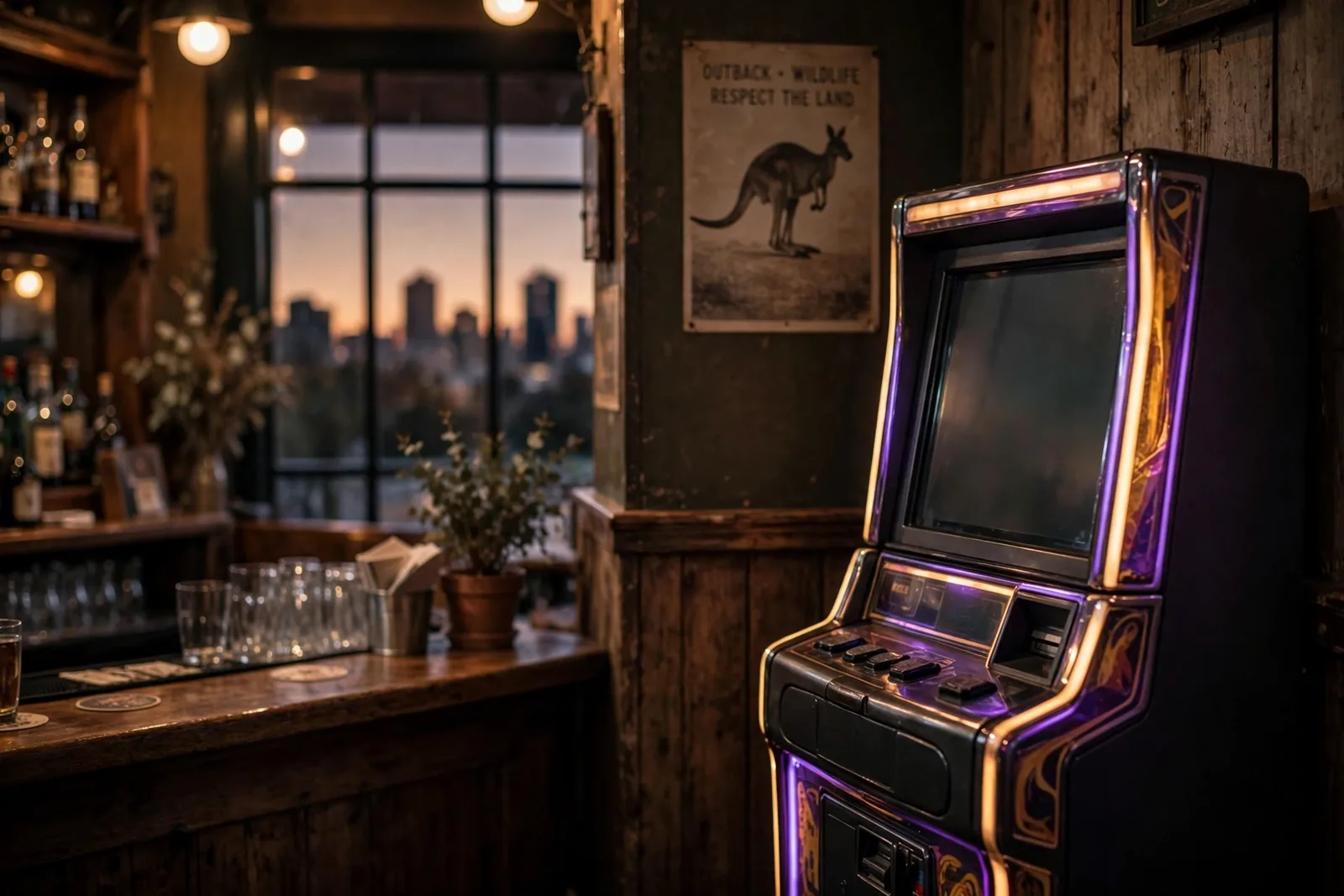
Lightning Link is an Aristocrat game series made by an Australian developer. In Australia, its established setting is a venue machine, not an online real-money game. That distinction matters: the name may appear in searches for online play, but the game is not offered online for real money to Australian players.
The boundary is legal as well as practical. The Interactive Gambling Act 2001 makes it unlawful for operators to provide specified real-money interactive gambling services to people in Australia. These include online poker and casino-style games. The prohibition covers services such as pokies, blackjack and roulette when they are supplied online to Australian customers. It is directed at the businesses providing the service, not at a local venue machine bearing a familiar title.
That difference can be easy to miss when the same game name is used across conversations about venues and the internet. A physical machine in an Australian venue and an online casino-style service are not interchangeable forms of access. The first is where Lightning Link is played in Australia; the second would fall within the federal restrictions if offered for real money to people here. A page using the game’s name does not change that legal line.
Choosing an online pokies site involves more than the page title: check the operator details that matter to you before deciding where to play. This list provides a concise reference for readers considering Lightning Link online pokies in Australia in 2026.
Playfina Casino
Playfina Casino is listed with a Curacao eGaming license held by Hollycorn N.V. since 2017. Its minimum deposit is A$20–30, depending on the offer.
Kingmaker
Kingmaker lists crypto payouts at around 90 minutes and fiat payouts at 1–5 days. Its minimum deposit is A$30.
Ricky Casino
Ricky Casino lists crypto payouts in under an hour and PayID payouts in 1–3 business days. The minimum deposit is A$20, or A$30 to qualify for the bonus.
LevelUp Casino
LevelUp Casino is listed with Curacao eGaming license OGL/2023/174/0082, held by Dama N.V. Its minimum deposit is A$15.
WinSpirit Casino
WinSpirit Casino is listed with Curacao eGaming license OGL/2024/923/0383, held by Antillephone N.V. Its minimum deposit is A$30.
JustCasino
JustCasino is listed with a Curacao Gaming Control Board license.
MrPacho
MrPacho lists crypto payouts at 30–120 minutes and fiat payouts at 24–72 hours. Its minimum deposit is A$30.
Bizzo Casino
Bizzo Casino is listed with a Curacao Gaming Control Board license, with TechSolutions Group N.V. identified as the operator.
7Bit Casino
7Bit Casino is listed as operating under a Curacao license, with Dama N.V. as its operator.
Roby Casino
Roby Casino is listed with a Curacao eGaming license held by Roby Games Ltd.
The Act places the compliance burden on operators. Australian players have not, as far as known cases indicate, been prosecuted simply for gambling on offshore websites. That is not the same as approval, protection or a guarantee about every circumstance. It means the law’s enforcement model is aimed at the supply of prohibited services rather than treating the individual player as its principal target. The distinction is important, but it does not turn an offshore service into a lawful Australian offering.
The federal regulator is the Australian Communications and Media Authority, usually called ACMA. It monitors compliance with the Interactive Gambling Act and takes enforcement action against prohibited services and their advertising. One of the tools available to it is a request to internet service providers in Australia to block websites that provide prohibited interactive gambling services or advertise them. Blocking does not make the legal issue disappear; it is a practical measure intended to restrict access to material that breaches the rules.
The scale of that work is visible in ACMA’s published enforcement figures. Following actions taken since November 2019, the regulator has blocked more than 1,455 illegal gambling and affiliate websites. The number of services that have left the Australian market since enforcement began in 2017 is reported inconsistently: one figure puts the total above 210, while another says more than 190. Both describe withdrawals following regulatory pressure.
The figures also explain why an online page can be present one day and inaccessible later. Enforcement is not only a statement of policy; it affects whether services and associated promotional sites remain reachable from Australia. ACMA’s blocking requests are part of that process. A website’s temporary availability, or the appearance of a familiar game title there, is not evidence that the service is permitted to provide online casino-style gambling to Australians.
This is a narrow but consequential distinction. Lightning Link belongs to a series created by an Australian company and encountered on venue machines in Australia. The federal online boundary concerns operators supplying prohibited gambling services to people located here. It does not rest on whether a game was designed locally or whether its name is recognised by local players. The governing question is what kind of service is being provided, and to whom.
The law also shapes what can responsibly be said about online access. A description of the game’s Australian presence should not be confused with an invitation to find an offshore casino or a suggestion that one is an approved substitute. There is no real-money online Australian version of Lightning Link to direct players toward. The venue context is the relevant one for the game in this market.
This page is affiliate-linked and may contain sponsored recommendations. That disclosure does not endorse prohibited online gambling services or alter the legal position described here. Real-money gambling content is for adults aged 18 and over; age does not make a prohibited online service lawful in Australia.
Legal Warning
Under the Interactive Gambling Act 2001, it is unlawful for operators to provide real-money interactive gambling services, including pokies, to people in Australia.
The line is plain, even if the internet is not.
“Free” can describe the price of entry, the currency on screen, or the absence of a cash prize. Those are not the same thing. In social-casino play, pokies-style games use virtual currency, and a player cannot win real money. Under the Interactive Gambling Act, that distinction means such platforms are not treated as gambling: the familiar visual language may remain, but the cash outcome does not.
That boundary matters for anyone looking for a free version of Lightning Link. A screen can show reels, symbols and a running balance without that balance being money. Virtual credits belong to the game’s own economy. They may let a session continue, but they do not become a cash balance merely because the display resembles one. The distinction is not decorative. It changes what the activity is.
A social version may offer the rhythms associated with pokies: a button press, a result, a change in the credit total, then another decision about whether to continue. Such a sequence can feel recognisable while remaining separate from gambling for money. The resemblance is precisely why the terms deserve attention. On-screen familiarity is not proof that two experiences have the same legal or financial character.
The phrase “free play” can also mean a demonstration mode, where a game is shown without a cash stake. That is different from a social-casino platform built around virtual currency, though both can lack cash prizes. Without a cash award, the main question is not whether the screen looks authentic, but what the credits represent and whether anything of monetary value can be won. A displayed number, on its own, settles neither point.
For Lightning Link in particular, the wording used to describe a free online version should not be mistaken for confirmation that a particular platform offers the title. A social-casino environment may contain pokies-style games, but that general fact does not establish the availability, identity or terms of any specific game. Names and graphics can be borrowed, adapted or used for games with similar themes. The label on a page is less informative than the rules attached to the play.
Virtual currency also makes “free” a limited description. It signals that the play does not award cash; it does not necessarily explain how credits are supplied, whether they are replenished, or what features sit behind them. Those details vary between platforms and cannot be inferred from the word alone. The important dividing line remains the prize: where the result cannot yield real money, the activity differs from gambling for money under the IGA.
That difference does not erase the cultural likeness. Social play can preserve the bright, repetitive grammar of the pokies while removing the monetary result. It offers the shape of a familiar pastime in a setting where the balance is symbolic. There is a small irony in this: a game can retain the apparatus of chance while the law’s classification turns on what the player can take away. The screen may look busy. The prize is absent.
In social-casino play, pokies-style games use virtual currency, and a player cannot win real money, which means these platforms are not treated as gambling under the Interactive Gambling Act.
This distinction is useful when comparing descriptions of free Lightning Link play. “Online,” “demo” and “social” are not interchangeable terms, and a page using them does not by itself establish whether play is simulated, uses virtual credits or offers a cash prize. The decisive point is whether the platform allows winnings to be received as money. For social-casino platforms offering pokies-style games with virtual currency, players cannot win real money, so the IGA does not treat that activity as gambling.
A cautious reading of the word “free” is therefore less about suspicion than precision. It separates a no-cash-prize pastime from a service in which money is staked for a monetary outcome. It also prevents virtual credits from being mistaken for deposits, winnings or a promise of future value. The resemblance may be deliberate; the distinction is still real.
This page is affiliate-linked and may contain sponsored recommendations. That disclosure does not change the distinction between virtual-currency play and gambling for money. Anyone accessing real-money gambling content must be at least 18 years old.
Lightning Link is a game series created by Australian developer Aristocrat. That distinction matters: the name refers to a family of games, not necessarily one identical machine or one fixed version wherever it appears. The singular form is convenient in conversation, but it can conceal the fact that a series has more than one expression.
The distinction is familiar beyond gambling. A product name can become shorthand for a whole category, while the things sold under that name remain separate editions. In the case of Lightning Link, the shared label identifies the series and its developer; it does not, by itself, settle which particular version is being discussed. The name is a beginning, not a full description.
That small piece of precision helps untangle the many ways people refer to Lightning Link pokies. A person asking about a Lightning Link pokie may mean the series generally, rather than one specific title. The same is true of phrases such as “online Lightning Link” or “Lightning Link online pokies”: they can blur the identity of the game with the question of where it can be accessed. Those are different matters. The series name tells what is being named; it does not establish the setting or terms under which a particular version can be played.
There is a cultural detail in the developer’s identity, too. Aristocrat is Australian, as is the game series it created. That does not make every use of the name an Australian product in the everyday sense, nor does it answer questions about access. It does place Lightning Link within a local history of game development, rather than making it merely a phrase encountered in an international catalogue. The distinction is modest, but useful: origin and availability are not interchangeable.
The word “series” can sound bureaucratic, as if it belongs on a filing label. Here it performs a practical task. It stops the name from carrying more certainty than it can bear. A familiar label may make different versions seem interchangeable, especially when people discuss them loosely as “Lightning Link.” Yet naming the family is not the same as identifying a particular member of it. Careful description begins by keeping those two levels apart.
Lightning Link is a family of games created by Aristocrat, meaning the name refers to a series rather than one identical machine or fixed version. This distinction explains why different versions may exist despite sharing the same series name.
This matters particularly when the phrase is used in online contexts. A mention of Lightning Link online pokies may describe a search for the game, a reference to a related product, or a discussion of the series as a whole. The wording alone cannot prove that the original game is available in that context. Nor can a familiar name turn a similar game into Lightning Link itself. Recognition is not evidence of equivalence.
For the same reason, “Lightning Link slots” is less precise than it appears. It may be used informally to point toward the series, but the broad label does not identify a specific version. In writing about pokies, a little restraint with categories helps prevent a common confusion: the name of a series is not a guarantee that every product carrying a resemblance shares its identity.
The essential description is therefore straightforward. Lightning Link is a series by Australian developer Aristocrat. Beyond that, the name alone should not be asked to do too much. It does not specify a particular version, prove online availability, or answer where a machine is encountered. Those questions belong to separate parts of the subject.
The page carries affiliate links and may include sponsored recommendations. Anyone accessing real-money gambling content must be at least 18 years old. Neither statement changes what Lightning Link is: a series with a name, a developer and a place in Australian game-making. The rest depends on which version and setting is meant.
In Australia, Lightning Link belongs to the physical venue rather than the online casino. Its presence is on venue machines; it is not offered for real-money online play to Australian players. That distinction is more than a question of screen size. It places the game within a particular social setting: one where entertainment is encountered in a public place, attached to the routines and rules of that venue.
The word “venue” can sound almost featureless, as though a machine were simply waiting in a room. But the setting shapes the experience. A physical machine is part of a shared environment, even when play itself is solitary. People arrive for different reasons, pass through the same space and may notice the same glowing cabinet without having the same relationship to it. The game’s Australian presence is therefore not a matter of an identical product appearing everywhere in the same way; it is a matter of a series designed for land-based play being encountered through venues.
That is the practical answer to the question of where Lightning Link is found in Australia. It is played on venue machines. A search for an online version can blur two separate ideas: a game that exists in a recognisable digital form and a game that is available for real-money play to people in a particular country. Those are not interchangeable. In this market, the venue machine is the relevant setting.
The distinction also resists a familiar assumption about technology: that a game becomes more accessible simply by moving onto a phone or computer. A screen may resemble another screen, and a familiar name may travel easily, but availability depends on more than visual resemblance. For Australian players, Lightning Link’s real-money setting remains the venue. The online version people may imagine is not an equivalent route to play.
The physical environment gives the machine a visible address. Online services can be encountered in private, detached from the place where the operator is based; a venue machine, by contrast, is encountered within the premises that host it. That does not make the experience risk-free or socially neutral. It does make the context harder to mistake: this is a machine situated in a venue, not an invitation to treat every online use of the same name as the same product.
There is a small cultural irony in that difference. Digital life is often described as the great dissolver of distance, yet the Australian version of this particular experience remains tied to a place. Its reach is not measured by how readily a screen can be opened. It is measured by its presence on venue machines.
That boundary matters when people use broad phrases such as “Lightning Link online.” They may be looking for a visual imitation, a game with related mechanics, or the original title itself. Those categories can be confused in casual conversation, but they do not alter where the original is available for real-money play in Australia. The venue is not a nostalgic detail attached to an otherwise online product. It is the setting in which Australian players encounter Lightning Link.
This section is affiliate-linked and may contain sponsored recommendations. No online casino recommendation is made here. Real-money gambling content is restricted to people aged eighteen or older; that age threshold does not change the distinction between venue play and online availability.
The machine stays put.
Lightning Link is not available online for real-money play to people in Australia. Its Australian setting is the venue machine, not a website or a real-money app. That distinction matters because a page, advertisement or offer describing “real money” play does not change the game’s availability or the law around online casino-style gambling.
Under the Interactive Gambling Act 2001, operators cannot provide real-money online casino games, including pokies, to people in Australia. The law is directed at providers, rather than treating an individual player as the target of enforcement. The Australian Communications and Media Authority monitors compliance and can ask internet service providers to block access to prohibited services and advertising. Access and legality are not the same thing.
The bonus figures that appear in discussions of offshore real-money gambling need similar care. They do not establish a route to Lightning Link online, and they should not be read as a current or universal offer. A specialist review describes wagering requirements in the range of 30x to 50x the bonus amount, with some offers carrying requirements as high as 70x. These are terms reported in that kind of review, not a promise that any particular offer exists or applies in Australia.
A wagering requirement sets how much qualifying play must take place before bonus funds, or winnings attached to them, can be withdrawn. The multiplier applies to the bonus amount under the stated terms; it does not mean that the balance is simply available after accepting an offer. Terms may also define which games count, whether a maximum stake applies, and what happens when the requirement is not met. Those details can alter the practical value of an advertised bonus.
Expiry is another condition, not a decorative footnote. A specialist review reports bonus expiry periods from 7 to 30 days. That range is a report from a particular type of source, not a fixed rule across operators or a reliable description of every current promotion. The specific terms govern an offer, and an expired bonus may no longer be usable. Time limits can make a headline figure look more generous than the conditions feel in practice.
None of these bonus mechanics makes a real-money Lightning Link game available to Australian players. Nor does an offer attached to some other online game turn it into the Aristocrat venue title. The language of promotions can blur those distinctions; the legal and practical setting does not.
This page is affiliate-linked and may contain sponsored recommendations. That disclosure does not endorse or advertise an online casino service. In Australia, real-money gambling content is restricted to adults aged 18 or over, while online casino-style services remain prohibited for operators to provide to people in the country. The distinction is plain, if less marketable than a bonus banner.
The word “app” can make a familiar venue game sound as though it has simply moved into a phone. For Lightning Link, that is not the Australian arrangement: the game is played on venue machines and is not offered online for real money to Australian players. A mobile listing or a page using the game’s name does not change that distinction.
The difference matters because an app can refer to several things: a venue operator’s general-purpose app, a game played with virtual currency, or an online gambling service. Those are not interchangeable. A title or image that resembles Lightning Link is not evidence that Aristocrat’s venue game has become a lawful real-money app for Australians. Online casino-style gambling services are prohibited when supplied to people in Australia.
There is also a broader mobile catalogue of games built around Hold and Spin. A specialist review describes online platforms as offering similar mechanics from Aristocrat and other developers, but those are separate games, not a portable version of Lightning Link. Their symbols, presentation and rules may differ; the shared feature is the general bonus format, not identity of product. That distinction is easy to blur on a small screen, where a familiar mechanic can do the work of a familiar name.
So-called tips attached to an app do not turn chance into a dependable method. They may describe how a particular game works, but they cannot establish a reliable way to secure a result. For the same reason, a listing for Happy Lantern should not be treated as proof that the venue variant is available as an Australian real-money download. A matching name or theme is not enough to establish what is being offered.
Attention: A mobile app listing or a similarly styled game does not make the original venue game a lawful real-money download for Australian players.
The legal line is about the service, not the size of the screen. A phone does not make prohibited online casino gambling permissible. Any real-money gambling content is for adults aged 18 or over, but that age threshold does not make an online casino service lawful in Australia.
This page may contain affiliate links and sponsored recommendations. That disclosure does not endorse or promote an online gambling service; the distinction between a venue machine and a similarly styled mobile game remains the important one.
The Major and Grand jackpots are part of Lightning Link’s appeal, but their presence does not turn a stake into a forecast. A specialist review describes both jackpots as increasing over time as people wager on linked machines. That links their growth to activity across the machines, rather than to a sequence of results on one individual machine. The review does not make the next outcome predictable.
Eligibility can also be conditional. A specialist review notes that a jackpot may require a maximum bet. The condition matters: a smaller stake may not qualify for that jackpot, while betting at the maximum does not make a win certain. It changes the terms of eligibility, not the odds by magic.
That distinction is where talk of how to win on Lightning Link pokies tends to outrun the mechanics. A larger bet can meet a stated condition, but it cannot guarantee a jackpot or create a reliable pattern. The Major and Grand remain prizes tied to the linked game, not rewards that can be summoned by timing, persistence or a particular betting sequence. A strategy cannot make uncertainty disappear.
In Australia, Lightning Link is played on venue machines; it is not offered online for real money to Australian players. The jackpot structure is therefore relevant to the physical game, not a promise attached to online Lightning Link games. Real-money gambling content is for adults aged 18 and over.
Fairgoslotshubau.com’s content is affiliate-linked and may include sponsored recommendations. That disclosure does not change the distinction between explaining a jackpot condition and promising a result. The former is useful context. The latter would be fiction.
Hold and Spin changes the rhythm of a Lightning Link round. A specialist review describes the feature as a sequence in which positions carrying special symbols remain fixed while the other positions spin independently. The board is no longer moving as one field: some symbols stay put, and activity continues around them.
That separation is the point of the feature. A locked symbol gives the eye a fixed reference while the remaining spaces change. Each independent spin can alter one part of the display without dislodging the symbols already held. The result is a round built around contrast: stillness in some positions, motion in others.
It is a small mechanical distinction, but it changes how the action reads. A conventional spin presents a fresh arrangement across the whole display. Hold and Spin instead lets a round accumulate a visible pattern, with each new result judged against what has stayed in place. The player follows both the symbols that have settled and the spaces still turning.
Hold and Spin Process
Symbol Locking
Special symbols that land on the reels remain fixed in their positions.
Independent Spinning
While the special symbols are held, the remaining positions on the board spin independently.
Pattern Accumulation
New symbols are added to the display with each spin, building a pattern against the symbols already in place.
That describes the feature, not a method for influencing it. The independent movement of open positions does not make a particular result predictable, and a locked symbol is not a promise that another will appear. The appeal is in watching the arrangement develop, not in discovering a sequence that can be controlled.
People looking to play Lightning Link online may encounter descriptions of this mechanic, or similar features in other games. That does not make the original venue game an online real-money option for Australians. Here, the sequence is best understood as part of the machine’s design, rather than as an online instruction set.
The distinction matters. Rules explain what the display does; they do not turn a game into a strategy. The symbols hold. The outcome remains uncertain.
This article is affiliate-linked and may contain sponsored recommendations. Real-money gambling content is for people aged 18 and over.
A specialist review gives a minimum-bet range of $0.20 to $1.00 per spin, varying with the venue and version of Lightning Link. That is a reported range, not a fixed price attached to every machine. The amount shown on a particular machine is the practical reference; a figure quoted elsewhere cannot establish what a venue offers.
The wish to download Lightning Link is understandable in a culture where games are expected to travel with their players. But the original game is encountered on venue machines in Australia, not as a real-money download for Australian players. A file or app described as Lightning Link does not, by its label alone, make it the same game or provide an authorised route to play for money.
The distinction is easily blurred by names. Searches for a download may lead to social play, lookalike titles or games with familiar mechanics, none of which changes the status of the original. Nor does the phrase “Lightning Dollar Link” establish that a downloadable version is available. Branding travels more freely than a machine.
In Australia, the physical venue remains the setting for real-money play of Lightning Link. A request for a download therefore meets a boundary, not a hidden installation step. That boundary is part of the game’s location: the machine is present where gambling is permitted under the applicable venue arrangements, while online casino-style services for Australian players are prohibited. A screen can imitate a cabinet; it cannot relocate the law.
A specialist review identifies Happy Lantern, Magic Pearl, Sahara Gold and High Stakes among the familiar Lightning Link variants. Their names suggest distinct settings, but the meaningful differences lie in the paytables and bonus features rather than the artwork alone. A title is a label, not a guide to its rules.
Paytables set out how symbol combinations correspond to outcomes; bonus features shape what can happen beyond an ordinary spin. Both can vary across the series, so two games sharing the Lightning Link name should not be treated as identical. Nor does a more elaborate theme, by itself, indicate a better paytable or a more rewarding feature. The distinctions are specific to each variant.
That leaves a modest but useful way to understand the range: the games belong to one series, while their individual layouts of rewards and bonus play differ. The names commonly encountered in specialist coverage offer a starting point for recognising that variety, not a ranking. No single title can stand in for the whole family.
In Australia, Lightning Link is encountered on venue machines, not as a real-money online game. The variants therefore remain differences within a land-based series, rather than a catalogue of online pokies. Players must be at least 18 to access real-money gambling content.
This article is affiliate-linked and may contain sponsored recommendations. It does not recommend online casino services.
No, operators cannot legally provide online casino-style gambling services, including pokies, to people in Australia under the Interactive Gambling Act 2001. The Act targets providers; that does not make offshore services approved or lawful.
Lightning Link bet sizes typically range from $0.20 to $1.00 per spin, depending on the variant and platform. However, Lightning Link is not offered online for real money to Australian players.
No. Lightning Link is a venue-machine game in Australia, and there is no real-money online Australian version; other online games may use similar Hold and Spin mechanics.