Learn how live baccarat hands are scored, what distinguishes table formats, and how to assess casino features and online-play limits in Australia.
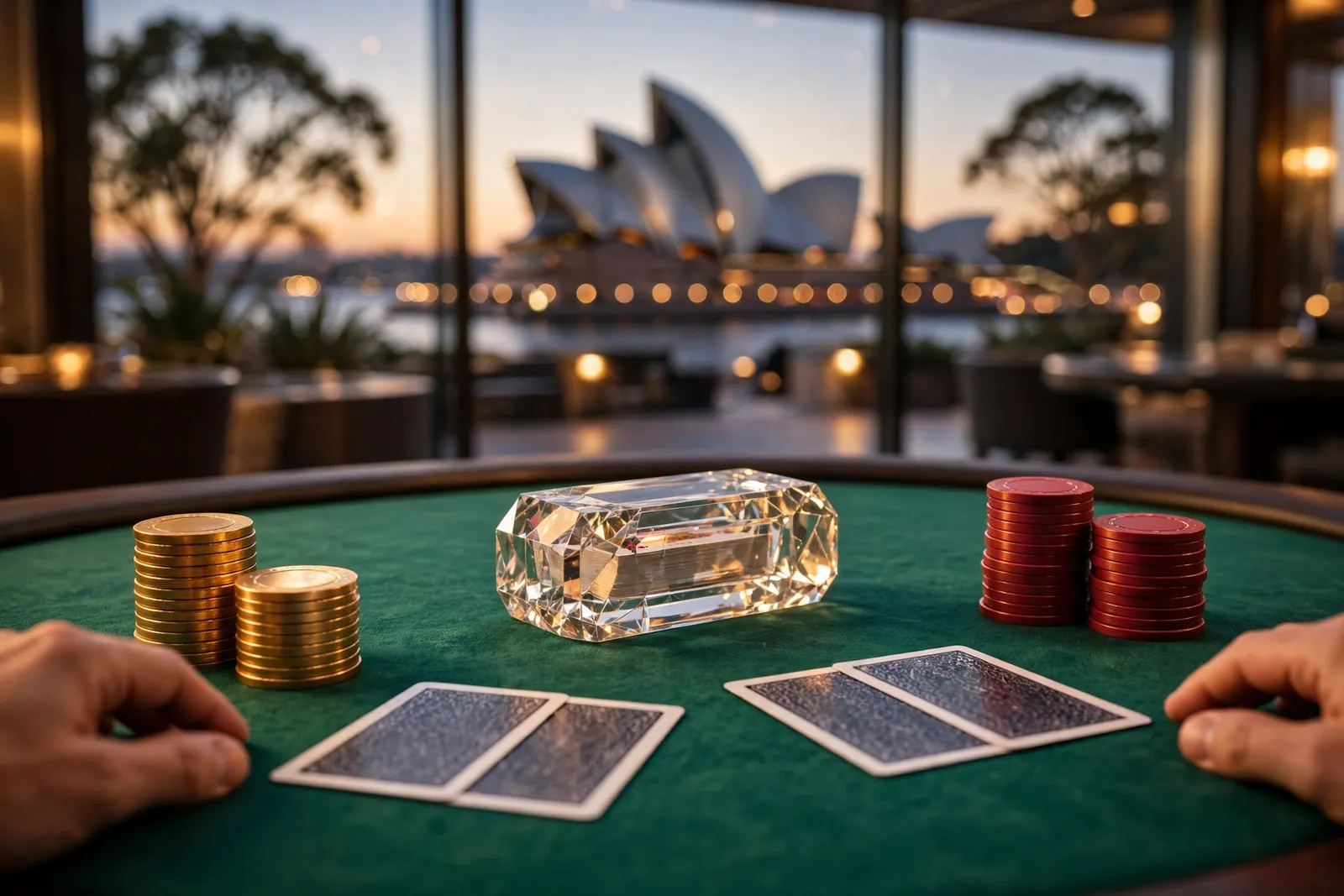
Baccarat asks players to predict which of two hands will finish nearer nine: the Player hand or the Banker hand. A third choice is a tie, when the totals match. These are bets on the result, not decisions about how to build a hand. The rules leave that arithmetic to the game.
Cards are added, but only the final digit matters. If a hand’s sum passes ten, its left-hand digit is discarded: a total of twelve, for instance, counts as two. Picture cards count as zero, so their presence does not lift a hand’s total. The same small scale governs every comparison; a hand does not need to reach nine to win, only to sit closer to it than the opposing hand.
That makes baccarat casino rules unusually spare in one respect. There is no choice between taking another card and standing, as there is in some other card games. The contest is settled by comparing the resulting totals, with the closest to nine taking the hand. If neither side is closer because the totals are equal, the tie bet corresponds to that outcome.
Choosing a live baccarat casino involves more than finding a table: check the operator details that matter to you, such as licensing information, minimum deposits and payout options. Use this list as a reference when deciding where to explore the game.
Playfina Casino
Playfina Casino is listed with a Curacao eGaming license held by Hollycorn N.V. since 2017. Its minimum deposit is A$20–30, depending on the offer.
Kingmaker
Kingmaker lists crypto payouts at around 90 minutes and fiat payouts at 1–5 days. The minimum deposit is A$30.
Ricky Casino
Ricky Casino lists crypto payouts in under an hour and PayID payouts in 1–3 business days. The minimum deposit is A$20, or A$30 to qualify for the bonus.
LevelUp Casino
LevelUp Casino is listed with Curacao eGaming license OGL/2023/174/0082, held by Dama N.V. Its minimum deposit is A$15.
WinSpirit Casino
WinSpirit Casino is listed with Curacao eGaming license OGL/2024/923/0383, held by Antillephone N.V. Its minimum deposit is A$30.
JustCasino
JustCasino is listed with a Curacao Gaming Control Board license. No other operator details are provided here.
MrPacho
MrPacho lists crypto payouts at 30–120 minutes and fiat payouts at 24–72 hours. Its minimum deposit is A$30.
Bizzo Casino
Bizzo Casino is listed with a Curacao Gaming Control Board license, with TechSolutions Group N.V. named as operator. No other operator details are provided here.
7Bit Casino
7Bit Casino is listed as operating under a Curacao license, with Dama N.V. named as the operator. No other operator details are provided here.
Roby Casino
Roby Casino is listed with a Curacao eGaming license held by Roby Games Ltd. No other operator details are provided here.
The labels can sound like people at a table, but Player and Banker name the two hands, not the people placing wagers. The structure is almost clerical: choose a side, let the totals be counted, and see which is nearer the fixed destination. Nine is the whole horizon.
Live dealer baccarat begins in a studio, not inside a computer’s account of a deck. A professional dealer handles physical cards at a table, while a camera stream carries the game to a virtual table on screen. The image is digital; the cards being dealt are not. That distinction is the format’s central promise of presence, and also its most important practical difference from RNG baccarat.
In RNG baccarat, software determines outcomes through an algorithm. There is no physical hand of cards for a camera to show. A live table instead puts a human dealer and real cards at the centre of the broadcast. The software still has a role: it provides the online setting in which the stream and the virtual table appear. But the source of the dealt cards is a studio table rather than an algorithm.
The arrangement sits between two familiar ideas of a game. Baccarat has long depended on a compact set of rules and a visible act of dealing; online play adds the convenience of a screen without replacing that act with simulated cards. The studio becomes a kind of theatre, though not one in which the outcome is scripted. The dealer performs the game’s procedure, while the camera makes that procedure legible at a distance.
That visible dealing matters because online play can otherwise flatten distinctions. A card image in a software game and a card shown on a live stream may look similar when reduced to pixels. Their origin differs. In a live dealer game, the image is a broadcast of a physical card being handled; in RNG baccarat, the result comes from software. The screen presents both, but it does not make them the same kind of event.
The virtual table is therefore more than a decorative surface. It is the point where the streamed studio and the player’s online game meet. The dealer remains in the studio; the player encounters the table through the platform. This division makes live baccarat neither a conventional casino table nor simply a software simulation. It is a remote presentation of a physical game, arranged for online viewing.
The word “live” can suggest a directness that the format does not quite offer. The cards are real, and the dealer is present at the studio table, but the experience reaches the viewer as a stream. The camera is the intermediary. That small distance is not a flaw so much as the condition of the format: a real table translated into a screen image, with the familiar ritual of dealing preserved in a new setting.
There is a cultural bargain in that translation. Software offers an outcome generated inside the device; a live studio offers an outcome attached to a visible human action. One asks for confidence in a system’s operation, the other supplies a scene that can be watched. Neither form makes a game free of chance. Their difference is about how the game is produced and presented, rather than a promise that one can control what happens.
The studio also gives the online table a particular texture. A physical deck has edges, faces and a place in space; a software result is rendered as an image. The stream lets those physical objects enter the online setting, though only through the camera’s view. It is an old ritual carried by modern infrastructure. The table travels without moving.
That is why live baccarat online is best understood as a hybrid format. It is not a remote player handling cards, nor a computer simulating a dealer. It is a professional dealer handling physical cards in a casino studio, with the game carried to a virtual table by video. The distinction is plain, even if the screen makes it easy to overlook.
This is a description of a gambling format, not an invitation to use it. Gambling can cause financial harm, and Fairgoslotshubau.com is not liable for losses. 18+ only.
A live dealer baccarat session has a public rhythm, even when watched alone. The camera carries a real dealer’s movements to a virtual table: cards are handled on screen, and the dealer’s prompts mark the moments when betting opens and closes. The viewer is not simply watching a replay. The stream follows a hand as it unfolds, with the table’s small pauses and transitions becoming part of the experience.
Those prompts give the session its social timetable. A hand is not an isolated result appearing without warning; there is a period of attention before the deal, then a change in pace as cards are revealed. The dealer’s voice and gestures organise that interval for everyone at the table. In a physical room, the same signals would be part of the furniture of play. On screen, they are carefully delivered cues, carried across a webcam stream.
The dealer does not become a companion merely by being visible. Their role is practical: to present the cards and guide the session through its stages. That formality is part of the appeal. The table is designed to feel shared, but the interaction remains bounded by the game’s procedure. A prompt is not a conversation; it is an invitation to follow the next step.
Some live games may also provide chat between players and the dealer, or among players themselves. A specialist review describes this as an available feature in some settings, not a guaranteed part of every session. Where it is present, chat can add a thin layer of company: greetings, short remarks, the occasional reaction to a hand. It can also remain unused. Silence is a perfectly ordinary form of participation.
That optionality matters. A live table borrows the look of a room without requiring everyone in it to perform sociability. The camera offers faces, hands and a shared field of attention; the chat box, if provided, offers a separate channel. One can be present in the session without turning it into a conversation. The social arrangement is modest, but deliberate.
A live dealer session's social interaction is modest and optional; players can engage via chat or remain silent while following the dealer's prompts.
Time, meanwhile, is less flexible than the screen suggests. A stream can make a table appear continuously available, yet a specialist review notes that schedules may impose restrictions. The timetable for a particular game therefore matters to its availability; a live feed is not the same thing as an endless service. There is a quiet contrast here between the immediacy of the image and the ordinary limits of operating hours.
The pace also belongs to the people watching. A dealer’s prompt gives a brief interval for attention, while the reveal draws that attention back to the table. The experience is therefore not only about seeing cards move. It is about waiting together, however loosely, and recognising the same cue at the same moment. That shared timing can make a solitary screen feel less solitary, without making the participants a community.
The format’s intimacy has a boundary. A dealer can be seen and heard, but the relationship is mediated by a camera, a table interface and whatever interaction the game makes available. The performance is live; the setting remains remote. A room, translated into a screen.
Live dealer gambling is for adults aged 18 and over. Gambling can cause financial harm, and participation carries a risk of losing money. Fairgoslotshubau.com is not liable for losses.
The distinction between live dealer baccarat and RNG baccarat is not a choice between two sets of card values. It is a difference in how a round is produced. In live dealer baccarat, a professional dealer handles physical cards at a streamed table. In RNG baccarat, algorithm-based software determines the outcomes; no real cards are dealt for the round.
That difference changes the texture of the game. A live table places the result in a visible sequence of actions, while RNG baccarat presents an outcome generated by software. Neither description, on its own, says anything about whether a particular result is favourable. The format is not a forecast.
International casino platforms may offer both kinds of baccarat. Their shared name can make them seem interchangeable, but the distinction matters to anyone comparing a streamed table with a software version. One has a dealer and cards in view; the other has an algorithm at its centre. The underlying game remains recognisable, while its presentation and mechanism differ.
The names can also conceal variations within live dealer baccarat itself. No Commission Baccarat, for instance, changes the settlement of winning Banker bets. In the conventional version, a winning Banker wager is subject to a commission; this variant removes that charge. The phrase sounds like a small administrative mercy. It is not the whole rule.
A specialist review describes No Commission Baccarat as potentially adjusting payouts for certain Banker totals instead. That is the detail to keep in view: removing commission does not necessarily mean every winning Banker bet receives the same return as it would under the standard arrangement. The precise treatment depends on the table’s stated rules, so the label alone cannot settle how a winning hand is paid.
Attention: Removing the commission in No Commission Baccarat does not necessarily mean every winning Banker bet receives the same return, as payouts for certain totals may be adjusted.
This is a familiar bargain in games of chance: one visible deduction disappears, and a less conspicuous condition may take its place. The change is not inherently better or worse. Its meaning depends on the particular payout schedule, especially the totals singled out by the table rules. A player who notices only the absence of commission may miss the more consequential part of the arrangement.
The distinction also explains why “baccarat” is not always a complete description of the product. A software-generated round and a live streamed round belong to different formats; a commission-free table adds a further rule variation to the live version. These labels describe separate things: the mechanism that produces the round, and the terms on which a particular bet is settled.
There is no need to treat No Commission Baccarat as a wholly new game. Its central identity remains baccarat, but its payout terms are altered. The sensible point of comparison is not the reassuring sound of the name, but the written settlement rules for Banker wins. A familiar table can carry an unfamiliar condition.
Formats and variants, then, answer different questions. RNG baccarat identifies software-generated outcomes rather than physical cards dealt by a live dealer. No Commission Baccarat identifies a change to commission and, potentially, to payouts on certain Banker totals. Keeping those categories separate makes the label easier to read—and harder to mistake for a promise.
A baccarat table can look much the same from one screen to another, while the terms around it differ in ways that matter before a hand begins. A useful comparison starts not with a claim of being “best”, but with the conditions attached to play: the stake range, the wallet currency, and the rules that apply to deposits and withdrawals. These are practical distinctions, not a recommendation to use an online casino.
In Australia, that distinction matters. The Interactive Gambling Act 2001 prohibits operators from providing real-money online casino games to people physically in the country. There are no locally licensed online casinos officially operating here. The criteria below describe what a platform’s terms may contain; they do not turn an offshore service into an authorised one.
A table’s minimum stake determines whether its entry point fits a player’s budget. Its maximum can matter just as much: a table may be unsuitable if its permitted range is either too high or too low for the way someone intends to play. The displayed limits should be checked for the particular table, rather than inferred from a general description of a casino.
One specialist review reports live baccarat minimums of $5–$10 per hand and describes $1 tables as uncommon. That is a report about the tables it surveyed, not a fixed market standard. Availability can vary, so the figure is best treated as a prompt to inspect the table rules rather than a promise of what any particular lobby will offer. VIP tables, where available, may sit at a very different scale; a specialist review reports that some casinos set their limits as high as A$20,000 per bet. That, too, is a reported feature of some offerings, not a typical threshold.
The point of comparing limits is not to find the largest table. A high ceiling says little about whether a game suits a player’s budget; a low minimum does not make gambling financially safe. Stake size is one part of the terms, not a verdict on the platform.
A wallet denominated in Australian dollars avoids the conversion margin that can apply when balances are held in US dollars or euros. The reported margin on those balances is 2.5–4%. Currency choice therefore affects the amount represented by a deposit or withdrawal, even before the game itself enters the picture.
The unit shown in a wallet can also shape how clearly transactions are understood. A balance that matches the currency used for everyday spending is easier to compare with incoming and outgoing amounts than one that changes value as exchange rates and conversion charges apply. That is a matter of accounting clarity, not an advantage in the game.
A comparison should distinguish the currency of the wallet from the currencies displayed in promotional material or on a table. The relevant terms are those governing the actual account balance and its conversion. If a platform’s wording leaves that relationship unclear, the uncertainty is itself worth noticing.
A casino’s presentation may foreground the tables, but the terms determine how money moves around them. Minimums, maximums and currency treatment belong beside the game description in any careful assessment. So do the conditions that govern account transactions. Clear wording makes those conditions easier to understand; attractive graphics cannot do that work.
This is not a winners’ roll call. A ranking would imply that one platform is suitable across different budgets and circumstances, when the decisive details are individual and can change. More importantly, a polished comparison cannot resolve the legal position of real-money online casino play in Australia. An offshore platform’s accessibility does not make its offer locally licensed.
The restrained approach is to treat every advertised feature as a claim to be checked against the applicable terms, and every stake as money that can be lost. Baccarat remains gambling, not a method of managing a budget. No online casino is endorsed here; Fairgoslotshubau.com is not liable for gambling losses.
18+ only. Gambling can be harmful and carries a financial risk.
A baccarat lobby is more than a row of attractive table tiles. It is the part of a site that tells players whether a table is available, what pace it runs at and when it can be accessed. Without those details, a catalogue is decoration pretending to be a timetable.
The distinction between standard and Speed tables matters because pace changes the shape of a session. A specialist review puts standard live baccarat at around 40–50 hands an hour, while Speed tables exceed 80. Those figures are estimates, not a promise of an exact rhythm: dealing, pauses and the flow of a particular table can all affect how quickly a session moves. Still, the gap is large enough to make a speed label useful rather than ornamental.
Faster play compresses the time available between hands. A table that looks identical in a small lobby tile may therefore offer a substantially different experience once opened. Clear labels should identify the format before entry, with the table’s rules and limits accessible without making players hunt through unrelated menus. A lobby that hides basic distinctions leaves the work to the player. That is poor architecture.
Availability deserves the same clarity. A table may be listed but not open, or access may be restricted by its schedule. A specialist review notes that live baccarat schedules can carry time restrictions and advises checking the chosen site’s timetable. The useful information is not merely that a table exists, but when it can actually be joined. Where schedule details are buried, the lobby has mistaken inventory for service.
Good organisation also separates tables in ways that help people compare them without implying that one is universally superior. Pace, current availability and the applicable table information are practical distinctions; promotional labels are not substitutes for them. A “fast” tag means little if its meaning is unclear, and a polished image cannot tell a player whether the table is running.
The lobby, in other words, is a small piece of infrastructure: it shapes expectations before a hand is dealt. In a live format, where access depends on an operating table rather than a software screen available on demand, that information is part of the experience itself.
Adults aged 18+ only. Gambling can cause financial harm. Fairgoslotshubau.com is not liable for gambling losses.
A payment menu can look like a small map of modern Australian finance: PayID beside bank transfers, card brands beside e-wallets, and cryptocurrency at the edge. Specialist market reviews describe these as methods encountered on international gambling platforms, but their presence in a menu does not establish that a service is lawful, accessible or suitable for people in Australia. Nor does it mean every platform accepts every method.
The distinctions matter. A bank transfer and an e-wallet may move money through very different systems; cryptocurrency brings its own handling and price risks. A payment label alone says little about fees, processing conditions or the route funds take. Visa and Mastercard may appear in such reviews, but that is not an invitation to use a credit card for gambling. No payment method turns a prohibited service into a permitted one.
The phone has made the table portable, though not necessarily simple. Specialist reviews report live dealer baccarat compatibility with Android and iOS devices. The stream, table interface and payment account still depend on the platform and the device working together; a compact screen may make the table harder to follow, while a connection interruption can break the continuity that distinguishes streamed play from software dealing. The practical availability of a stream can also be affected by Australian restrictions on online casino services.
Legal Warning
Under the Interactive Gambling Act 2001, it is prohibited for operators to provide real-money online casino games to people physically located in Australia.
There is a more fundamental limit to the idea of trying a few hands on a phone. Live dealer games are often offered only for real money, a condition noted in specialist reviews. That means a free-play option cannot be assumed, and access may require a funded account. A bankroll is not merely a technical prerequisite: it changes the character of the session, turning an interface test into financial exposure.
The path from payment method to phone screen is therefore not a neutral convenience story. It joins financial infrastructure to a streamed game and places the burden of understanding the terms on the person using the service. In Australia, international platforms may accept local players, but online casino games are prohibited services under the Interactive Gambling Act 2001. Payment access and mobile compatibility should not be mistaken for local authorisation.
Eighteen-plus only. Gambling can cause financial harm; Fairgoslotshubau.com is not liable for gambling losses. Anyone experiencing difficulty controlling gambling can seek support from an appropriate Australian service.
A baccarat casino bonus can look generous in its headline and modest in practice. The relevant measure is not the advertised sum but the terms governing wagering: which games count, how much each game contributes, and what restrictions apply before a balance can be withdrawn. For live dealer baccarat, the contribution may be limited. One specialist review reports a contribution range of 5–15% toward wagering requirements; that is a report about particular terms, not a dependable rule across offers. The promotion’s own conditions determine the result.
This matters because a low contribution can make baccarat a slow way to clear a wagering requirement. A bet may count for only a fraction of its value, while the requirement itself continues to apply. A baccarat online casino bonus therefore cannot be assessed from its headline alone. The arithmetic sits in the small print, where enthusiasm tends to lose its footing.
The game’s stated house edges also differ sharply by bet. In live baccarat, the Banker wager carries a 1.06% house edge, compared with 1.24% on Player. The gap is narrow, but the Tie wager is another matter: its house edge is 14.36%. These figures describe the mathematical disadvantage built into each option over repeated play; they do not predict the result of an individual hand. A close contest on the felt can conceal a substantial difference in the underlying cost.
That distinction is useful when promotional language blurs the game’s choices into a single category. A bonus does not erase the house edge, and a higher wagering contribution would not change the odds of the bet itself. It changes only how play is counted against the promotion’s conditions. Those are separate calculations.
Bitcoin is among the payment methods available in the Australian market, alongside other forms of payment. Its presence does not alter baccarat odds or the terms attached to a promotion. A bitcoin baccarat casino search may join payment and game in one phrase; mathematically, they remain separate matters. Currency conversion, transaction conditions and bonus eligibility belong to account terms, while the house edge belongs to the game.
Gambling can cause financial loss. This site is not liable for losses incurred through gambling. For adults aged 18+ only; gambling should be treated as a risk, not a means of income. If gambling is causing harm, support is available through relevant Australian services.
A baccarat scoreboard is a record of completed hands, not a map of the hands still to come. Its appeal is easy to understand: a run of Banker wins or a succession of alternating results gives a session a visible shape. But a shape is not a signal. Each new hand is resolved on its own terms; a past sequence does not make a particular outcome more likely next.
The pace affects how quickly that record grows. A specialist review puts standard live tables at roughly 40–50 hands an hour and Speed tables above 80. Those figures describe the pace reported by that type of source, not a promise about any particular session. At the faster rate, a board can accumulate results quickly, leaving less time to pause between one mark and the next. Speed changes the rhythm, not the meaning of the record.
There is a further wrinkle in what a result actually records. Baccarat cards are counted by their point values, with picture cards treated as zero; when a hand’s total passes ten, its left-hand digit is discarded. So the visible outcome is a reduced total, not a full account of the cards dealt. A scoreboard can preserve the result of a hand while saying little about the route by which it arrived there.
That distinction matters when a sequence looks persuasive. A repeated result may feel like momentum, while a change may seem like a correction. Neither reading turns the record into a forecast. The board describes what has already happened, and its compact notation can encourage more certainty than the underlying information supports.
A useful interpretation is modest: the scoreboard can help keep track of a session’s past outcomes, especially when hands arrive rapidly. It cannot make chance legible in advance. A tidy trail of marks is still only a trail.
18+. Gambling involves financial risk; losses are possible. Fairgoslotshubau.com is not liable for gambling losses.
Australia has no locally licensed online casinos officially operating. The distinction is not between local casinos with different permissions: under the Interactive Gambling Act 2001, an Australian-licensed operator cannot provide online casino games, including baccarat, to people in Australia. The law places the prohibition on the service provider. It does not make a player criminally liable merely for using an offshore site.
International platforms may accept Australians and offer both live dealer and software-based baccarat. Their availability does not make them Australian-licensed or bring them within a local casino licensing system. Nor does acceptance of Australian customers mean access is assured: offshore casino services are actively blocked and enforcement is directed at their provision.
That creates a legal and practical gap. A familiar-looking baccarat table may sit on a service with no Australian regulator responsible for resolving a dispute over an account or withdrawal. The site’s own terms then carry particular weight, while the protections associated with a local licence are absent. The distinction is structural, not cosmetic.
Money leaving such a platform can face conditions that are easy to overlook at the point of play. A specialist review has reported weekly withdrawal caps of $5,000–$10,000 at offshore sites; this is a reported condition, not a rule applying to every platform. Caps can shape how quickly a balance may be withdrawn, and the governing terms may also set procedures or eligibility conditions. A displayed balance is not the same thing as money already received.
Baccarat’s orderly rituals can make the surrounding arrangement seem equally settled. It is not. Australian law bars operators from supplying real-money online casino games to people in the country, while international platforms that accept Australians operate outside a domestic licensing framework and face active blocking. No local casino licence stands behind that offer.
Australians can play live baccarat on international casino platforms that accept Australian players, but there are no locally licensed online casinos officially operating in Australia. Australian-licensed operators cannot offer online casino games under the Interactive Gambling Act.
Yes. International platforms offer live dealer baccarat, streamed from a studio with a professional dealer handling physical cards.
Australians regularly play baccarat online through international casino platforms, which offer both live dealer and RNG versions.
Sometimes, but trial play at live tables is typically limited because only a limited number of seats are available.
Yes. Live baccarat can be played on Android and iOS devices.
It is baccarat played at a virtual table while a live stream shows a professional dealer handling physical cards in a studio. Players bet on the Player hand, Banker hand or a tie; the hand closest to nine wins.