Australia’s online casino rules set the boundary, while the available live-table details describe baccarat rather than roulette.
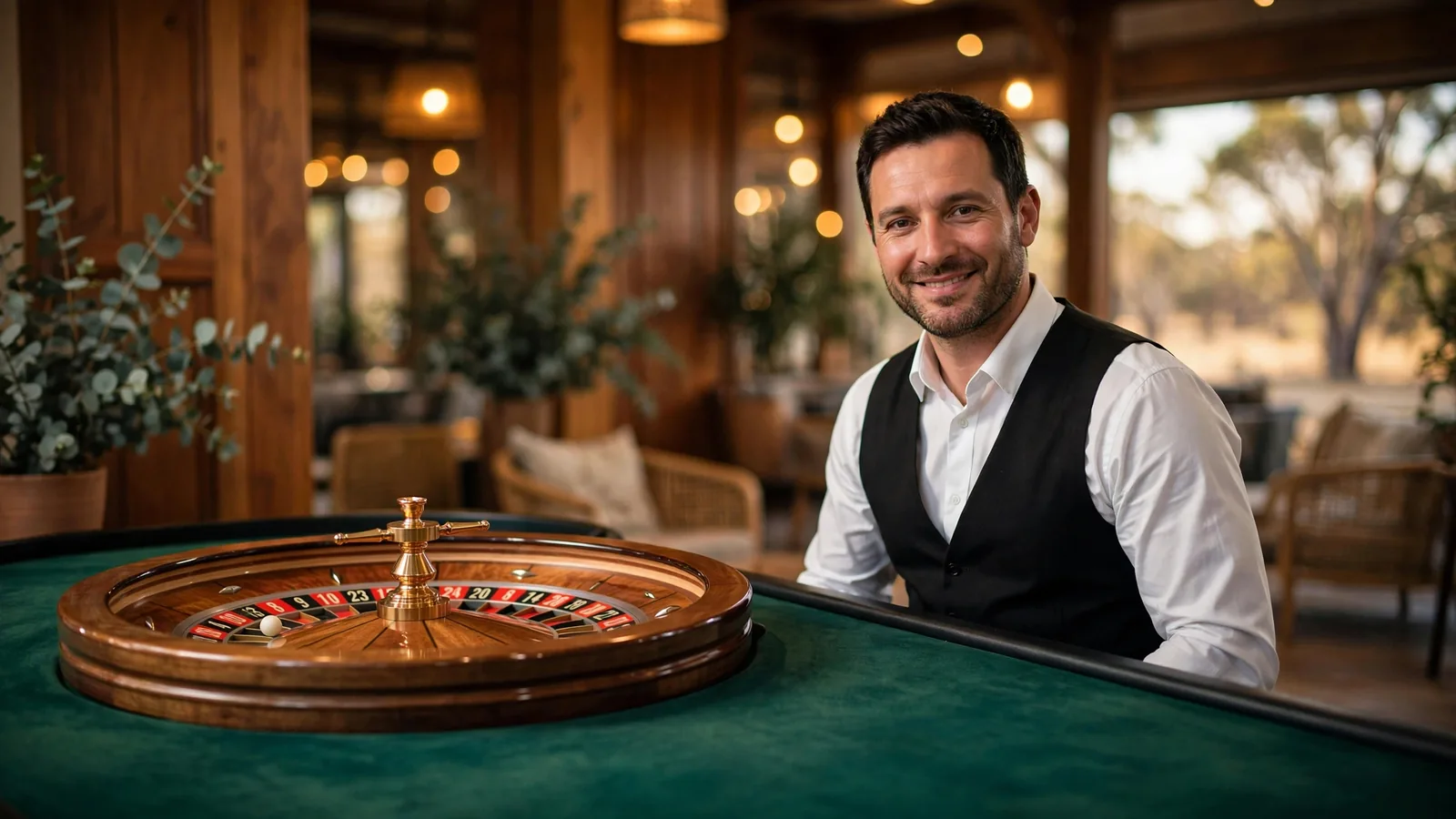
The phrase “online roulette” suggests a familiar arrangement: a casino puts a wheel on a screen, a player places a stake, and the game proceeds. In Australia, however, the first question is not how the wheel works. It is whether an operator may lawfully provide an online casino game to someone in the country.
The Interactive Gambling Act 2001 draws a firm line around that activity. Australian-licensed operators cannot offer online casino games, including roulette, to people physically located in Australia. The restriction applies to the operator’s provision of the service; it does not create a locally licensed online casino sector for roulette to occupy. There are no online casinos officially licensed to operate in Australia.
That distinction matters because familiar casino language can make a product sound like an ordinary local service. A page labelled “Australian online roulette”, for instance, may refer to an offshore service or simply use Australian wording to attract attention. The label does not make the operator Australian-licensed, nor does it alter the law governing casino games offered to people in Australia.
Choosing live roulette in Australia means looking for a table experience that suits your preferences, while also checking the practical details available for each casino. These short verdicts highlight the specific operator information provided for this list.
Playfina Casino
Playfina Casino is listed with a Curacao eGaming license held by Hollycorn N.V. since 2017. Its minimum deposit varies by offer, at A$20–30.
Kingmaker
Kingmaker lists crypto payouts at around 90 minutes and fiat payouts at 1–5 days. Its minimum deposit is A$30.
Ricky Casino
Ricky Casino lists crypto payouts in under an hour and PayID payouts in 1–3 business days. The minimum deposit is A$20, or A$30 to qualify for the bonus.
LevelUp Casino
LevelUp Casino is licensed by Curacao eGaming under OGL/2023/174/0082, with Dama N.V. named as the license holder. Its minimum deposit is A$15.
WinSpirit Casino
WinSpirit Casino is licensed by Curacao eGaming under OGL/2024/923/0383, with Antillephone N.V. named as the license holder. Its minimum deposit is A$30.
JustCasino
JustCasino is listed with a Curacao Gaming Control Board license. No further operator details are provided here.
MrPacho
MrPacho lists crypto payouts at 30–120 minutes and fiat payouts at 24–72 hours. Its minimum deposit is A$30.
Bizzo Casino
Bizzo Casino is listed with a Curacao Gaming Control Board license, with TechSolutions Group N.V. named. No further operator details are provided here.
7Bit Casino
7Bit Casino is listed as operating under a Curacao license, with Dama N.V. as the operator. No further details are provided here.
Roby Casino
Roby Casino is listed with a Curacao eGaming license, with Roby Games Ltd named. No further operator details are provided here.
The Act’s reach is broader than a single game. Online casino-style services such as roulette, blackjack, poker and slots are treated as prohibited interactive gambling services when provided to customers in Australia. The legal boundary concerns the service and its provision, not whether the game is presented as a live table, a digital version or a familiar casino pastime. A change of screen design does not change the category.
This framework also explains why roulette cannot responsibly be described as an offering from an Australian-licensed online casino. Such an operator cannot lawfully provide it. The phrase “licensed casino” can be especially misleading when it leaves the jurisdiction unstated: an overseas licence, where one exists, is not an Australian licence and does not turn the service into a locally authorised one.
The law places substantial obligations on providers. The Interactive Gambling Act sets a maximum daily penalty of $360,000 for an individual who violates it and $1.8 million per day for a body corporate. Those figures concern violations of the Act, not a fee or penalty imposed on a person merely for being a customer. The distinction is worth keeping clear; legal responsibility should not be blurred into a general warning that makes every participant sound equally exposed.
At the same time, the absence of player liability does not make offshore casino services a lawful Australian market. Such services are actively blocked and enforcement is part of the regulatory picture. The legal position is therefore not that local operators provide roulette under a domestic licence while customers choose whether to participate. The local licensed offering does not exist; the prohibition is directed at operators providing the service to people in Australia.
This is an unusually stark arrangement for a country whose public life is full of regulated wagering. The law does not treat every form of gambling as interchangeable. It draws a specific boundary around real-money online casino games, leaving roulette on the prohibited side when offered as an online casino service to people in Australia. A table can be streamed, animated or dressed in the language of entertainment; the legal category remains the same.
The result is a gap between the way people describe a desired game and the way the market is legally constituted. “Live roulette” may sound like a product waiting to be selected, but it cannot be presented as a lawful service from an Australian-licensed online casino. Nor should a page imply that checking for a local casino licence will reveal a legitimate domestic roulette operator. There are none officially operating in that capacity.
The wording matters, because a catalogue or ranking can function as promotion even when it is wrapped in neutral-sounding commentary.
No local licence. No local roulette offer.
18+ only. Gambling can cause financial harm. Fairgoslotshubau.com is not liable for losses arising from gambling.
Legal Prohibition
Australian-licensed operators cannot lawfully provide online casino games, including roulette, to people physically located in Australia under the Interactive Gambling Act 2001.
Bonus language can make a casino offer sound like a simple gift. The conditions attached to it tell a less generous story: wagering requirements specify how much qualifying play must take place before bonus funds or related winnings can be withdrawn. The rules may also define which games count, how much each contributes, and whether a deadline applies. Those details matter more than the headline.
The distinction between games is important. A specialist review has reported that live dealer baccarat contributes 5–15% towards wagering requirements. That is a figure attributed to one review, not a stable rule across operators or offers; terms can change, and an individual promotion may set different conditions. It applies to baccarat, not roulette. It cannot establish what a roulette offer would require, how roulette would count, or whether any such promotion is available or appropriate to people in Australia.
The word “bonus” also covers different arrangements. A deposit offer, free spins, cashback and a no-deposit promotion are not interchangeable, and their conditions need not be alike. A no-deposit offer may sound cost-free, but its name alone says nothing about withdrawal eligibility or qualifying play. Without the actual terms, there is no sound basis for treating any bonus as value.
Nor do payment labels settle the question. Bitcoin or another cryptocurrency appearing in a search for roulette does not establish that a casino accepts it, that a promotion applies to it, or that the arrangement is lawful for Australian customers. The same caution applies to searches for lightning roulette: a game name joined to a bonus does not prove that the bonus exists or that its terms cover that game. Search phrases have a way of making separate claims look like a package.
The arithmetic behind wagering requirements is often less visible than the promotional headline. A contribution percentage changes how quickly qualifying play adds towards a requirement; it does not alter the requirement itself, guarantee a withdrawal, or predict a result. If a game contributes only a fraction of each qualifying stake, the apparent simplicity of a bonus can conceal a longer path through its terms. The baccarat figure is useful only within that narrow frame.
Roulette advice and roulette promotions should not be blended into one promise, either. A tip about choosing a bet is not evidence that a bonus improves its prospects, while a bonus does not turn a game into a reliable way to recover losses. No “system” follows from wagering conditions. Those conditions govern eligibility, not outcomes.
There is a social ritual in the bonus headline: generosity is announced first, qualification later. The player is invited to think of the offer as a present, then asked to read the accounting rules. The imbalance is deliberate in form, even when every condition is written down. Fine print is still print.
For Australian audiences, promotional wording cannot make an online casino offer lawful or suitable. A search for a roulette bonus, a crypto payment route or a free-entry offer does not change that. The safer reading is literal: only the written terms establish what an offer says, and no bonus language should be mistaken for a promise of profit.
Attention: A bonus name alone does not guarantee withdrawal eligibility or qualifying play; only the written terms establish the actual value of an offer.
18+ only. Gambling can cause financial harm. This website is not liable for losses.
Roulette and baccarat are distinct casino games, even when both appear under the broad heading of live casino. A roulette table centres on a wheel; live dealer baccarat centres on cards and the comparison of two hands. The distinction matters because a description of one cannot stand in for the other. The live-game details described here concern baccarat, not roulette.
There are two forms of baccarat offered by international platforms: live dealer baccarat and RNG baccarat. Their shared name points to the same underlying game, but the experience of play is different. One places a real dealer and physical cards in a streamed studio; the other uses algorithm-based software to determine outcomes. The difference is not decorative. It is the difference between watching a human deal and seeing a digital result generated by software.
In live dealer baccarat, the dealer and cards are physically present in a studio, while the table is viewed through a stream. The screen becomes a small window onto a staged, repeatable ritual: cards are dealt, a hand is resolved, and the process begins again. That visible human action gives the format a social texture, even though the game is still being played remotely. The dealer is real; the table is virtual to the person watching.
RNG baccarat removes that studio performance. No physical cards are dealt for the individual outcome. Instead, algorithm-based software determines it. This makes the distinction easy to state, if not necessarily important to every player: live dealer baccarat offers a streamed encounter with a dealer and cards, while RNG baccarat presents outcomes produced by software. Neither format changes the fact that the game is baccarat.
The words “live” and “dealer” can carry a certain promise of presence. Yet the presence is mediated by a camera and screen, not by sharing a room. In that sense, live casino borrows from older public rituals: a table, a dealer, a sequence observed by others. The digital version preserves enough of the ceremony to make it recognisable, while moving the audience elsewhere. A compact theatre.
That contrast also explains why a roulette label should not be treated as interchangeable with a baccarat description. Roulette and baccarat do not become the same game because they share a casino setting or a live-stream format. They do not describe roulette mechanics.
The wording matters, particularly when a game name is attached to “live.” In live dealer baccarat, the stream shows a real dealer dealing physical cards; in RNG baccarat, software determines the result without real cards. Those are concrete differences, not variations in phrasing. A roulette game would require its own game-specific account rather than borrowed baccarat terminology.
18+ only. Gambling carries financial risk. Fairgoslotshubau.com is not liable for gambling losses.
A streamed studio encounter where a real dealer deals physical cards.
An algorithm-based software version where outcomes are produced digitally without physical cards.
A live baccarat hand is organised around two sides: Banker and Player. A wager can also be placed on a tie. These are predictions about which side’s hand will finish closest to nine, not choices about how to control the cards. Once betting closes, the hand proceeds according to baccarat’s dealing rules.
The arithmetic is deliberately compact. Picture cards count as zero. When a hand’s total goes over ten, the digit on the left is discarded: the remaining digit is its baccarat total. So the score is not the sum as it would appear in ordinary arithmetic; it is the value left after this adjustment. The hand nearer nine takes the result.
That small piece of arithmetic changes the feel of the game. A hand that appears to have accumulated a large total does not necessarily lead. What matters is its final baccarat value, and the same calculation is applied to both sides. The dealer follows the table’s rules rather than deciding freely whether another card would be useful.
A further card is dealt when a hand’s total is under five. That rule is part of the game’s prescribed sequence, not a tactical choice made by the person holding the wager. The player is not asked to hit, stand or alter the hand. Baccarat’s apparent simplicity comes partly from this removal of individual decisions: the wager is made on an outcome, while the cards follow the rules.
The distinction matters for anyone arriving with roulette in mind. Roulette centres on a wheel and a chosen result; baccarat centres on two hands and their final totals. The games do not share a method of play, and these hand rules are not a way to play casino roulette. Nor do they offer a system for winning: the rules explain how a result is reached, not how to predict it.
The Banker, Player and Tie options are the basic shape of the wager, while the closeness of a hand to nine determines the outcome. That is enough to follow the logic of a hand without mistaking the process for a test of card-playing skill. Its calm, repetitive arithmetic is part of the design. Little drama in the sums.
For a newcomer, the useful distinction is between placing a wager and playing the hand. The wager expresses a view about the result; the hand itself is governed by fixed dealing and scoring rules. Learning those rules can make the sequence easier to understand, but it cannot make any outcome certain.
This is an explanation of baccarat, not roulette instructions or a recommendation to gamble. Gambling can cause financial loss, and Fairgoslotshubau.com is not liable for losses. 18+ only. Gambling should be treated as a financial risk, not a way to make money.
Baccarat Hand Scoring
Sum the cards
Add the card values together, counting picture cards as zero.
Apply the ten-rule
If the total exceeds ten, discard the leftmost digit to find the final baccarat value.
Compare totals
Compare the final values of the Player and Banker hands; the one closest to nine wins.
Baccarat gives the table a compact vocabulary: Player, Banker and Tie. These are the choices around which a wager is made, not instructions for taking a turn or controlling the cards. The central comparison is simple to state. The winning side is the one whose hand comes closest to a total of nine.
That small set of labels carries a little social theatre. “Player” and “Banker” sound like roles in a contest, though the wager is on which side will prevail, not on a particular person’s skill. The dealer conducts the game; the names belong to the two sides being compared. The table’s language makes a formal contest out of a small calculation.
The aim is not to build the highest total without limit. It is to be nearer nine than the opposing hand. That makes baccarat distinct from casino roulette, where a wager concerns an outcome on a wheel rather than which of two hands finishes closer to a target. Roulette rules do not explain baccarat, and baccarat’s labels should not be mistaken for roulette betting choices. Similar surroundings in a live casino do not make the games interchangeable.
A Player wager backs the Player side; a Banker wager backs the Banker side. A Tie wager selects the third named possibility. The distinction matters because the three choices are not three different ways of reaching nine. They identify what the bet supports. The hand comparison supplies the game’s aim, while the wager records which result is being backed.
The rule’s elegance lies in its restraint. It does not ask participants to predict every card or to treat the dealer as an opponent. It asks which side will end closer to the target. That direct comparison is part of baccarat’s enduring appeal: the table can be busy with ceremony, but the decision at its centre remains legible.
The simplicity of the choices should not be mistaken for certainty. A wager names an outcome; it does not make that outcome more likely. Nor does a familiar table label turn a game into a harmless pastime. Baccarat is a form of gambling, and losses can have financial consequences. Fairgoslotshubau.com is not liable for gambling losses.
The distinction is especially important in a live setting, where a dealer’s presence and the pace of a shared table can give chance a human face. The dealer handles the proceedings, but the available choices remain Player, Banker or Tie, measured against the same target. No personal rapport changes the rule. The numbers decide the comparison.
For Australian readers, this explanation is descriptive, not an invitation to play: the Interactive Gambling Act 2001 prohibits operators from providing real-money online casino games to people in Australia. The rules of a game and the law governing its provision are separate matters.
18+ only. Gambling can cause financial harm. A limit is not a guarantee of safety.
A house-edge figure is a way of describing the mathematical advantage built into a wager over repeated play. It is not a forecast for an individual hand, nor a promise that a particular session will follow the long-run pattern. A player can win or lose sharply in the short term; the percentage describes the structure of the bet, not the fate of the person making it.
House Edge Basics
A house-edge figure describes the mathematical advantage built into a wager over repeated play, not a forecast for an individual hand.
For live dealer baccarat, the reported house edge is 1.06% on Banker and 1.24% on Player. The Tie wager is a different proposition: its reported edge is 14.36%. Those figures make the distinction between the main choices plain. Banker and Player are close in mathematical terms, while Tie carries a substantially larger house advantage.
That does not make a wager a sensible choice simply because its edge is lower. The figures do not tell whether a table suits a particular budget, how long someone will play, or what will happen in the next hand. Nor do they turn a run of results into evidence that a change is due. A percentage is an accounting description of the game’s rules, not a reading of luck.
The gap between the main wagers and Tie also shows why a general label such as “baccarat odds” can conceal important differences. Each choice has its own payout structure and mathematical cost. Treating them as interchangeable would erase the very distinction the figures are meant to convey.
The same caution applies when baccarat is placed beside casino roulette. These baccarat percentages are not roulette odds, and they cannot establish which roulette bet has the better mathematical profile. They provide no basis for naming a best live roulette casino, comparing roulette tables, or declaring that one casino offers the best odds. Those are separate questions requiring roulette-specific information and, for a venue comparison, evidence about the venues themselves. A baccarat number cannot do that work by association.
The search for a “best” casino often turns a numerical comparison into a recommendation. But even a valid house-edge comparison would describe only one feature of a game, not the quality or suitability of an operator. Here, the available percentages concern baccarat wagers alone. They do not rate casinos, and they do not support a roulette strategy.
The practical value of the figures is narrower, but more honest: they show that Banker and Player have reported edges near one another, while Tie is markedly less favourable by that measure. They also mark a boundary. The mathematics belongs to these baccarat bets; extending it to roulette would be false precision.
Numbers can clarify a game. They cannot change its subject.
A roulette wheel is a small machine for turning chance into ceremony. Its numbered pockets, turning motion and final resting place give the game a visible drama: uncertainty is made to travel in a circle before settling on a result.
The distinction matters in a request for live roulette in Australia with English-speaking dealers. A language label would describe the dealer’s speech, not the wheel, the game’s terms or the operator’s status. A streamed table may suggest a room and a person on camera; suggestion is not a description.
Nor does the phrase “online casino with roulette” identify a particular product.
This restraint is not a refusal to recognise what the search is about. It is a refusal to turn a familiar picture into a claim about a real service. They are not interchangeable simply because both are table games. A baccarat studio, dealer or card procedure cannot stand in for a roulette wheel.
The larger setting is unusually consequential in Australia. The Interactive Gambling Act 2001 prohibits operators from providing real-money online casino games, including roulette, to people in the country. An imagined wheel and an imagined English-speaking dealer would therefore do more than decorate an explanation: they could make an unverified offering sound concrete. The language of availability deserves more care than that.
A wheel can be pictured without being specified. For a real table, details about the wheel and dealer would need to belong to that table, rather than being borrowed from convention or from another game. No borrowed certainty.
A live table changes the texture of a game: cards are handled in a studio, a dealer appears on screen, and decisions unfold alongside a broadcast rather than behind a sequence of software prompts. That format has a practical consequence. A specialist review describes live dealer games as often being offered only for real money, so access may depend on having a real-money bankroll rather than a free-play balance. The wording matters: it describes a tendency reported in that kind of review, not a condition that can be assumed of every table.
For baccarat, the distinction is between the live setting and the money placed on the outcome. The format supplies a dealer, physical cards and a streamed table; it does not, by itself, say anything about whether a particular service is available to people in Australia. Nor does a description of live baccarat establish that roulette is offered in the same format, or that an English-speaking dealer is present. Game names travel easily between menus. Conditions do not.
That separation is useful when “real money” appears to promise a simple answer. It only describes the stake format. It does not settle the rules, table access, payment arrangements, or what happens when a balance is lost. An AUD wallet may avoid a conversion margin where a balance is otherwise held in USD or EUR, but currency convenience is not protection against gambling losses. Money remains at risk.
There is also a social difference between free practice and a live table funded with cash. A streamed dealer gives the proceedings a human face; the bankroll gives each decision a financial consequence. The first can make a game feel more immediate. The second makes that feeling costly. No romance required.
This account concerns baccarat’s live-play format, not a claim about real-money roulette or a European roulette table. It cannot be used as an invitation to play. Gambling can cause financial harm, and Fairgoslotshubau.com accepts no liability for losses. 18+ only. Gambling should not be treated as a way to make money; support is appropriate when play causes harm.
A roulette system is often presented as if the table could be persuaded by a sequence: increase a stake after a loss, repeat a chosen pattern, or divide bets across outcomes. Such routines can organise a session, but their neatness is not evidence that they change the result. A run of previous outcomes does not, by itself, establish what the next spin will be.
That distinction matters in a market where the language of online casino play can sound ordinary while the service itself sits on the wrong side of the law. The Interactive Gambling Act 2001 prohibits operators from providing real-money online casino games to people in Australia. A confident-sounding system does not alter that boundary. Nor does a site’s polished presentation turn an offshore casino into a locally licensed one.
Claims about a “roulette strategy to win” often collapse two different ideas: managing how much is staked and improving the chance of a favourable outcome. The first concerns a player’s own limits; the second would require evidence about the game and its rules. A betting pattern cannot guarantee profit. The promise is tidier than the mathematics.
Site comparisons require the same restraint. A name, a payment option or a description of a live table would not, on its own, establish that a roulette service is lawful or suitable for Australians. There are no locally licensed online casinos officially operating in Australia, and offshore casino services are actively blocked and enforced against. The distinction is not a footnote.
Baccarat rules, table pace and house-edge figures cannot be transferred to roulette simply because both games sit under the broad casino label. A house edge belongs to a particular wager under particular rules; it is not a general property that can be borrowed by another game.
The sober account of roulette strategy, then, is less theatrical than its sales language. Better to leave the promise on the table.
A casino roulette table layout is a practical map: it connects the place a wager is made with the outcome that wager concerns. Describing that map accurately requires more than naming roulette. It calls for details tied to a particular game, including the markings and betting choices actually presented. Without those particulars, a neat explanation would be less a guide than a drawing made from expectation.
The same restraint applies to claims about a roulette casino advantage. An advantage figure is not a general compliment or warning; it is a mathematical claim about defined rules and wagers. It cannot be borrowed from baccarat, whose bets and outcomes are different, or supplied by intuition. A percentage without its game-specific basis can look precise while answering the wrong question.
That distinction matters because a table’s appearance and its mathematical terms are not interchangeable. A layout description tells how choices are arranged; an advantage calculation concerns how those choices perform under stated rules. Neither can stand in for the other. Pairing an imagined diagram with an unsupported figure would give a false impression of certainty.
That is not a claim that all roulette tables share one design, nor a suggestion that a particular arrangement is standard.
One concerns where bets are placed; the other concerns the mathematics behind them. Treating either as self-explanatory would flatten the very details that make a useful account possible.
No diagram. No invented edge.
This page does not offer roulette play or recommend a casino. Gambling can cause financial harm, and Fairgoslotshubau.com is not liable for losses. 18+ only.
Yes. International platforms that accept Australian players offer live baccarat, streamed from a studio with a real dealer and physical cards.
Australian-licensed operators cannot offer online casino games, including baccarat. Australians do play through international platforms, but that does not make those services locally licensed.
Some live baccarat schedules have time restrictions. Check the schedule for the table you choose.
Yes. Live baccarat can be played on Android and iOS devices.
Sometimes, but trial play at live tables is limited because seats are scarce. Live dealer games are often available only for real money.
The Banker bet has the lower house edge: 1.06%, compared with 1.24% for Player and 14.36% for Tie.
Baccarat is regularly played online by Australians through international casino platforms that accept Australian players.