This guide distinguishes Plinko’s peg-and-drop format from slot labels and examines offshore access, payments, terms and free play.

Plinko belongs to a curious borderland in online game design. Its familiar image is simple: a disc drops through a field of pegs, changing direction as it falls, before landing in one of several spaces. The result is presented as a visible journey rather than a reel stopping on symbols. Yet online catalogues may place Plinko beside slot games, and the language around it can make the distinction seem smaller than it is.
That placement is a category choice, not proof that every Plinko title is a slot in the mechanical sense. A conventional slot centres on reels, symbols and combinations; a Plinko-style game centres on a falling object and the route it takes. Both can turn a random outcome into a compact visual event, which helps explain why they may share a digital shelf. The packaging is similar. The play is not identical.
The word “slot” can also refer to the commercial setting rather than the game’s underlying design. A casino catalogue may group titles by broad format, provider or interface, even where their screens behave differently. That convenience has a cost: labels flatten distinctions. A player looking for a Plinko slot may be seeking the pegboard animation, a familiar betting interface, or simply a game filed under a known category. Those are not necessarily the same expectation.
Choosing a Plinko casino in Australia involves more than finding the game: it also helps to understand the licensing and payment details available for each operator. Use these short notes as a reference when deciding where to explore Plinko play.
Playfina Casino
Playfina Casino is listed with a Curacao eGaming license held by Hollycorn N.V., in place since 2017. Its minimum deposit is A$20–30, depending on the offer.
Kingmaker
Kingmaker lists crypto payouts at around 90 minutes and fiat payouts at 1–5 days. The minimum deposit is A$30.
Ricky Casino
Ricky Casino lists crypto payouts in under an hour and PayID payouts in 1–3 business days. The minimum deposit is A$20, or A$30 to qualify for the bonus.
LevelUp Casino
LevelUp Casino is listed under Curacao eGaming license OGL/2023/174/0082, held by Dama N.V. Its minimum deposit is A$15.
WinSpirit Casino
WinSpirit Casino is listed under Curacao eGaming license OGL/2024/923/0383, held by Antillephone N.V. The minimum deposit is A$30.
JustCasino
JustCasino is listed with a Curacao Gaming Control Board license. That licensing detail is the available point of reference for this operator.
MrPacho
MrPacho lists crypto payouts at 30–120 minutes and fiat payouts at 24–72 hours. The minimum deposit is A$30.
Bizzo Casino
Bizzo Casino is listed with a Curacao Gaming Control Board license, with TechSolutions Group N.V. identified as the operator.
7Bit Casino
7Bit Casino is listed as operating under a Curacao license, with Dama N.V. identified as its operator.
Roby Casino
Roby Casino is listed with a Curacao eGaming license, with Roby Games Ltd identified as the license holder.
The distinction matters because appearance can carry more authority than it deserves. A disc bouncing across pegs looks almost physical, as if each collision were a little event with its own logic. In a digital game, however, animation is presentation. It does not by itself explain how outcomes are generated, what probabilities apply, or whether a particular screen offers any meaningful influence over the result. A lively descent is still a designed interface.
Nor does the presence of “Plinko” in a title establish a common standard. The name describes a broad visual idea, not a single universal rulebook. Different implementations may vary in layout, available choices and the way outcomes are displayed. Without clear details for a specific game, it is safer to treat the label as a family resemblance than as a promise of identical mechanics. One name, many possible arrangements.
This is where slot terminology can mislead in both directions. Calling a Plinko-style game a slot does not turn it into a reel game; calling it a standalone arcade-style game does not make it independent of casino conventions. It can borrow the visual grammar of one format and the catalogue position of another. The online interface is adept at making these borders look tidy. The underlying categories are not.
Provider information offers one limited point of comparison. KA Gaming’s slot RTP percentages typically fall within a range from 94% to 96%. That range concerns its slots; it should not be transferred automatically to Plinko, to every game supplied by the company, or to a title simply because a catalogue places it near slot games. A provider-wide figure would be too blunt to describe an individual game, and a neighbouring category is not evidence.
RTP, or return to player, is a statistical measure associated with the long-run share of stakes a game is designed to return across extensive play. It is not a forecast for a single session, a personal result, or a measure of how entertaining a game will feel. Even where an RTP is disclosed, it cannot tell a player what the next outcome will be. Numbers describe a model, not a plot.
That distinction is particularly useful when a game’s animation feels unusually transparent. Watching the disc take each turn may create a stronger impression of cause and effect than watching symbols stop on reels. But visible motion does not necessarily mean that the outcome is more predictable. The screen can reveal the route while leaving the rules behind the route less visible. A clear picture is not the same as a clear explanation.
RTP Meaning
Return to Player (RTP) is a statistical measure of the long-run share of stakes a game is designed to return; it is not a forecast for a single session or a personal result.
A careful description of Plinko, then, begins with the mechanics that can actually be seen and separates them from the label attached by a catalogue. It identifies whether the game uses a pegboard descent, explains any stated choices, and avoids borrowing a slot’s RTP unless that figure is explicitly tied to the particular title. Where provider information is sparse, restraint is more useful than a confident comparison.
Plinko can be packaged as a slot because digital casinos organise games for browsing, not because every format has become interchangeable. The category tells something about where a title is filed; it tells much less about how that title works. The difference is small in a menu and substantial in meaning.
The phrase “online Plinko” suggests a simple migration: a familiar falling-disc game, moved from a screen in a public place to a browser or app. But the online version sits inside a different commercial arrangement. It may be presented among casino games, with the same account, payment and promotional language used for other gambling products. The appearance of a small game does not make the business behind it small, local or equivalent to a physical arcade.
For Australian visitors, one feature of that arrangement can be easy to misread. Offshore online casinos often accept Australian payments while operating under licences issued elsewhere. A payment method that works across a border is not a certificate of Australian approval. Nor does an offshore licence become a local one simply because a website is available in English, displays Australian currency or accepts a payment from an Australian account.
That distinction matters before the game itself enters the picture. “Plinko” can be used as a broad label for games built around a disc dropping through pegs and landing in a space associated with a result. On a casino site, the same label may sit beside a balance, a rules panel and casino-style language about stakes or prizes. The setting changes the meaning: a game mechanic becomes part of a gambling service when money is involved. The visual is only the front door.
The name can also be stretched by presentation. A casino may describe a game as Plinko-style, use Plinko in a page title, or group a drop-and-land game with other casino offerings. Those descriptions do not, by themselves, establish who made the game, how it works, or whether a particular title is available to Australians. A search for a Plinko game at an online casino can therefore lead to a mixture of genuine game descriptions, broad category pages and promotional language. Similar wording is not proof of identical products.
“Live” can add another layer of ambiguity. In gambling, it often signals a streamed or presenter-led format, but the word alone does not verify that a particular Plinko game is live, who operates it, or what is being shown. A moving graphic can feel immediate without being a live event. The distinction is more than technical: presentation can lend a game the atmosphere of a shared room even when the player is interacting with a digital interface.
Attention: A payment method that works across borders is not a certificate of Australian approval, nor does an offshore licence become local because a site accepts Australian currency.
The same caution applies to familiar local vocabulary. Australians call poker machines pokies, but that does not make an online Plinko game a pokie in the ordinary sense. The terms may be placed close together because both belong to gambling language; their mechanics and settings remain different. A casino page can create a kind of linguistic neighbourhood in which distinct products appear interchangeable. They are not.
Payment acceptance is another such neighbourhood. An offshore site may have built its payment arrangements to accommodate people in Australia. That is a fact about the site’s commercial reach, not a recommendation and not an invitation to play. It says nothing, on its own, about the quality of a game, the reliability of a service or the protections available to a customer. A familiar payment route can make a distant operator feel close. It does not move the operator’s licence across the sea.
This is why a description such as “online casino with Plinko” should be read as a claim about a site’s catalogue, not as a judgement about its standing. The game label answers, at most, what a page says it offers. It does not answer the more consequential question of what kind of operator is behind that page. A polished interface can make those questions seem settled before they have been asked. They are not settled by polish.
There is a quiet irony in the arrangement: the game is designed around a visible descent, while the important distinctions sit out of sight—in the corporate location, the licensing jurisdiction and the terms attached to the service. The player sees the path of the disc; the legal and commercial geography is less theatrical. Yet that geography defines what the screen represents. A casino-style game is not made locally regulated by being easy to reach, and a foreign licence is not a local endorsement.
That boundary should also keep descriptions measured. It would be misleading to present an offshore Plinko casino as a locally approved place to gamble, or to turn the fact that Australian payments may be accepted into a reason to use one. The online setting is real; the implication that accessibility equals approval is not. An interface can be available without being an offer that should be made to Australians.
The human question remains larger than the game’s bright geometry. Gambling can cause serious harm, particularly for people already vulnerable to it; a neat interface does not soften that risk. Any gambling activity is for adults aged eighteen or older, but an age boundary does not resolve the separate question of whether a service is appropriate or authorised in Australia.
The border is not a footnote. It is part of the product’s meaning.
A figure displayed beside a Plinko game can look like money already earned. In practice, a balance on screen and money available to withdraw are different things. The first is an account entry; the second depends on whether the operator’s cashout conditions have been met and the payment request has cleared. That distinction matters more than the animation that produced the balance.
An on-screen balance can consist of several distinct categories: deposited funds, promotional credit, winnings, and amounts currently eligible for withdrawal. If a sum is marked as pending, restricted, or unavailable, it should not be treated as cash.
For Australians considering real-money Plinko, the word “balance” can conceal several categories: deposited funds, promotional credit, winnings and amounts currently eligible for withdrawal. An account page may combine them or display them in separate fields. The labels are not decorative. If a sum is marked pending, restricted or unavailable, it should not be treated as cash in a bank account.
Offshore sites commonly set minimum withdrawal thresholds between A$75 and A$150. A balance below the stated threshold may therefore be visible without being eligible for a payout request. The exact threshold and any other conditions belong to the operator’s terms, not to a general assumption about how Plinko works. A game’s result and an account’s withdrawal status are separate matters.
The gap can be frustratingly ordinary. A screen can update instantly; a payment process depends on account checks and the operator’s handling of the request. Even where a cashout button is available, submitting a request does not itself show that the money has arrived. The account history, withdrawal status and eventual bank or payment-provider record tell different parts of the story.
KYC—know your customer—checks commonly appear at the first cashout. Offshore operators may ask for identity documents such as a passport or driver’s licence, along with a utility bill. The purpose is to match the person and account details before releasing funds. This can turn a seemingly simple withdrawal into an administrative exchange: documents are uploaded, reviewed and sometimes queried before the request proceeds.
The timing of that check matters. A player may have registered and used an account without being asked for documents, only to meet the requirement when trying to withdraw. That sequence does not make the check a surprise exception; it makes the account’s earlier appearance of completeness a poor guide to whether it is ready for payment.
Documents should be handled cautiously. An identity file contains more than a name, and a bill can disclose a home address. The operator’s privacy terms and the method used to submit documents are therefore part of the cashout picture, not an afterthought. A request to provide KYC material should be considered alongside the operator’s stated document rules and account conditions.
The first payout can also expose a mismatch between the name on an account and the name on a payment method. Account details, identity documents and payment records may need to align for a withdrawal to proceed. Where they do not, the operator may ask for clarification or hold the request. The precise handling varies, so a generic promise of “easy withdrawals” says little about the paperwork that follows.
A real-money Plinko account is not made dependable by a polished app, a download link or a game labelled “2.0.” Those describe presentation or access, not whether a balance can be withdrawn. Nor does a “no deposit” label answer the cashout question: any applicable conditions determine whether funds can be released. The useful distinction is between a displayed figure and an amount that has cleared the operator’s checks and reached the chosen payment destination.
First Withdrawal Process
Document Submission
Provide identity documents such as a passport or driver’s licence and a utility bill for KYC checks.
Account Verification
The operator reviews the uploaded documents to match the person with the account details.
Payment Alignment
Ensure the name on the account, identity documents, and payment method align for the request to proceed.
People must be at least eighteen to gamble. That threshold does not make an offshore cashout straightforward, and it does not transform an account balance into money in hand. Gambling can cause serious harm, particularly for people already vulnerable to it; a withdrawal interface cannot measure that cost.
The paperwork is part of the product, whether or not it appears beside the game. A balance is a claim on an account. A completed payment is something narrower, and more concrete.
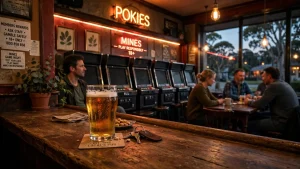
A Plinko-style casino game belongs to a digital vocabulary of falling balls, pegs and chance. Pokies belong to a much older, more visible Australian setting: the pub or club, the room set apart from the bar, and the familiar machine whose losses have become part of public argument. The two are not the same experience. Placing one beside the other, however, shows how a game can carry different social meanings depending on where it sits.
The physical pokie room has a civic history because its costs have been counted, debated and attached to real places. A report by gamble.com.au put Victorian poker-machine losses at A$2.6 billion over the year it covered, more than A$44.7 million above the figure it gave for 2015. Those are reported figures for a particular period, not a timeless measure of what players lose. Even with that qualification, the scale invites a question beyond the mechanics of any single game: what does a community accept as ordinary entertainment, and at what point does ordinary become a public concern?
That argument has often taken the form of a proposed limit. Senator Nick Xenophon and MP Andrew Wilkie called for a A$1 maximum bet on poker machines. The proposal made the speed and scale of machine gambling tangible by putting a number on each wager. A limit of that kind is not simply a technical adjustment to an EGM; it is a statement about how much intensity should be built into a routine leisure activity. The proposal did not erase the wider dispute. It gave the dispute a measure.
A Plinko casino game can look much lighter in the imagination: a ball drops, deflects across pegs and lands in a position associated with an outcome. The physical pokie room has furniture, staff, regulars and a social setting; a digital game can be encountered on a screen without any of those surroundings. Similarity at the level of chance does not make the experiences interchangeable. Nor does a bright, simple visual design make questions about gambling’s effects disappear.
The contrast also says something about how Australians have learned to discuss gambling. Poker machines are not merely individual devices. Their place in pubs and clubs has made them a subject of local attention, while reported losses and proposals to curb bets have moved the debate into public policy. The machine is visible; the argument around it is visible too. Digital games can be less rooted in a shared room, but their presentation still draws on familiar ideas of risk, anticipation and reward.
Gambling Limits
Proposals have been made by Senator Nick Xenophon and MP Andrew Wilkie to implement a A$1 maximum bet on poker machines to curb the speed and scale of machine gambling.
That difference matters when people talk about online Plinko games as though they were simply a new version of the old pokie. The comparison can help explain why a game of chance attracts attention, but it should not flatten the distinctions between a local machine culture and a screen-based format. One has a long-established civic footprint; the other is understood through its digital form. Neither description, by itself, settles what the experience means for an individual or a community.
The proposed A$1 limit is a small piece of political history, not a rule governing every gambling product. Its significance lies in the argument it records: whether the design of a game should be left to the industry and the player, or constrained because the surrounding social costs are too large to treat as private matters. That argument outlasts any one game’s interface.
Different rooms, same public question.
A Plinko casino review earns its space by separating what can be checked from what is merely declared. A description of the game’s visible layout, the stated rules for a round and the provider information attached to it can be assessed against the product itself. “Best”, “trusted” and “high-paying” are conclusions, not evidence; without a disclosed method and supporting details, they tell more about the reviewer’s confidence than the game.
That distinction matters when a familiar name is used to make an unfamiliar product seem settled. A Plinko title, a casino-style game bearing a celebrity’s name, or a version labelled deluxe or verde should not be treated as proof of a connection, a particular feature set or a favourable reputation. A review can report what its own inspection established. It cannot turn a label into verification.
The less visible terms deserve the same attention as the game description. A headline may celebrate a bonus while giving little prominence to how its conditions affect play. Bonus funds are not cash: they carry wagering requirements, and the rules may limit which games count, or how much they count. That qualification can change the practical meaning of an otherwise accurate promotion.
One specialist review reported blackjack as contributing only 10% toward wagering requirements. That is a report of a particular term, not a dependable rule for every casino or offer. It illustrates why the percentage attached to a game matters: a player may place bets and still make slow progress against a requirement if the contribution rate is low. A review that mentions the bonus but omits this detail leaves out a material part of the offer.
The same discipline applies to claims about a Plinko game’s pace, fairness or potential returns. Without a stated basis, confident adjectives remain advertising-shaped prose. A useful account identifies what was observed, distinguishes it from what the operator says, and flags conditions that could alter the reader’s understanding. It does not manufacture a league table from vague impressions.
There is a small civic habit in this kind of scrutiny. Gambling products are surrounded by language designed to make complicated arrangements feel effortless. A careful review slows that language down. It gives the terms equal standing with the spectacle, and treats an omitted condition not as fine print’s natural habitat but as missing information.
Less glitter. More particulars.
Plinko may resemble a simple casino game, but its online setting sits within a law that draws a firm boundary around real-money casino services. Under Australia’s Interactive Gambling Act 2001, operators cannot provide online casino games for money to people physically located in Australia. That prohibition covers casino-style services, not merely a particular game or a particular name for it.
Enforcement belongs to the Australian Communications and Media Authority, the federal regulator responsible for the Act and for monitoring compliance with interactive gambling rules. ACMA can ask Australian internet service providers to block websites that provide prohibited gambling services or advertise them in Australia. A blocked address is therefore not simply a technical inconvenience; it is one visible part of the regulatory response.
The scale is substantial. After enforcement actions, ACMA had blocked more than 1,455 illegal gambling and affiliate websites since November 2019. The figure includes affiliate sites as well as gambling services, a reminder that enforcement can reach the surrounding promotional infrastructure too.
The count of services that have left the Australian market is less settled. One published account puts the number above 210 since enforcement began in 2017; another reports more than 190 over the same period. Those totals should not be collapsed into a single exact figure. They differ, but both describe withdrawals following regulatory action.
The disappearance of a site can be abrupt from the user’s side: a page stops loading, a familiar address no longer works, or a service vanishes from local access. The law, meanwhile, concerns the operator’s provision of prohibited services. Players are not criminalised for using offshore sites, but that does not make the services lawful to offer in Australia or exempt them from blocking.
This distinction matters when a Plinko-branded casino page is treated as though its availability proves permission. A website can be reachable for a time and still sit within a prohibited category; a foreign licence does not override Australia’s rules. The legal question is not whether a game has a local-sounding name, but whether an operator is supplying real-money online casino play to people in Australia.
The regulator’s work is both legal and practical: monitoring services, taking enforcement action and asking access providers to block prohibited sites. The network changes. The boundary does not.
A free-play label changes the apparent transaction, not necessarily the nature of the experience. In a no-stake mode, the points or credits on screen are not money to withdraw; they are part of a simulation. That distinction matters, but the word “free” can do too much work. It does not, by itself, explain what is being offered, how the mode operates or whether any conditions apply.
Attention: A "free" label does not erase the risk of gambling harm; free-play modes can maintain engagement and are not a guarantee of suitability.
For Plinko, the label may refer to a demonstration rather than a real-money game, but the title alone cannot establish which version is available. Nor does it show whether access is unrestricted, tied to an account, or accompanied by other terms. A named game and a free-play badge are not a complete description. The missing detail is precisely what separates a useful explanation from an invitation dressed as one.
The same caution applies to requests for free spins. Spins are a feature associated with slot-style play, but their presence in a description does not make them cash, nor does it establish that a particular Plinko title includes them. No specific title or set of conditions can be inferred from the phrase. The small print, if there is any, carries more meaning than the label.
There is also a quieter cost: attention. A free mode can keep a person watching outcomes and returning to the screen even when no money changes hands. That is not the same financial exposure as wagering, but it can make the boundary between demonstration and paid play feel less distinct. For some people, gambling can cause serious harm; a free label does not erase that possibility. Real-money gambling is for adults aged eighteen or older, and free-play language should not be mistaken for a guarantee of suitability.
The sensible reading is modest: free play may describe a non-cash version, but it cannot certify what a particular game provides or on what terms. The label is only a label.
Crypto can appear in discussions of Plinko payments because it changes the route money takes between an account and a wallet. That does not establish that a particular Plinko game, casino or script supports it. The payment method and the game are separate questions.
A specialist review describes crypto withdrawals as often clearing faster than other methods. Speed, however, is only one part of the result. A network fee can be deducted during a transfer, while a conversion spread can affect the value when cryptocurrency is exchanged for another currency. The amount arriving in a wallet may therefore be smaller than the figure shown before those costs are applied.
The distinction matters because “withdrawal completed” can describe the transfer leaving a service, not the final value received after network charges or conversion. The chain of steps is less visible than a bank transfer’s familiar line on a statement; the arithmetic is not less real.
Crypto also introduces a price that can move while funds are held or converted. A displayed balance in one currency and a wallet balance in another are not directly comparable unless the conversion rate and any spread are known. A quick transfer can still arrive at a poorer value. Fast, but not free.
For Plinko-related searches, the wording can make a payment method sound like a feature of a specific game. It is not evidence of a particular provider, script or operator’s capabilities. A script is software; a crypto payment arrangement belongs to the service that handles deposits and withdrawals. Treating the two as interchangeable obscures who sets the terms and who processes the transaction.
While crypto transfers may be faster, the final amount received can be affected by network fees deducted during transfer and conversion spreads when exchanging cryptocurrency.
The practical question is not simply whether cryptocurrency moves quickly. It is what amount remains after fees and conversion, and which currency the recipient actually receives. Where those details are not stated clearly, speed alone says little about the final proceeds.
A bonus is a conditional balance, not cash sitting in a player’s account. That distinction matters whether an offer is described as a deposit match or a no-deposit bonus: the label describes how the credit is presented, not whether it can be withdrawn immediately. Bonus-derived winnings may remain subject to wagering checks before they become eligible for withdrawal.
The multiplier changes the apparent value. A specialist review gives a worked example: a $100 bonus with a 40x wagering requirement calls for $4,000 in bets before winnings derived from that bonus can be withdrawn. The calculation is straightforward; its implications are less so. A balance can look substantial on screen while the amount of required betting remains larger still.
A specialist review also describes wagering requirements in the 30–50x range. That is a report of terms described in that review, not a fixed rule for every offer. Conditions vary, and the multiplier alone does not explain the full obligation. The written terms determine what counts toward wagering and what happens to bonus-related funds if the conditions are not met.
The distinction is especially important when an offer is framed as free. “No deposit” does not, by itself, mean “no conditions”; nor does a displayed bonus establish that the credited amount is cash available to withdraw. The arithmetic can be checked before the offer is accepted. The qualifying terms deserve the same attention.
Bonus language is designed to make the first number prominent. Wagering language supplies the second, less welcome number: the amount of play tied to that credit. Read together, they describe the real shape of the offer more accurately than the headline does. A bonus may add funds to a balance, but until its conditions are satisfied, that balance is not equivalent to money in hand.
A UK-facing Plinko label says something about the audience a page appears to address, not whether a service is available to people in Australia. A site may use British wording, display a UK identity or be discussed in a UK context; none of those details, by themselves, establish where it accepts customers or how it operates. Geography in a heading is not a passport.
The same caution applies to “lucky” branding. It is a promise-shaped adjective, not a description of a game’s rules, odds or ownership. Without an identifiable service and details that can be checked against its own terms, the label cannot support a judgement about quality or safety. It may belong to a game, a site, a promotional page or merely a phrase repeated elsewhere. Those are not interchangeable things.
“Casino guru” can sound like an independent seal of approval. The phrase alone does not establish who is behind a review, whether a particular Plinko title has been assessed, or what evidence supports an assessment. No specific guru or lucky Plinko service can be identified from these labels alone. A confident tone is easy to manufacture; verification is less decorative.
The useful distinction is between a name and a record. A meaningful assessment would identify the operator or game, explain what was checked and separate observable features from opinion. If those particulars are absent, the label remains just a label. It cannot tell whether the service is legitimate, suitable for Australians or even the same service another page describes.
That may feel like an unsatisfying answer. It is more honest than turning a suggestive name into a recommendation.