The phrase can describe a machine-playing area, while casino properties are licensed separately by the state or territory where they operate.
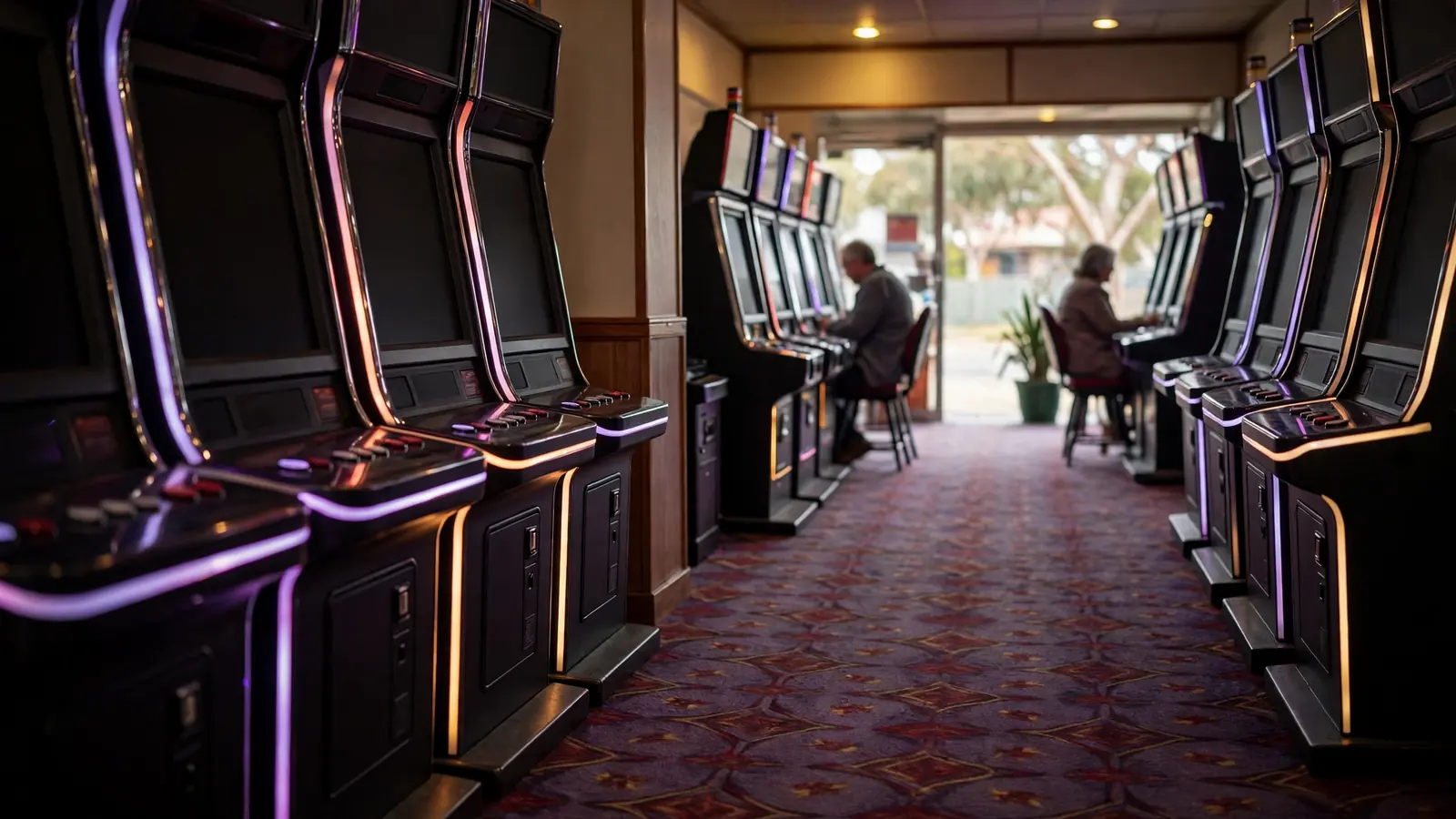
“Pokies parlour” sounds like a distinct kind of Australian gambling venue: a room organised around electronic gaming machines, perhaps within a larger place of entertainment. But the phrase does not, by itself, identify a full-scale casino. In ordinary use, it can point to the machine-playing area or to a local gaming venue more broadly. The distinction matters because a familiar label is not the same thing as a formal category of casino.
A casino is a property operating under a licence issued by the state or territory where it is located. Australia does not have a single national casino licence or one central authority licensing every property. Instead, the framework is divided among jurisdictions, each responsible for the licence within its borders. The result is a national casino sector made up of separately regulated properties, rather than one uniform chain of venues governed by a single set of local rules.
That division reflects a larger Australian habit: gambling has been woven into community life through different kinds of places, while the authority to regulate those places remains local. A neighbourhood parlour and a full-scale casino may both be associated with pokies, but the shared association does not make them interchangeable. One phrase describes an atmosphere or a gaming area; the other refers to a licensed property within the casino sector.
Choosing a pokies parlour-style casino in Australia means checking what is known about its licensing, payment timing and entry requirements. This list offers a concise reference to the available details for each operator.
Playfina Casino
Playfina Casino is listed as operating under a Curacao eGaming licence held by Hollycorn N.V. since 2017. Its minimum deposit is A$20–30, depending on the offer.
Kingmaker
Kingmaker lists a minimum deposit of A$30. Its stated payout timing is around 90 minutes for crypto and 1–5 days for fiat.
Ricky Casino
Ricky Casino lists a minimum deposit of A$20, rising to A$30 to qualify for the bonus. Stated payout timing is under an hour for crypto and 1–3 business days for PayID.
LevelUp Casino
LevelUp Casino is listed under Curacao eGaming licence OGL/2023/174/0082, held by Dama N.V. Its minimum deposit is A$15.
WinSpirit Casino
WinSpirit Casino is listed under Curacao eGaming licence OGL/2024/923/0383, held by Antillephone N.V. Its minimum deposit is A$30.
JustCasino
JustCasino is listed as licensed by the Curacao Gaming Control Board. No payment or minimum-deposit details are provided here.
MrPacho
MrPacho lists a minimum deposit of A$30. Its stated payout timing is 30–120 minutes for crypto and 24–72 hours for fiat.
Bizzo Casino
Bizzo Casino is listed as licensed by the Curacao Gaming Control Board, with TechSolutions Group N.V. named in connection with the licence.
7Bit Casino
7Bit Casino is listed as operating under a Curacao licence and is operated by Dama N.V.
Roby Casino
Roby Casino is listed under a Curacao eGaming licence, with Roby Games Ltd named as the licence holder.
The word “parlour” can make a venue sound self-contained, even intimate. It suggests a room set aside from the public bustle, with machines as its central feature. Yet it does not tell the whole story of the premises around it, its operating arrangements or the regulatory category it falls under. In particular, calling somewhere a pokies parlour does not establish that it is a casino. Nor does the presence of machines alone settle that question.
The reverse distinction is useful too. A full-scale casino is not simply a parlour with more machines. It belongs to a wider property and licensing framework, and its identity is not reduced to one room or one type of game. The machines may be prominent, but the venue is still a casino property governed by the jurisdiction that issued its licence. The language of everyday gambling can blur these categories; the licensing structure does not.
A specialist review places the number of full-scale Australian casinos above twenty and describes them as spread across all eight states. That is a reported snapshot, not a permanent count: properties and the market around them can change. Its value is mainly in conveying scale. Casinos are not confined to one state or one metropolitan centre, but they remain a distinct part of a wider landscape that includes other forms of gaming venue.
The word “parlour” also carries a social suggestion. It evokes a smaller, more local setting, perhaps somewhere people recognise as part of a routine rather than a destination in its own right. That impression may fit some uses of the term, but it should not be mistaken for a guaranteed description of a venue. A phrase can tell something about how people imagine a place without proving how that place is licensed or run.
For casino entry, the minimum age is eighteen nationwide. Major Australian casinos operate around the clock, twenty-four hours a day. Those conditions help mark the scale and public character of the casino sector, but they do not turn every venue where pokies are played into a casino. The legal identity rests on the property’s place in its jurisdiction’s licensing system, not on the hours it keeps or the name attached to a gaming room.
This is why “pokies parlour casino” can sound like a single category while actually joining two different ideas. “Pokies parlour” points towards a local gaming setting or machine area; “casino” points towards a licensed property in the state-and-territory system. The words may overlap in casual conversation, but they answer different questions: what kind of gambling space is being described, and what kind of regulated property it is.
In Australia, that difference is more than a matter of wording. The country’s casino sector is distributed across jurisdictions, while the everyday vocabulary of pokies is looser and more local. A parlour may be a useful description of a setting. It is not, on its own, a licence category. A casino is.
Australia’s casino map is not simply a row of capitals. Gambling facilities are distributed across the country, and the local shape of that map depends on what is counted: a major casino, a smaller gaming venue or another facility offering gambling. One specialist review describes gambling as present in 147 cities. That is a dated snapshot, not a permanent census; venues open, close and change category, while the larger pattern remains one of dispersed access rather than a single national centre.
In that review’s city comparison, Sydney, New South Wales, ranks first, with 11 gambling facilities. The number is more useful as a measure of concentration than as a timeless record: it reflects the review’s way of counting and the market at the point it was compiled. A city’s prominence does not mean every facility resembles a full-scale casino. The word “parlour” can blur those distinctions, although a local gaming venue and a casino are not interchangeable simply because both have machines.
The Northern Territory offers a smaller-scale illustration. The same specialist review counts three casinos across three cities, with Alice Springs listed as the Territory’s leading city for casinos at one. The phrasing is a reminder that rankings can sound grander than the underlying figures. In Alice Springs, Lasseters Casino is at 93 Barrett Drive. Elsewhere, Jupiters Gold Coast Casino & Hotel stands on Broadbeach Island, while Country Club Casino’s address is on Country Club Avenue in Prospect, within Meander Valley. These locations show how the national map runs from a regional centre to coastal resort territory and a Tasmanian locality, rather than following one urban template.
Operating hours create a different kind of map. All major Australian casinos run around the clock. That continuity belongs to large properties, not automatically to every gaming venue or every service within a complex. A late-night entrance and a restaurant’s schedule are separate matters; the casino’s broad operating pattern should not be mistaken for a promise that every part of the building is open at every hour.
Entry is more uniform. The minimum age for casino entry is 18 nationwide, and major casinos require valid photo identification. Those conditions turn the threshold into a regulated point of access, rather than a casual extension of a hotel lobby or entertainment precinct. They also matter in a country where casino licences are issued by state and territory authorities: the national age floor sits alongside local rules governing individual properties.
A casino may be open all night, but entry is not anonymous. The map has many local variations; the threshold is clear.
“Pokies parlour” suggests a room defined by its machines: rows of screens, familiar sounds, and a place organised around play. But that image does not describe a standard Australian casino inventory. The national count offers scale, not a template for what any single venue contains.
Across Australian casinos, 3,308 gaming machines are both installed and covered by venue licences. The two conditions matter: a machine counted in this figure is not merely authorised on paper, nor simply present somewhere outside the licensed casino setting. It belongs to the licensed and installed total.
Across Australian casinos, 3,308 gaming machines are both installed and covered by venue licences.
That figure is useful precisely because it has limits. It says nothing about how the machines are divided between properties, how they are arranged, or what a particular venue makes available. A national sum cannot turn every casino into the same parlour, any more than a count of chairs could describe the character of every room in the country. The number gives a measure of the sector’s machine footprint; it does not furnish a venue-by-venue catalogue.
The word “parlour” can also make the machine count sound like a complete account of casino life. It is not. The figure concerns gaming machines, not the full range of facilities or activities found across casinos. Nor does it establish that a local gaming room and a full-scale casino operate on the same scale. The shared vocabulary of pokies can blur differences that are substantial in practice.
Counts are tidy. Places are not.
A review can describe a website’s appearance, explain how its pages are organised or repeat claims made by an operator. None of those things establishes that the service is licensed to provide online casino games in Australia. A polished site and a familiar name are evidence of presentation, not regulatory authority.
That distinction matters because Australian law does not provide for real-money online casinos serving people in the country. The Interactive Gambling Act 2001 prohibits operators from supplying online casino games, including slots and table games, to customers in Australia. A review that calls a site “trusted”, “safe” or “approved” cannot make that prohibited service lawful. The confidence of the adjective is not a licence.
Reviews also have limits as records of fact. They may reflect a particular visit, an operator’s own descriptions or a reviewer’s interpretation of what appeared on a page at that time. A domain can change while the name remains recognisable; a page can also be copied, redirected or presented under an alternate address. Similar branding, matching colours or familiar wording do not prove that two addresses belong to the same authorised service—or that either one is authorised.
Regulatory action forms a different kind of evidence. The Australian Communications and Media Authority (ACMA) can seek website blocking when services breach the rules. ACMA has taken blocking action against illegal gambling services, including alternate domains associated with Fair Go. A specialist review may discuss those domain changes, but its account should not be mistaken for a licensing decision. That decision belongs to the regulatory framework, not to a reviewer’s star rating.
Blocking can affect which domains resolve through Australian internet service providers. As addresses change over time, one domain may stop loading while another appears. The technical result can be confusing: an address that once opened may no longer do so, and a newly listed address may look like a simple replacement. Neither event settles the central question. Reachability is not approval.
This is where casino reviews are most useful when read narrowly. They can help explain what a writer claims to have examined and when, while leaving legal conclusions to official regulatory material. The wording of a review should be separated from the evidence beneath it: does it identify the exact domain discussed, distinguish observation from promotion, and point to a regulator for any claim about Australian authorisation? If it treats a changing address as proof of legitimacy, it has crossed from description into assertion.
The word “parlour” adds another possible blur. In Australia, it can suggest a physical gaming venue, while an online-facing casino name may borrow similar language for branding. A shared phrase does not make an online site the digital branch of a licensed local venue. Nor does a review of that site establish a connection with a physical casino.
Regulatory Action
The Australian Communications and Media Authority (ACMA) can seek website blocking when services breach the rules, including alternate domains associated with illegal gambling services.
Domain changes are a matter of infrastructure and enforcement. Reviews are commentary. Neither should be asked to certify what only the law and its regulators can determine.
A promise of a sign-up reward, or of a bonus requiring no initial payment, belongs to a familiar language of online marketing: a new account is framed as an opportunity to receive something before committing money. In Australia, that language cannot be separated from the legal status of the service being promoted. An attractive label does not create an exception to the rules.
The Interactive Gambling Act 2001 prohibits operators from supplying real-money online casino games to people who are physically in Australia. That covers casino-style services offered over the internet, rather than only a particular format of game or a particular kind of account. A bonus attached to an online casino account therefore cannot make the underlying service lawful. Calling it a welcome offer, a no-deposit reward or a sign-up benefit changes the sales pitch, not the legal character of the service.
This distinction matters because bonuses are often presented as if they were separate from gambling: a gift for registering, a token of welcome, something to try before deciding. Yet their purpose is bound up with attracting people to an account and encouraging engagement with the service behind it. Where that service is prohibited for Australian customers, promotional language cannot turn the invitation into a permissible offer.
Nor does the absence of an upfront payment change the position. “No deposit” describes the advertised condition of an offer; it does not establish that the operator may provide casino gambling in Australia, or that the offer may lawfully be advertised here. The same applies to rewards described as being for new members. A sign-up threshold is a marketing distinction, not a regulatory one.
That can be easy to miss when an offer is displayed beside familiar branding, polished design or claims of broad international availability. Such details may make a promotion look routine. They do not answer the central question of whether an operator is allowed to provide the service to people in Australia. The law concerns the service and its provision, not merely the wording used to draw attention to it.
The federal regulator, the Australian Communications and Media Authority, oversees compliance with the Interactive Gambling Act 2001. Its role is not to certify a bonus as safe because it is described as free, introductory or limited to new accounts. The relevant legal boundary is that online casino services are prohibited for Australian customers; a promotional label cannot sit outside that boundary simply by being presented as a separate benefit.
Advertising is part of that picture. ACMA may ask Australian internet service providers to block websites that provide prohibited interactive gambling services or advertise them in Australia. A page promoting a sign-up reward can therefore be relevant not only as an inducement but as advertising for a service that the law prohibits. The distinction between an operator’s own offer and a third party’s promotional page does not, by itself, make the underlying invitation acceptable.
Attention An attractive sign-up bonus or no-deposit offer does not make a prohibited online casino service lawful under the Interactive Gambling Act 2001.
This is why a bonus should not be treated as evidence of approval. A page may describe an offer in confident terms, but the offer’s presence says nothing about whether the service is authorised for Australian residents. Likewise, an account-registration prompt or a claim that no payment is needed does not establish a lawful route into online casino gambling. The promotion speaks for the business trying to attract attention; it is not a regulatory decision.
The language of “free” can also obscure what is being asked in return. A reward may be tied to registration or to subsequent activity, but the details of any particular promotion cannot change the prohibition on supplying real-money online casino services to people in Australia. There is no need to parse a promotional label as if one special phrase might create a loophole. It does not.
Physical gaming venues and online casino services occupy different legal settings. A promotion connected with a physical venue should not be confused with an online offer, and an online sign-up bonus should not be read as an extension of a local venue’s arrangements. The shared words—casino, bonus, membership—can disguise a basic difference in how the service is provided and regulated.
The appeal of an introductory reward is plain: it lowers the apparent barrier to joining. That is precisely why the distinction between marketing and permission matters. In Australia, a no-deposit claim is still a claim used to attract people to an online casino service, not a pass around the law. A polished invitation remains an invitation.
A website can load, accept account traffic or reappear under a different address without becoming an Australian-licensed online casino. Those are technical conditions, not regulatory credentials. A working page shows that a connection has been made; it says nothing, by itself, about whether the service is lawful.
That distinction matters because the Australian boundary is drawn around the service being provided, not the ease with which its webpage opens. Under the Interactive Gambling Act 2001, operators cannot provide real-money online casino games to people physically in Australia. Slots, poker and table games fall within the prohibited interactive gambling category. The law addresses the operator’s conduct; it does not turn a reachable site into an authorised one.
The internet is good at making a temporary route look like a permanent institution. A domain changes, a page resolves, and the old name appears to have survived. But an alternate address does not alter the service behind it or confer Australian approval. Nor does a site’s ability to accept account traffic prove that its operations comply with Australian law. Access is a fact about connection. Approval is a matter of law.
The Australian Communications and Media Authority (ACMA) is the federal body responsible for enforcing the Interactive Gambling Act and monitoring compliance with federal interactive gambling rules. It can investigate services that provide or advertise prohibited online gambling, and can ask Australian internet service providers to block access to websites carrying those services or their advertising. Blocking is therefore part of an enforcement process, not a certification system in reverse: a site being reachable does not mean that it has passed a regulatory test.
Since November 2019, ACMA enforcement actions have led to the blocking of more than 1,455 illegal gambling and affiliate websites. The figure reflects action against services and sites, not a count of individual players or a measure of how many people have encountered them. The distinction is useful. Enforcement concerns the supply and promotion of prohibited services; a domain appearing in a browser does not change that legal focus.
The record of services leaving the market is reported differently. One tally puts withdrawals since ACMA began enforcement in 2017 at more than 210 illegal services; another gives the figure as over 190. Those accounts disagree, so neither should be presented as an uncontested total. Both describe withdrawals following enforcement, rather than a guarantee that every prohibited service has disappeared or that a service no longer visible has been formally cleared.
A blocked address may stop resolving through an Australian internet provider, while an alternate address may later appear. That shifting surface can encourage a mistaken inference: if the route changes, perhaps the status has changed with it. It has not. A new domain is a new web address, not a new Australian licence. The law does not travel with the spelling of a URL.
This is one of the less theatrical features of gambling regulation. The public sees a page open or fail to open; the regulator’s concern is whether a prohibited service is being supplied or advertised to people in Australia. Those events can coincide, but they are not the same thing. A site can be accessible without being lawful, and a blocked site’s absence from one connection does not amount to a general verdict on every other address.
The penalty framework reinforces that the legislation is directed at violations by providers and other regulated parties. The maximum daily penalty is $360,000 for an individual and $1.8 million for a body corporate. These are statutory maximums, not a description of what happens in every enforcement matter. The practical lesson is narrower: technical access does not establish legal standing, and changing a domain does not rewrite the rules.
A browser can find a door. It cannot issue a licence.
“Free spins” and “free chips” belong to the vocabulary of online casino promotions. The words suggest a small gift attached to play, but the label alone establishes neither that an offer exists nor that it is available to people in Australia. It says nothing reliable about who is making the offer, what conditions might attach to it, or whether the service behind it may lawfully provide casino games to Australian customers.
That distinction matters because a promotional phrase can travel further than the service it describes. It may appear in an advertisement, on a copied page, or beside a casino-style brand whose web address changes. Repetition does not turn the wording into proof. Nor does the presence of “free” make an inducement separate from gambling: spins and chips are still terms for participation in casino-style games, even when no price is named in the phrase.
In Australia, the Interactive Gambling Act 2001 prohibits operators from providing real-money online casino games to people physically in the country. A bonus-like description cannot alter the character of the service underneath it. Where a site offers online slots or other casino-style games for real-money play, dressing part of that activity as a free allocation does not create an Australian authorisation.
Promotional terms like "free spins" or "free chips" are marketing language and do not prove the existence of a lawful Australian offer.
The distinction between a physical pokies parlour and an online promotion is also easy to blur. “Free chips” may sound like a familiar casino-floor courtesy, while “free spins” evokes a digital game interface; neither expression, by itself, identifies a licensed Australian venue or an authorised online service. Search language compresses setting, product and promise into a few words. The law does not.
A further complication is that promotional copy can remain visible after access to a site has been disrupted. ACMA may ask Australian internet service providers to block websites that provide prohibited interactive gambling services or advertise them in Australia. A page, brand name or offer description appearing elsewhere does not settle whether the service is permitted here. Availability of the wording is not a permission slip.
That makes “free” an especially thin piece of evidence. It can be a headline rather than a complete account of an offer; it can describe a feature without proving its terms; and it can be used to attract attention without establishing who stands behind the page. None of those possibilities confirms that Australian customers can lawfully receive the promotion. The small word carries a large suggestion.
For a reader trying to understand what the phrase means, the safest interpretation is narrow: it is promotional language associated with casino-style play, not confirmation of a genuine or lawful Australian offer. The phrase does not show that a particular venue provides spins or chips, and it does not make an online casino service permissible. A gift-shaped label changes the packaging, not the regulatory boundary.
A bonus attached to a casino name can sound like a small courtesy: a promotional extra, separate from the gambling itself. In Australian law, that separation is not a safe assumption. When an offer promotes online casino-style gambling to people in Australia, the advertising sits within a market where such services are prohibited. A generous label does not change the nature of the service being promoted.
The Interactive Gambling Act 2001 prohibits operators from providing real-money online casino games to people in Australia. Advertising those services to an Australian audience is also banned. That makes a supposed online pokies-parlour promotion more than a question of its conditions or presentation: the underlying activity matters. A bonus cannot make a prohibited online casino lawful, and a polished advertisement cannot make it an authorised local offer.
For gambling advertising that is permitted, restrictions on inducements and promotions still shape what can be said and when. The rules are especially significant between 5:00 am and 8:30 pm. A promotion’s wording, placement and audience are not decorative details; they form part of how advertising is regulated. The distinction is an awkward one for a market fond of presenting incentives as harmless extras. They remain advertising.
Enforcement gives that framework a visible edge. The Australian Communications and Media Authority can investigate and act when an operator provides or advertises prohibited online gambling services. Since November 2019, the authority has blocked more than 1,455 illegal gambling and affiliate websites following enforcement action. Blocking does not turn every promotional claim into proof of illegality, but it does show that online gambling advertising is not merely a matter of voluntary standards.
A claim about a bonus therefore needs to be read in context: who is making it, what service it promotes, and whether that service may legally be offered to people in Australia. The appearance of an offer on a page, or its circulation through an affiliate, does not establish that it is lawful or locally approved. Nor does promotional language convert an offshore online casino into an Australian casino.
The everyday language of bonuses suggests a gift. Regulation asks a less sentimental question: what conduct is the offer designed to encourage, and is the advertised service permitted here? In the online casino market, that question comes before the fine print. The label is secondary.
“VIP parlour” suggests a room apart: a place where status is made visible through quieter surroundings, restricted entry or recognition by staff. The phrase carries an old social promise. Gambling has often borrowed the architecture of clubs, dividing public gaming floors from spaces where membership signals not only spending power but belonging. That symbolism should not be mistaken for a map of Australian casino access.
A label alone cannot establish that a venue has a VIP room, who may enter it, or what conditions apply. Nor does the idea of a special parlour create a separate legal category. In Australia, casino properties sit within state and territory licensing systems; the VIP language describes a possible venue arrangement, not a substitute for those rules. No named casino can be assigned a particular tier on the strength of the phrase.
Ordinary entry requirements remain the baseline, not a privilege to be negotiated away. The minimum age for casino entry is 18 across the country. A status distinction inside a venue does not change that threshold. It also does not turn a private space into a different kind of casino or establish that access is available to the public.
There is a useful distinction between access and status. Access concerns whether someone can enter a venue under its rules. Status concerns how a venue may recognise or separate some guests once inside. The first has a clear public threshold; the second depends on arrangements that cannot be inferred from a label. A velvet rope is not a licence.
So the VIP parlour is best understood as an idea about hierarchy within a physical venue, rather than a guaranteed feature or a promise of entry. Australian gambling regulation is built around jurisdiction and licensing, while the language of exclusivity belongs to the social theatre of the casino. The two can occupy the same building. They are not the same thing.
The phrase “real-money casino” changes the question. It is no longer about a physical gaming venue or the atmosphere of a parlour; it is about whether an online operator may offer casino-style games to people in Australia. Under the Interactive Gambling Act 2001, operators cannot provide real-money online casino games to customers physically located in the country. That includes slots and table games.
A site may load, accept account activity or appear at a different web address. None of those things makes it an Australian-authorised online casino. Technical access describes what a connection can reach, not what the law permits an operator to provide. A familiar name or polished interface cannot bridge that gap.
This distinction matters because the Australian system does not create a local licence for online casino operators to serve residents. The legal boundary concerns the service itself, rather than the branding wrapped around it. Changing a domain does not change the nature of the offer.
The Australian Communications and Media Authority is the federal body responsible for enforcing the Act and monitoring compliance with federal interactive gambling laws. Its role is not to certify a reachable website simply because it functions from a particular connection. The relevant question remains whether the service is one the law allows to be provided to people in Australia.
That leaves “real money” as a meaningful dividing line. A physical casino and an online casino-style service may use similar games or language, but they do not occupy the same regulatory position. In this market, the online version is prohibited when offered to Australian customers. Access is not approval.